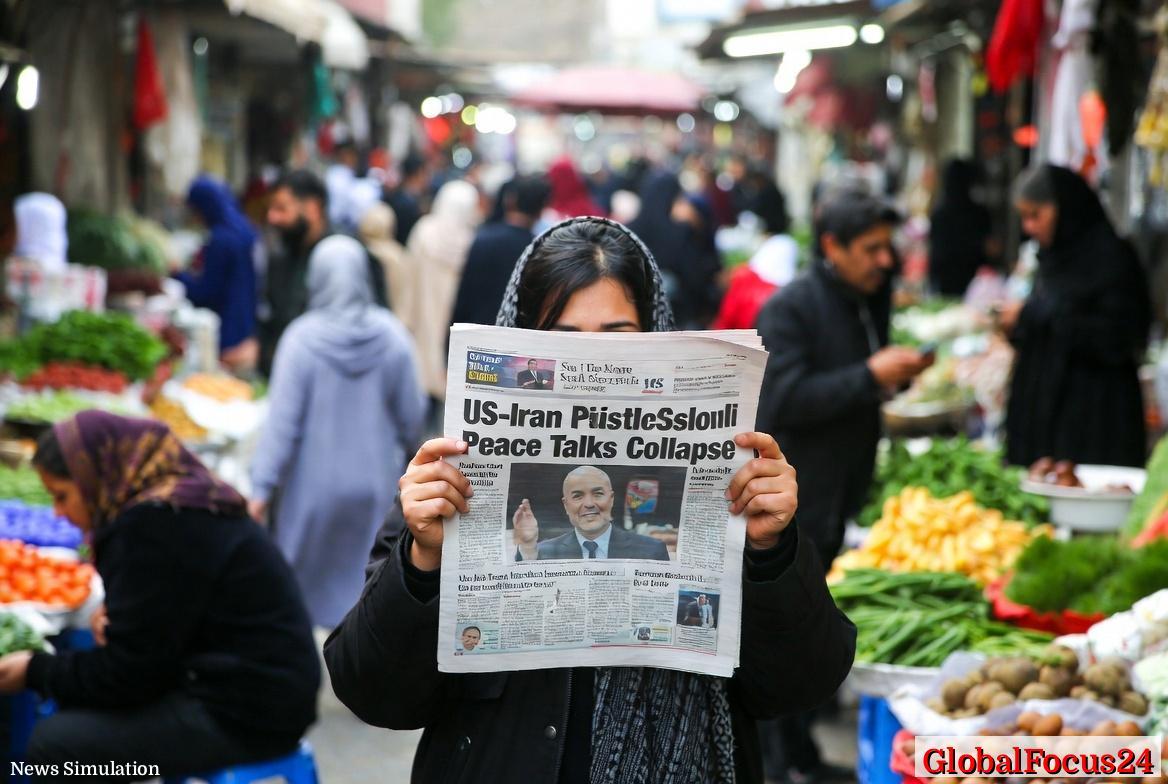
US-Iran Peace Talks Collapse as Washington Prepares Strait of Hormuz Blockade and Weighs Military Action
Breakdown of Failed Negotiations
Peace talks between the United States and Iran have broken down, dashing hopes of a diplomatic resolution and prompting Washington to consider new military measures in the Persian Gulf. According to senior officials, the talks concluded late Sunday night after 72 hours of intense back-and-forth negotiations in Geneva. No agreement was reached on Iran’s nuclear program, regional military activity, or inspections at critical nuclear facilities.
The collapse marks one of the lowest points in U.S.-Iran relations in recent years. Both sides entered the discussions under heavy international pressure to avoid conflict, following months of heightened tension in the Gulf region. Hopes for even a temporary easing of sanctions or oil export restrictions evaporated as talks ended abruptly without a joint statement.
The immediate fallout was swift: oil prices surged past $105 per barrel for the first time in over a year as traders reacted to the prospect of new disruptions in Gulf shipping lanes. Within hours, the U.S. Defense Department confirmed it had begun logistical preparations for a potential blockade of the Strait of Hormuz — a narrow waterway through which nearly one-fifth of the world’s oil supply flows.
Strategic Importance of the Strait of Hormuz
The Strait of Hormuz has long stood at the center of global energy security. It connects the Persian Gulf with the Gulf of Oman and the Arabian Sea, serving as the primary export route for crude oil from major producers such as Saudi Arabia, Kuwait, Iraq, and Iran. Roughly 20 million barrels of oil move through the strait daily, meaning any disruption could echo across global markets.
A blockade, even limited in duration, would represent one of the most aggressive U.S. military postures in the region since the early 2000s. Pentagon officials have characterized the potential move as both a deterrent and a contingency plan, intended to ensure freedom of navigation while pressuring Tehran to return to negotiations.
Iran, for its part, has repeatedly warned that any attempt to restrict its shipping would be met with “decisive” action. The country maintains significant naval and missile capabilities along its Gulf coastline, including small fast-attack craft and anti-ship weapon systems designed specifically for asymmetric warfare in confined waters. A confrontation near Hormuz would likely involve rapid escalation, potentially drawing in regional partners and NATO forces.
Market and Economic Reaction
Global markets responded immediately but not chaotically. Oil futures climbed above $105 per barrel, their highest level since mid-2024, as traders priced in the possibility of shipping disruptions and broader conflict risk. Analysts noted that the surge came after several weeks of oil stability, highlighting just how sensitive energy markets remain to developments in the Gulf.
Equity markets were more restrained. The S&P 500 fell just under 0.5 percent in early trading, with investors recalibrating after a strong rally in anticipation of a peace agreement. The Dow Jones Industrial Average dipped 0.83 percent to 47,520, and the Nasdaq-100 declined 0.47 percent to 24,998. Energy stocks, however, surged on the news, reflecting expectations of higher profits for producers and refiners amid elevated oil prices.
Economists warned that a sustained crisis could renew inflationary pressures worldwide. The International Energy Agency has previously estimated that a one-week blockade or significant disruption in the Strait of Hormuz could spike global oil prices by as much as 30 percent, inflicting broad economic ripple effects. Consumer fuel costs, shipping rates, and inflation expectations would likely rise almost immediately.
Historical Context: A Pattern of Confrontation
Tensions between Washington and Tehran have ebbed and flowed for decades, often revolving around nuclear policy, regional influence, and maritime security. The current standoff recalls earlier flashpoints, including the 1988 “Tanker War” phase of the Iran–Iraq conflict when U.S. and Iranian naval forces exchanged fire in the Persian Gulf. That confrontation resulted in the destruction of Iranian naval assets and briefly precipitated fears of full-scale war.
More recently, collisions and drone shoot-downs in the Gulf between 2019 and 2023 underscored how easily miscalculations could escalate. Each episode temporarily rattled energy markets but ultimately stopped short of major conflict. This latest diplomatic collapse, however, is considered more serious given its scope and the renewed discussion of military blockades.
Historically, international sanctions and global oil demand have played major roles in shaping Iran’s strategy. Tehran has endured repeated economic isolation and domestic hardship linked to restrictions on its oil exports. Observers suggest that the failure of the latest peace talks may harden Iranian resolve while deepening its economic woes, especially as the United States signals readiness to tighten sanctions further.
Regional and Global Implications
Regional governments have reacted cautiously but with visible concern. The United Arab Emirates and Saudi Arabia, both key U.S. security partners and major oil exporters, called for restraint and the urgent resumption of dialogue. Their economies depend heavily on uninterrupted shipping through the Strait of Hormuz, and both nations have invested billions in diversifying export routes through pipelines to the Red Sea.
European partners expressed alarm over the breakdown in negotiations. The European Union’s foreign policy chief urged both sides to “maintain open channels of communication,” emphasizing that stability in the Gulf remains foundational to global trade. Asian economies such as Japan, South Korea, and India — among the largest consumers of Persian Gulf energy — are meanwhile exploring emergency measures to secure alternative supply lines in case of escalation.
In contrast, global competitors such as Russia and China may exploit the crisis for strategic advantage. Moscow, whose own crude exports compete with the Gulf’s, stands to benefit from any disruption that elevates prices. Beijing, which maintains substantial trade ties with Iran, has called for “mutual restraint” but has not committed to mediation efforts.
Domestic Repercussions in the United States
Within the United States, the situation has reawakened debate over foreign policy priorities and energy independence. Though political leaders from both major parties have avoided overt confrontation over the issue, there is growing concern about the potential for another drawn-out Middle East conflict. Public polling in recent years shows limited appetite for large-scale overseas military operations, even in response to Iranian provocations.
American energy producers, however, may emerge as near-term beneficiaries. The sharp rise in oil prices bolsters the profitability of domestic shale operations, particularly in Texas and North Dakota, where output has rebounded sharply after a brief slowdown in 2025. Analysts predict that if prices remain above $100 per barrel for several months, U.S. oil field investment and exports will surge, offsetting some of the global shortfall.
At the same time, higher energy prices could put new pressure on American consumers. Gasoline prices, already hovering near $4.40 per gallon nationwide, are expected to climb further if the standoff persists. Economists warn that inflation, which had only recently returned to the Federal Reserve’s 2 percent target, could reaccelerate, complicating monetary policy in the second half of 2026.
Diplomatic Options Narrow as Tensions Rise
Officials in Washington have indicated that while military options are being reviewed, diplomacy remains the preferred path. The State Department is reportedly coordinating with European allies, Turkey, and Gulf partners on potential confidence-building measures aimed at reviving dialogue. These may include limited sanctions relief or a renewed inspection framework through the International Atomic Energy Agency.
For now, however, the rhetoric on both sides remains defiant. Iranian state media described the breakdown in talks as proof of “American unreliability,” while U.S. officials accused Tehran of backtracking on commitments over nuclear transparency. The lack of a clear de-escalation channel raises concern among analysts that even a minor maritime incident could ignite a broader confrontation.
Outlook: A Volatile Road Ahead
The weeks ahead are likely to prove crucial. Naval movements in and around the Strait of Hormuz will be closely watched, not only by governments but also by global commodity markets that depend on its stability. While the U.S. has not formally declared any blockade, its preparations — including repositioning carrier strike groups and logistical support vessels — indicate a posture of readiness rather than mere signaling.
The broader economic implications could stretch far beyond energy markets. If the Gulf crisis deepens, shipping insurance premiums may rise, manufacturing input costs could climb, and emerging markets dependent on imported fuel might face currency strain. International coordination, particularly among G7 economies, will be essential to manage these cascading risks.
The failure of the U.S.-Iran peace talks marks a sobering moment in global diplomacy. With oil prices climbing, security tensions mounting, and market confidence wavering, the next phase will test the resolve of governments and institutions seeking to prevent one of the world’s most vital waterways from becoming an arena of conflict. In the absence of renewed dialogue, deterrence and uncertainty may once again define the balance across the Gulf — and the global economy that depends on it.