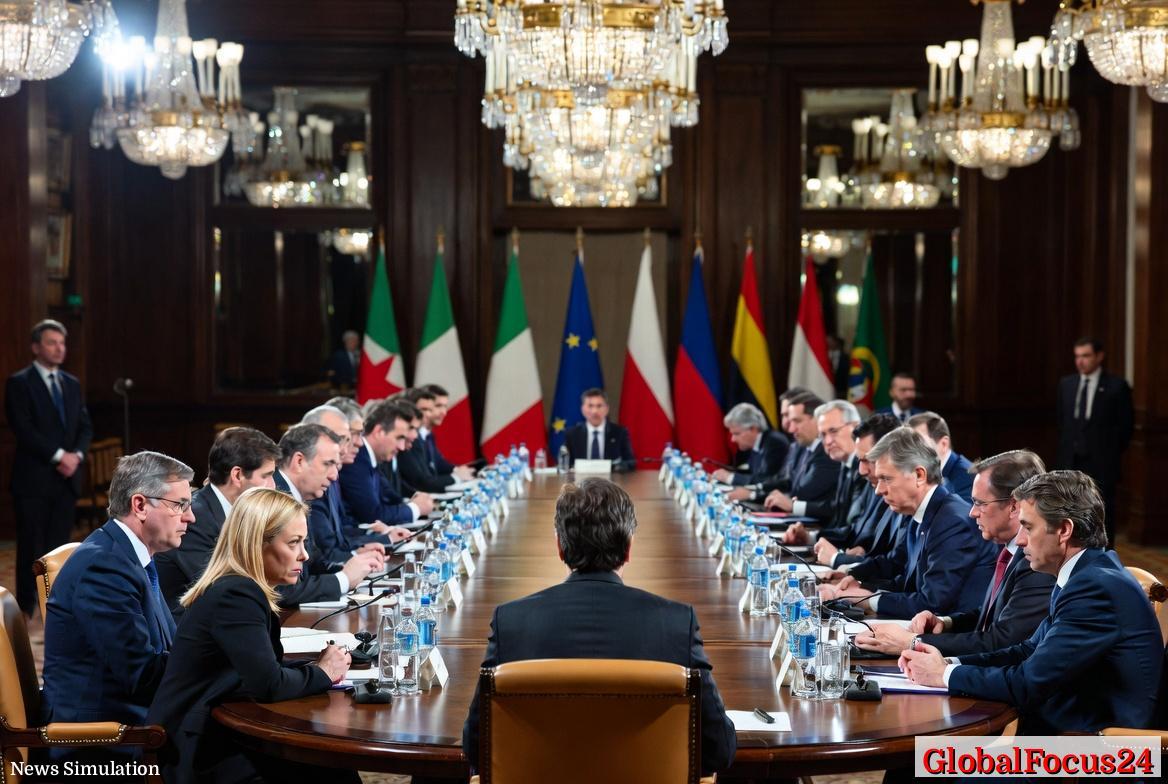
Italian Prime Minister Giorgia Meloni Faces Strains as Italy Rebalances Its Transatlantic Alignment
Italy’s relationship with the United States is entering a more demanding phase, as Prime Minister Giorgia Meloni confronts mounting friction tied to Washington’s approach to global security and trade. For a government that has tried to keep multiple doors open—both with the Trump administration in Washington and with European partners in Brussels—recent episodes have exposed how quickly “balance” can turn into political and economic risk. The pressure is not confined to diplomacy alone. It reaches into defense planning, supply chains, domestic public opinion, and the broader credibility of Italy’s leadership within Europe.
The challenge is particularly acute because Italy occupies a position that magnifies consequences. As the European Union’s third-largest economy, Italy commands substantial economic weight, with a gross domestic product larger than Russia. It also contributes meaningfully to alliance structures: active-duty military presence and operational commitments place it among the more engaged European partners in transatlantic security arrangements. That combination—economic scale and defense relevance—means that any rupture or ambiguity in the relationship with the United States carries costs that ripple across markets, military readiness, and diplomatic leverage.
A balancing tradition, tested by a new era
Meloni’s diplomatic posture has often been described as pragmatic and flexible. Rather than committing Italy fully to one strategic line, the government has sought to preserve its usefulness to Washington while also maintaining cohesion with European institutions. This equivocation is not new in Italian foreign policy. For decades, Italian leaders—across different political traditions—have frequently favored room for maneuver in international affairs. The national instinct has leaned toward keeping lines open, avoiding irreversible commitments, and maintaining influence by staying accessible to multiple power centers.
Historically, Italy’s geography has encouraged this style. The country sits at the crossroads of the Mediterranean, bordering regions tied to migration pressures, energy routes, and maritime security. In practice, that reality has rewarded diplomacy that can shift quickly, adapt to changing regional dynamics, and remain credible to actors with competing interests.
Yet the current environment makes that old advantage harder to sustain. Washington’s position under the Trump administration has shifted sharply in ways that many European governments find difficult to reconcile with their own policy priorities. Where Italy once could anticipate gradual adjustments and manage disagreements quietly, the pace of decision-making and the rhetoric surrounding trade and security have raised the stakes. Divergences that might previously have remained confined to negotiating rooms increasingly spill into public debates, alliance discussions, and parliamentary scrutiny.
Why Italy’s alignment became a liability
The tension surrounding Meloni’s alignment with Trump is not merely a matter of tone or personal political style. It is increasingly tied to concrete policy moves that affect European partners directly. Several elements have contributed to a broadening sense of discomfort inside Italy and across Europe.
One driver is Washington’s stance on the Middle East and its approach to Iran. Military actions involving Iran, and the broader posture toward deterrence and escalation, have triggered strong responses in Italy. The concern is rooted in the practical consequences of instability: disruptions to shipping, risk to energy security, impacts on migration flows, and the possibility of wider conflict that could alter regional security calculations. For governments bordering the central Mediterranean, these are not abstract concerns; they translate quickly into planning demands for naval and border security.
Another driver is the trade dimension. Threats of tariffs on European goods—linked to disputes over Greenland—have resonated as a direct challenge to European economic interests. Even when such threats are framed as leverage, they create uncertainty for exporters and manufacturers. They also undermine the sense of predictability needed for business investment, logistics contracts, and long-term planning.
In Italy, where industrial sectors depend on stable access to transatlantic markets and where manufacturing supply chains often rely on cross-border components, tariff uncertainty can become an immediate economic anxiety. Businesses may not wait for the final policy decision to adjust procurement and pricing strategies. That shift can slow investment decisions and strain smaller firms that lack financial buffers.
Public breakpoints: tariffs, refueling access, and diplomatic signals
The episode that most clearly illustrates the change in Italy’s stance involves two categories of action: public criticism and operational constraints.
First, Meloni’s government publicly characterized tariff threats as a mistake. Such a statement marks an important departure from a posture centered on accommodation. It signals that Italy is willing to challenge Washington’s approach in language that is likely to be heard not only in the United States but also across Europe. That matters because European unity is often reinforced—or weakened—by whether member states speak in consistent terms when interests diverge.
Second, Italian authorities blocked US bombers from refueling at a base in southern Italy during heightened regional tensions. This kind of operational decision carries weight. Refueling access is not a symbolic gesture; it affects flight planning, mission duration, and operational flexibility. It also demonstrates that Italy’s willingness to “keep relations open” has limits when regional risk becomes acute.
Taken together, these steps suggest a shift from quiet management to more explicit differentiation. Meloni’s government appears to be attempting a narrower path: maintain the alliance while distancing itself from aspects of US policy that have become politically and strategically costly domestically and regionally.
The broader European comparison: straddling the Atlantic is harder than it looks
Italy’s predicament is part of a wider European dilemma. Across the continent, leaders share a common constraint: maintaining the transatlantic partnership is central to defense planning and economic interdependence. Yet European governments also face domestic political pressure to resist actions that appear misaligned with Europe’s security interests or economic priorities.
Regional comparisons help explain why Italy’s approach is under scrutiny. In Northern Europe, governments often emphasize continuity in alliance commitments but can face strong domestic pressure when trade measures threaten industrial competitiveness. In Central and Eastern Europe, historical experiences shape how leaders prioritize security assurances, making them more resistant to decisions perceived as weakening deterrence—but potentially more vocal about actions that create instability or humanitarian risk. In Southern Europe, geography and migration dynamics increase the urgency of conflict prevention and raise the stakes when military escalation could spill into surrounding regions.
Italy, sitting in multiple categories at once—major economy, Mediterranean front line, NATO operational contributor—faces a compound challenge. It must consider how Washington’s actions affect Mediterranean stability, how tariffs and trade uncertainty affect industrial output, and how European partners interpret Italy’s alignment decisions.
Historical context: alliance cohesion and the limits of ambiguity
International relationships rarely follow a straight line. After the end of the Cold War, Europe and the United States developed habits of consultation and coordination, often treating disagreements as manageable through negotiation. Over time, however, the alliance experienced repeated shocks: changes in US strategy, evolving European security priorities, and a growing realization that domestic politics in Washington could translate into abrupt shifts abroad.
Italy’s traditional style—keeping relations open—was often an asset during periods when partners could absorb disagreements without causing immediate operational or economic damage. Today’s environment is different because policy moves can arrive with faster deadlines and higher visibility. When tariffs are threatened or military support access is questioned, the alliance framework can stop being abstract and become a matter of immediate operational planning and market expectations.
The historical lesson is not that flexibility is inherently wrong. Rather, it is that ambiguity has costs when other partners interpret signals as either endorsement or obstruction. If Italy appears too aligned with a controversial policy in Washington, it risks backlash from European partners and domestic constituents. If it appears too distant, it risks losing operational trust in the alliance. The margin for error narrows when divergences are sharp and communication is public.
Economic impact: from diplomatic posture to real-world risk
Economic impact often arrives quietly, but it can become significant quickly. Tariff uncertainty affects exporters first, but it also reshapes decision-making across entire supply chains. Italian manufacturing sectors face pressures related to pricing power, input costs, and logistics timing. Unpredictable policy signals can encourage firms to pause hiring, delay expansion plans, or shift sourcing strategies—actions that can reverberate through regional employment.
Financial markets also respond to political uncertainty with a focus on risk premiums. Even when investors do not assume immediate damage, they tend to price in the possibility of escalation. That can influence borrowing costs and investment sentiment.
On the defense side, operational constraints can introduce additional costs. When access to support services such as refueling is restricted, mission planners may need alternative routes, adjust schedules, or reconfigure assets. Those changes are not necessarily catastrophic, but they can affect readiness timelines and increase the complexity of joint operations.
The broader implication is that foreign policy choices can translate into budget priorities. If diplomatic friction persists, governments may redirect funds toward domestic resilience measures—energy security, supply chain diversification, and migration contingency planning—rather than focusing entirely on modernization projects.
Public reaction and institutional pressure
Public reaction in Italy tends to be sensitive to issues that connect directly to national interests: stability in nearby regions, the risk of wider conflict, and the costs of economic disruption. When government leaders communicate that tariff threats are mistaken or that operational access is constrained, the message lands not only in diplomatic circles but also with voters assessing whether their country is protecting its interests.
Institutions also play a role. Parliamentary debate, media scrutiny, and pressure from business associations can accelerate the need for clearer positions. When policy signals are inconsistent—support in one context, resistance in another—institutions often demand a coherent explanation. Over time, that demand can force governments to define boundaries more explicitly.
Meloni’s government appears to be responding to that institutional and public pressure by adjusting stance. The government is attempting to show that alignment with Washington does not mean uncritical endorsement. At the same time, it seeks to prevent a full rupture with the United States, which would undermine security and economic coordination.
The urgency of clearer choices
The episode underscores a central reality for European leaders: straddling both sides of the Atlantic becomes difficult when the Atlantic partners themselves diverge sharply. In a polarised environment, policy choices that once could be managed quietly increasingly require explicit decisions. Those decisions will affect defense cooperation, trade negotiations, and the credibility of European coordination.
Italy’s situation also reflects a practical dilemma. The country benefits from US alliance capabilities and strategic support, yet it must answer to domestic concerns and European expectations. When Washington’s policies trigger opposition across Europe, continued ambiguity can appear less like diplomacy and more like risk.
In the coming months, Italy’s approach will likely hinge on follow-through. Statements that tariffs are mistaken must be matched with concrete diplomatic engagement. Operational decisions that restrict refueling access may need to be clarified through ongoing alliance discussions so that they do not become a recurring pattern driven by short-term crises.
A strategic crossroads for Italy and the alliance
Italy’s balancing act is now at a crossroads. The government’s initial efforts to accommodate both Washington and European partners are meeting the boundary conditions imposed by current US policies—policies that many in Italy and across Europe interpret as destabilizing or economically harmful. In response, Meloni is attempting to adjust without severing the alliance, signaling a more selective approach to US alignment.
For the transatlantic relationship, the stakes extend beyond symbolism. Alliance trust relies on predictable coordination, and market confidence relies on political clarity. If disagreements remain contained within negotiation, the partnership can remain resilient. If divergences continue to escalate into public clashes and operational constraints, they can reshape how both sides calculate costs and responsibilities.
Italy’s next steps will therefore matter not only for domestic stability and economic planning, but also for European cohesion and alliance effectiveness. The challenge is not simply to “stay close” to Washington. It is to define closeness in a way that safeguards Mediterranean security interests, supports economic resilience, and preserves coordination with European partners in moments when the Atlantic compass points in different directions.