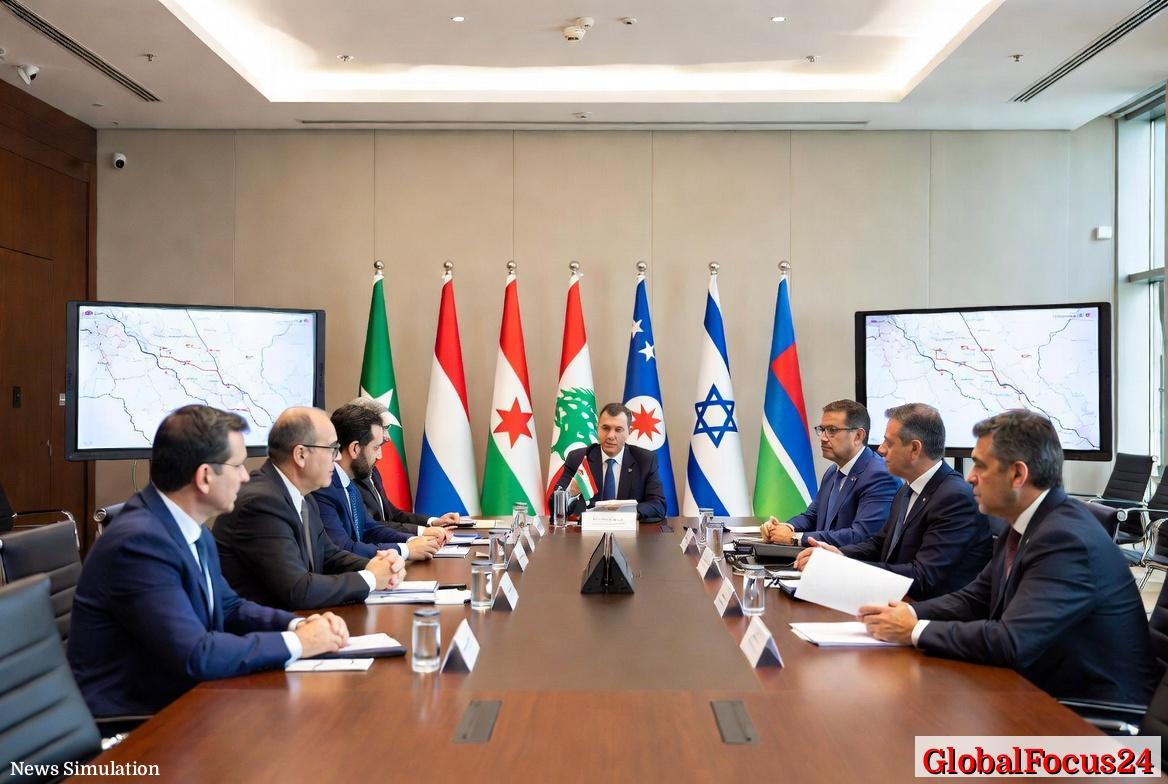
Israel Pursues Buffer Zone in Lebanon as Security Guarantee Amid Regional Tears and Tensions
In a region long defined by fragile ceasefires and shifting alliances, Israeli officials are pursuing a security buffer in southern Lebanon designed to deter Hezbollah and reduce cross-border flare-ups along a volatile frontier. The proposed zone would function as a tangible shield, creating a cleared area between the Israeli border and Hezbollah’s strongholds, with implications that extend well beyond the immediate theater of confrontation. While officials stress that the arrangement seeks to prevent future escalations, the plan comes amid a complex web of regional dynamics, historical grievances, and evolving security commitments that influence how such a buffer would be implemented and sustained.
Historical context: decades of border intricacy and deterrence The idea of a buffer zone along Israel’s northern edge is rooted in a long history of border management and coercive diplomacy in the Levant. After the 1948 Arab-Israel War and the 1967 Six-Day War, borders in the region became focal points for strategic depth and political signaling. In the decades that followed, margins of control, demilitarized zones, and international monitoring arrangements reflected the precarious balance between deterrence and escalation. In southern Lebanon, the presence of various militant groups, most notably Hezbollah, has repeatedly turned the border into a flashpoint. The 2006 Lebanon War highlighted the risks of escalatory cycles and underscored the appeal of physical demarcations that could limit cross-border fire upon civilian populations. The contemporary push for a buffer zone thus sits within this broader arc: a modern variant of deterrence measures that seeks to translate geostrategic caution into a tangible front-line shield.
Economic impact: considerations for local livelihoods and national security spending The pursuit of a buffer zone carries a multi-layered economic calculus. On the one hand, a stabilized border could reduce recurring costs associated with security incidents, casualty risks, and disruption to cross-border commerce, which has long linked communities across the border through markets, labor flows, and shared supply chains. On the other hand, the implementation would entail significant initial outlays for land clearance, monitoring infrastructure, and potential compensation for displaced or affected residents, as well as ongoing expenditures for surveillance, maintenance, and rapid response capabilities. Regions adjacent to the proposed zone would likely experience shifts in trade patterns, with some cross-border facilitation hampered during transition phases and others potentially rerouted through alternative corridors. The economic implications extend to broader macroeconomic considerations, including defense budgets, international aid commitments, and the opportunity costs of deploying resources toward border stabilization versus investment in infrastructure, education, or healthcare in neighboring communities.
Regional comparisons: how buffer concepts have played out elsewhere Border security strategies that involve physical barriers or buffer zones are not unique to this region. Several countries have experimented with similar approaches to reduce insurgent infiltration, cross-border smuggling, or militant sanctuaries. For example, some European and Asian contexts have deployed neutral or militarized zones along contested borders to minimize direct engagement and protect civilian populations, though the specifics — including governance, enforcement, and humanitarian safeguards — vary widely. Comparisons illuminate both potential benefits and challenges: a buffer can reduce casualty risks for civilians and frontline troops, yet it can also generate new frictions if local populations feel coerced or displaced, or if the mechanism for verification and accountability remains opaque. In regional terms, the effectiveness of any buffer depends on credible, verifiable commitments from all parties, sustained international engagement where applicable, and a clear framework for maintenance, incident response, and eventual normalization of the border landscape.
Security guarantees and reciprocal assurances: a delicate balance of promises and risks A central feature of the current discourse is the question of reciprocal security guarantees. Israel’s push for a cautionary buffer is tempered by concerns about how Lebanon would respond in turn, particularly in light of broader regional issues and domestic political dynamics. Analysts emphasize that secure borders are not merely about physical limits but about credible, enforceable commitments that prevent inadvertent escalations or opportunistic territorial annexations. The West Bank's evolving security reality has, in some circles, amplified considerations about how regional power dynamics could affect any agreement with Lebanon. The dynamic creates a need for a robust framework — including enforcement mechanisms, transparent rules of engagement, humanitarian protections, and independent verification — to prevent drift toward unilateral actions or reinterpretations of the buffer’s purpose. The balance remains delicate: the buffer must deter aggression while assuring Lebanon that the arrangement does not threaten its sovereignty or long-term territorial integrity.
Public reaction and civilian experiences: life near the frontier under scrutiny Communities living in the vicinity of the proposed buffer zone report a mix of apprehension and cautious pragmatism. Civilians who have endured past periods of conflict understand the potential benefits of reduced cross-border hostilities, including improved safety, predictability, and the chance to restore some normalcy to daily life. Yet local residents also voice concerns about displacement, loss of access to traditional grazing lands or agricultural terraces, and the long-term implications for regional identity and economic cohesion. Civil society groups emphasize the importance of safeguarding humanitarian access, ensuring that any land-clearing or security measures minimize harm to civilians, and guaranteeing avenues for grievances to be heard and resolved through independent processes. The public mood in nearby towns often reflects a broader regional sentiment: a desire for stability, tempered by memories of conflict and a vigilant insistence that any security arrangement must preserve human dignity and daily livelihood.
Strategic implications: how the buffer could reshape deterrence, diplomacy, and military planning If established, a buffer zone in southern Lebanon would recalibrate deterrence dynamics along Israel’s northern front. The spatial separation could constrain Hezbollah’s ability to maneuver, test responses, or mass-fire across the border in a manner that does not allow for rapid, reflexive retaliation. From a diplomatic standpoint, the zone would be a focal point for negotiations among multiple actors, including regional powers, international mediators, and humanitarian organizations. For the Israeli defense establishment, the arrangement would necessitate refined intelligence capabilities to monitor the corridor, rapid deployment protocols, and contingency plans for safeguards against potential escalations that might spill beyond the buffer’s confines. For Lebanon and its allies, the proposal could prompt a reexamination of security priorities, including how to maintain sovereignty, protect civilian infrastructure, and manage internal political pressures that influence responses to external security initiatives.
Operational considerations: governance, access, and the management of the zone Effective administration of a buffer zone would require a clear governance architecture. This could include a delineated geographic boundary, agreed-upon rules of engagement, and transparent processes for humanitarian access and civilian movement through or around the zone. Monitoring could rely on a combination of ground patrols, surveillance technology, and international observers to verify compliance and document incidents. A key challenge would be ensuring that the zone remains a security measure rather than a punitive carve-out that restricts livelihoods or fuels local grievances. Planning would also need to be sensitive to environmental considerations, such as water resources, cross-border ecosystems, and the impact on agricultural land, to avoid creating long-term ecological or economic scarcities that could destabilize the region further.
Policy framework: regional stability, humanitarian safeguards, and international law Any move toward a buffer zone must be anchored in a comprehensive policy framework that upholds international humanitarian law and protects civilian rights. Safeguards would include ensuring freedom of movement for essential workers, medicine, and humanitarian aid, alongside mechanisms to address violations promptly. The policy framework would also require consultation with regional organizations and neighboring states to ensure alignment with broader security objectives, human rights standards, and disaster-response coordination. Transparent reporting, independent investigations of incidents, and periodic reviews would be crucial to maintaining public trust and international legitimacy. The legal dimensions — including border delineation, sovereignty, and the status of residents within the buffer’s footprint — demand careful negotiation to avoid legal ambiguities that could destabilize the arrangement over time.
Economic resilience and community adaptation: planning for transition Beyond immediate security concerns, local economies and households near the border would benefit from resilience planning. Initiatives to diversify livelihoods, invest in border-region infrastructure, and preserve cross-border trade routes could mitigate short-term disruptions. Public-private partnerships might bolster agricultural productivity, cross-border logistics, and emergency response readiness. Education and vocational training programs could equip residents with skills relevant to security and civil administration, while cultural and historical exchanges could preserve the social fabric of border communities during a transition period. A well-structured resilience plan would help communities adapt to the realities of a buffer zone while maintaining their economic and social vitality.
Future outlook: conditions for sustainable security and regional normalization The ultimate success of any buffer-zone approach hinges on sustained, verifiable commitments, transparent governance, and ongoing regional engagement. If built on mutual interests and concrete assurances, the zone could contribute to a period of reduced cross-border aggression and a platform for broader stabilization efforts. However, the path forward is fraught with challenges: shifts in regional alliances, changing security architectures, and the possibility of retaliatory moves that could test the durability of the arrangement. Observers emphasize that success today does not guarantee permanence; the frontier between security and sovereignty remains a living, contested space that requires adaptive diplomacy, steadfast oversight, and unwavering attention to the civilian toll of conflict.
Conclusion: framing a difficult but potentially stabilizing option In a landscape shaped by history, geography, and the high-stakes calculus of regional power, the proposal for a buffer zone along southern Lebanon represents a consequential attempt to translate deterrence theory into a practical, enforceable measure. The approach seeks to reduce human suffering, lower the risk of rapid escalations, and create a framework for sustained dialogue about security, sovereignty, and regional cooperation. As discussions advance, the international community and local populations will watch closely to see whether the zone can function as a durable shield without becoming a source of new tensions or grievances. The test will be whether the security guarantees associated with the buffer are credible, verifiable, and respectful of the rights and livelihoods of those living on both sides of the border.