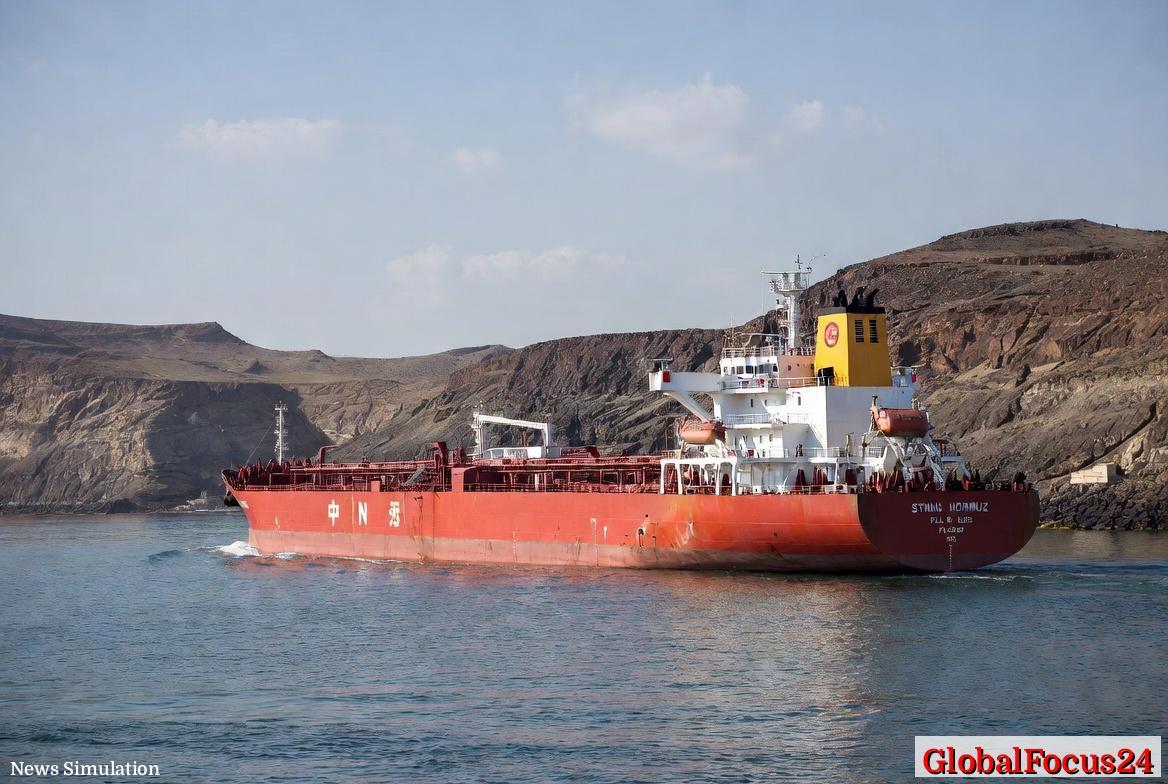
Tankers Navigate Strait of Hormuz as U.S. Blockade on Iranian Ports Takes Effect
Rising Tension in the World’s Most Critical Oil Transit Route
Several oil and chemical tankers passed through the Strait of Hormuz on Monday, marking the first full day of a wide-reaching U.S. blockade targeting vessels that call at Iranian ports. The movement, captured by global shipping data, unfolded against a backdrop of uncertainty in global energy markets and diplomatic friction following the collapse of peace talks between Washington and Tehran in Islamabad over the weekend.
The Strait of Hormuz, the narrow waterway between Oman and Iran, carries nearly one-fifth of the world’s crude oil exports. Any disruption in its flow reverberates across energy markets, with implications stretching from Asian industrial hubs to Western economies dependent on Gulf exports. On Monday, tanker movements showed that vessels were cautiously adjusting their routes to comply with U.S. restrictions, avoiding Iranian territory but keeping trade lanes active between the United Arab Emirates, Iraq, and broader regional ports.
Details of the First Transits
The Chinese tanker Rich Starry, operated by Shanghai Xuanrun Shipping Co. Ltd, was among the first to cross the strait since the blockade began. Despite being under U.S. sanctions, the medium-range vessel—with a Chinese crew aboard—was reported carrying roughly 250,000 barrels of methanol loaded at the UAE’s Hamriyah port. Methanol is a key industrial chemical used in plastics and fuels, and its journey marked a signal that non-Iranian trade would continue even as restrictions tightened around Tehran’s maritime activity.
Another vessel, the Panama-flagged Peace Gulf, was en route to the UAE. The ship typically transports naphtha, a vital petrochemical feedstock, across the Middle East to facilitate exports to Asia. Although the Peace Gulf has previously moved Iranian-origin cargo, its latest route avoided Iranian waters entirely—an early example of carrier compliance amid rising geopolitical pressure.
A third tanker, the Murlikishan (formerly known as MKA), was recorded heading north toward Iraq to load fuel oil. Historically, the vessel has participated in trades involving both Russian and Iranian supplies, reflecting complex global energy supply chains that now face renewed scrutiny under the blockade’s enforcement regime.
The Blockade Announcement and Policy Context
U.S. President Donald Trump announced the blockade late Sunday, following unsuccessful diplomatic talks aimed at relaxing constraints on Iran’s oil export sector. The talks in Islamabad had raised faint hope for compromise—potentially a phased reduction of sanctions in exchange for monitoring programs—but deteriorated over Iran’s demand for full sovereignty over its maritime exports.
By Monday morning, U.S. naval assets were actively enforcing restrictions along key Gulf chokepoints. The U.S. Fifth Fleet, headquartered in Bahrain, has historically played a major role in guarding freedom of navigation through the region. The new directive specifically targets vessels calling at Iranian ports, while permitting free passage for ships trading with nearby Gulf countries.
Washington described the measure as a temporary protective step designed to prevent “illegal transfers and sanctioned cargo movements,” though defense analysts view it as the most assertive maritime containment of Iran since the tanker standoff of 2019.
Historical Precedent and Strategic Importance
The Strait of Hormuz has long stood as the centerpiece of geopolitical tension in the Gulf. At its narrowest point, the strait is only about 21 miles wide, yet it handles energy shipments crucial to global stability. Historical flashpoints—from the Iran-Iraq War in the 1980s to the U.S.–Iran naval standoffs of 2019 and 2020—show how quickly incidents in these waters can escalate into regional crises.
Previous blockades and tanker seizures have triggered spikes in oil prices and altered trade routes as economies scrambled to secure stable supply lines. The 2026 blockade risks renewing those pressures, especially given Iran’s ongoing exclusion from major energy markets since the U.S. withdrawal from the 2015 nuclear accord. The difference today lies in scale: unlike earlier targeted sanctions, this move covers all foreign carriers dealing directly with Iranian ports, multiplying its impact on supply chain logistics.
Market Impact and Energy Sector Reaction
Global crude prices jumped modestly overnight, with futures for Brent and West Texas Intermediate each rising more than 2% by early trading Tuesday. Analysts caution that broader fluctuations could follow depending on how long the blockade remains in effect and whether any incidents occur involving neutral shipping.
Asian refiners, particularly in China, South Korea, and Japan, are among the most exposed to Gulf energy disruptions. Many of these nations rely heavily on flows through Hormuz, and even small curbs in transit can complicate supply chains and increase costs for production industries.
Energy traders are now recalculating transit risks. Insurers have already raised premiums on vessels operating near Iranian waters. The London-based marine risk firm Lloyd’s List Intelligence reported early indications of “heightened navigation alert status” across Gulf traffic maps. The ripple effects are also reaching currency markets, with the Iranian rial under fresh pressure and regional currencies fluctuating amid investor uncertainty.
Regional Comparisons and Diplomatic Reactions
Across the Gulf region, reactions have varied. The United Arab Emirates, whose ports serve as major transshipment hubs, has refrained from formal comment but continues normal operations. The UAE’s diversified economy—anchored by petrochemical and commercial exports—may benefit from redirected cargoes that would otherwise go through Iran.
In contrast, Oman and Qatar have expressed concern that further militarization of Gulf waters could jeopardize broader trade relationships with both Western and Asian partners. Omani officials called for “restraint on all sides,” echoing historical positions emphasizing maritime neutrality.
China’s foreign ministry issued a sharp statement Monday, calling the blockade “dangerous and irresponsible,” warning it could fuel instability in already volatile waters. Beijing remains one of Iran’s few major trading partners despite prior U.S. sanctions, and officials insisted that all shipping routes “must remain open to legitimate trade.”
Meanwhile, European policymakers urged immediate dialogue to prevent a repeat of past tanker confrontations that disrupted energy flows to southern Europe. The European Union has maintained indirect monitoring efforts through its maritime security missions in the Indian Ocean, underscoring Europe’s dependence on Gulf-origin hydrocarbons.
Economic Ramifications Beyond the Gulf
The blockade’s reach extends beyond energy logistics. By constraining Iranian exports—including condensate, petrochemicals, and refined products—the measure could indirectly affect smaller regional economies that rely on low-cost Iranian energy supplies. The tightening may also influence global methanol and naphtha markets, as Iran serves as a competitive producer in both.
For Iran, whose economy remains under heavy sanctions pressure, the blockade could deepen financial isolation. Without access to shipping revenues or export duties, Tehran faces diminishing foreign currency reserves and rising domestic inflation. Iranian officials have yet to publicly comment on the first day’s developments, though local analysts warn of significant strain on industrial operations tied to petrochemical and shipping sectors.
In neighboring Iraq, traders anticipate increased volume through its southern terminals as demand shifts away from Iranian sources. The shift may temporarily boost Iraqi export income, though it could also test the country’s port capacity. Such adjustments mirror past disruptions—most notably the 2012 tightening of Iranian crude exports—when Gulf partners scrambled to accommodate new supply routes.
Strategic Outlook and Future Scenarios
Security experts cite two potential trajectories for the coming weeks. In an optimistic scenario, diplomatic pressure could yield limited exemptions allowing humanitarian and non-energy cargoes into Iranian ports. That outcome would ease tension while maintaining negotiation channels between Tehran and Washington.
In a darker scenario, however, Tehran might retaliate through asymmetric tactics such as targeting U.S. naval operations, conducting missile tests, or obstructing commercial passage near the eastern approaches to Hormuz. Such moves would likely trigger swift countermaneuvers from the U.S. and allies, further destabilizing regional trade.
The next critical indicator will be energy market behavior. If shipping rates, insurance premiums, and freight costs keep rising beyond short-term volatility, global inflation may follow. Already, analysts assess that the Gulf blockade could intersect with existing supply chain constraints worldwide, amplifying strains in sectors from chemicals to aviation fuel.
Conclusion: Global Stakes in Narrow Waters
As the first day of the U.S. blockade passes, tanker traffic through the Strait of Hormuz demonstrates both resilience and wariness—ships moving cautiously under new rules that redefine regional commerce overnight. The developments underscore how one chokepoint, a mere sliver of ocean between two peninsulas, can shape the economic pulse of the world.
Whether the blockade proves a short-lived strategy or a prolonged confrontation will depend on upcoming negotiations and the willingness of stakeholders to keep the sea lanes open. For now, every vessel crossing Hormuz does so under an uneasy calm—navigating not only tides and shipping lanes, but the weight of history and the fragility of peace that stretches across one of the planet’s most vital routes.