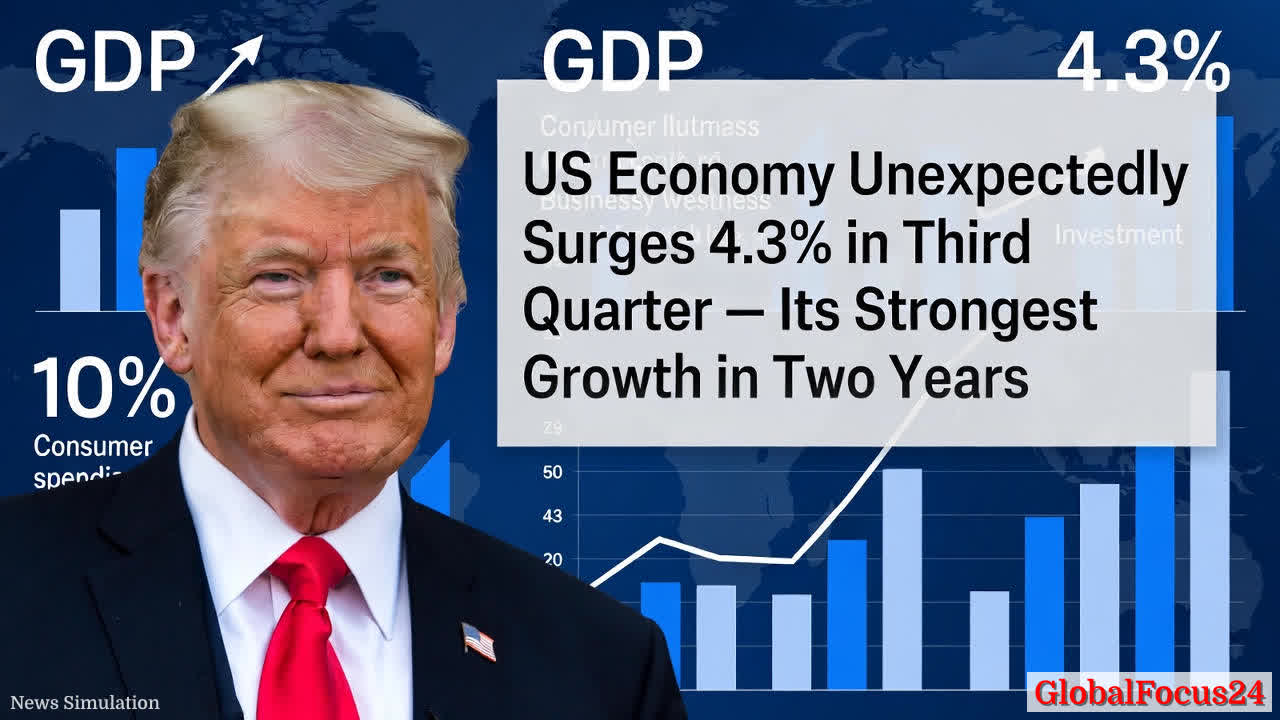
US Economy Surges 4.3% in Q3: A Deep Dive into Growth, Context, and regional contrasts
The U.S. economy expanded at an unexpectedly brisk pace of 4.3% in the third quarter, marking the strongest quarterly growth in two years. The Commerce Department’s revised estimate, released after seasonal adjustments and accounting for ongoing volatility in auto and energy markets, places the quarterly performance well above economist forecasts and signals a temporary acceleration that has surprised policymakers and markets alike. This article examines the drivers behind the surge, situates it within a broader historical and regional context, and analyzes the implications for inflation, employment, and future growth.
Historical context: momentum across cycles To understand the current 4.3% reading, it helps to place it within the arc of post-recession recoveries and the more recent policy environment. The United States has weathered a succession of shocks over the last few years—from supply chain frictions to shifts in consumer spending patterns and, more recently, tariff-related adjustments and policy pivots. Historically, quarterly growth above 4% is uncommon in the modern era outside periods of concentrated fiscal stimulus or temporary working through energy price swings. The latest figure, while robust, sits alongside a longer growth narrative that includes periods of slower expansion and episodes of volatility driven by financial conditions, commodity markets, and evolving consumer behavior.
Key drivers: consumption, investment, and services
- Consumption remains the backbone of the expansion. Consumer spending rose notably in the third quarter, supported by services demand and ahead-of-expiration incentives in certain durable goods categories. Household purchases of healthcare services, travel, entertainment, and other services contributed meaningfully to domestic demand.
- Investment in equipment and intellectual property surged, underscoring a business environment that favors capital deepening and productivity-enhancing assets. Businesses expanded outlays on information technology, data-center capacity, and other capital expenditures, signaling confidence in the medium-term growth trajectory.
- Net exports and inventories also played roles, with inventory dynamics and traded goods contributing to the quarterly arithmetic that produced the 4.3% annualized growth rate. While export performance benefited from favorable external conditions at points, import growth kept some portions of domestic demand in check, tempering the net effect.
Regional perspectives: where growth landed hardest Growth is rarely uniform across the United States, and the third-quarter surge reflected sectoral strengths that varied by region:
- Technology-centric hubs and these regions’ corporate investment cycles helped buoy aggregate numbers. States with robust capital formation from data centers, cloud infrastructure, and software services tended to post stronger results, reflecting the national trend toward digitization and AI-related capacity expansion.
- Consumer-heavy economies with substantial service sectors benefited from resilient household spending, particularly in urban and suburban areas with higher disposable incomes. Regions with diversified economies that blend healthcare, education, and professional services often exhibited steadier growth.
- The energy sector’s performance contributed to mixed regional outcomes. Areas with active energy production and related manufacturing supported higher activity, while regions facing softer energy demand saw a more moderate contribution to overall GDP.
Economic impact: implications for inflation, labor, and policy Inflation considerations and the labor market dynamics frame the interpretation of a 4.3% quarterly growth pace:
- Inflation and purchasing power: while the third-quarter household spending was buoyant, inflation remained a focal concern for policymakers and households alike. The pace of price increases varied across categories, with some services and durable goods experiencing more pronounced price pressure. A robust growth backdrop can both accompany and complicate inflation management, depending on how supply chains and wage dynamics evolve.
- Employment backdrop: unemployment has fluctuated, with recent readings showing pockets of softness in some sectors even as others remain resilient. A strong GDP print does not automatically translate into immediate labor market improvements, but it can influence hiring plans and wage trajectories as firms respond to higher demand and capacity utilization.
- Policy signaling: a sharper growth profile can influence central bank expectations, particularly around interest-rate paths and balance-sheet normalization. Policymakers typically weigh growth momentum against inflation risks and financial stability considerations when calibrating future policy adjustments.
Comparisons and contrasts: today vs. prior cycles Contextualizing the current growth spurt against past cycles highlights both similarities and distinct features:
- In prior expansions, large accelerations were often tied to aggressive fiscal stimulus or significant shifts in energy markets. The present surge appears to reflect a combination of resilient consumer demand, capital investment, and a favorable mix of external conditions.
- Credit conditions and financial markets have supported business investment during this cycle, with enterprise spending on technology and infrastructure playing a pivotal role. This contrasts with earlier periods where investment cycles were more volatile or driven primarily by external demand.
- The broader macro environment includes ongoing debates about tariffs, trade policy, and global supply chains. While tariff policy can influence investment decisions in the short run, the latest data suggests a degree of resilience even amid tariff-related uncertainty, underscoring a more complex, multi-factor growth story.
Public reaction and regional sentiment Public perception of a strong GDP figure tends to hinge on everyday experiences, including job prospects, wage growth, and the cost of living. In regions benefiting from capital investment and job creation, sentiment often improves as hiring becomes more robust and businesses report stronger revenue streams. Conversely, households facing elevated costs for essential goods and services may view a rapid growth backdrop with caution if wage gains lag behind price increases. Analysts emphasize that a single quarterly GDP figure, while informative, does not capture the full breadth of economic well-being and must be interpreted alongside labor market data and inflation trends.
The role of technology and innovation The third-quarter expansion underscores the accelerating role of technology and digital infrastructure in sustaining growth. Investments in data centers, cloud services, and related platforms reflect a shift toward higher productivity and scalable output. While some observers warn of potential overheating in certain segments—such as AI-related capital expenditure—industry experts stress that durable, financially solid project pipelines support longer-term gains rather than speculative bubbles. The health of major tech firms and their balance sheets remains a key determinant of continued investment momentum.
Global context: how the U.S. performance compares Internationally, the U.S. growth outpaced many peers during this period, contributing to a relatively stronger relative economic position. Global markets watched for signs that American expansion could spill over into stronger demand for imports, currency movements, and cross-border investment flows. The comparative performance also influenced U.S. trade dynamics, with a more robust domestic economy potentially shifting the balance of trade and investment sentiment worldwide.
Caveats and what to watch next
- The sustainability of growth hinges on several factors, including consumer wage growth, inflation trajectories, and the health of global supply chains. Policymakers and market participants will be watching for signs of demand cooling or acceleration in the coming quarters.
- The timing and trajectory of interest-rate adjustments will influence borrowing costs for households and firms. A tighter financial environment could temper investment, while a more accommodative stance could support continued expansion.
- Structural inflation pressures, particularly from services and housing, remain a focal point for the inflation outlook. How these components evolve will shape the next policy cycle and market expectations.
Bottom line: a snapshot with nuance The 4.3% third-quarter growth figure signals a period of robust economic activity driven by resilient consumer demand and noteworthy investment in equipment and digital infrastructure. While the surge is welcome and suggests the economy can translate strength into continued production and job creation, it is not a panacea. Inflation dynamics, labor market developments, and external shocks will collectively determine whether this momentum endures into the next year. By examining sectoral contributions, regional patterns, and the health of the innovation-driven investment cycle, a clearer picture emerges of where the U.S. economy stands today and what to anticipate in the quarters ahead.