U.S. Weekly Job Listings Fall to Lowest Level Since 2020, signaling a Cooling Labor Market
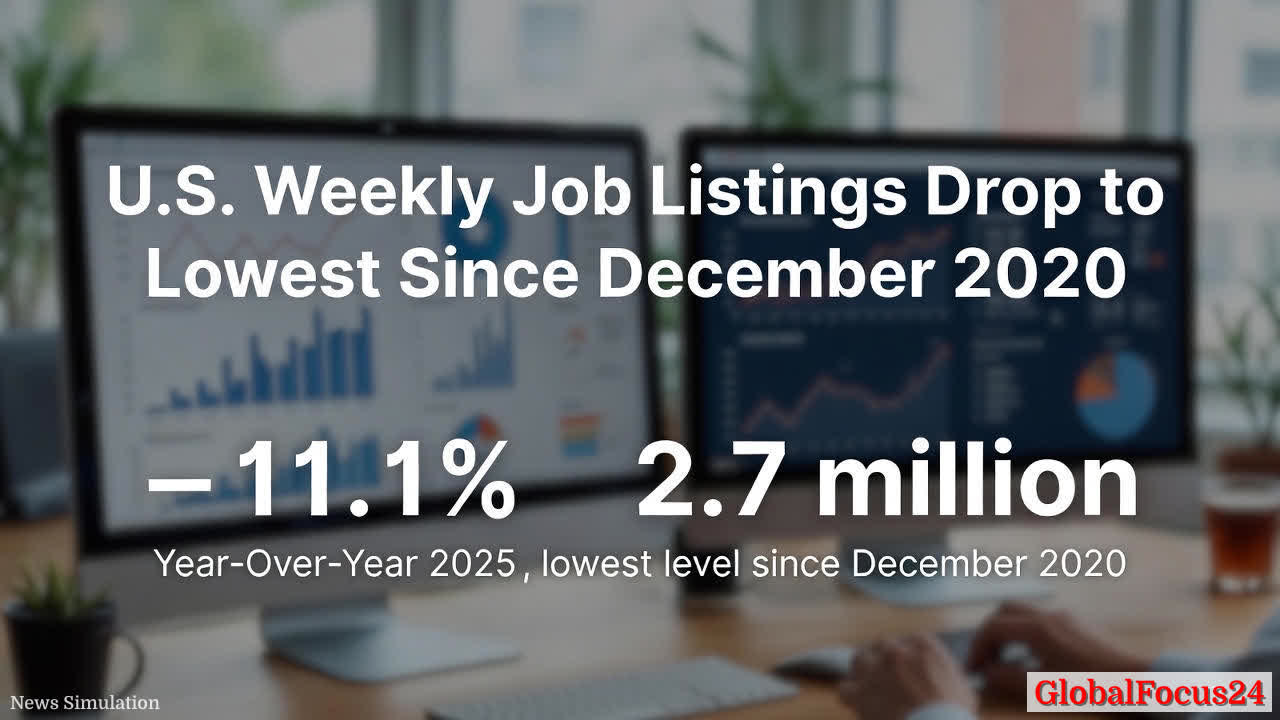
In a year marked by shifting economic dynamics and evolving labor demand, U.S. weekly job listings plunged to their lowest level since December 2020, underscoring a broad slowdown across manufacturing and services sectors. The latest data show an 11.1% year-over-year decline in job openings for 2025, with total listings hovering around 2.7 million. This trajectory places overall postings firmly below the pre-pandemic benchmarks of 2019, suggesting a notable erosion of hiring momentum across blue- and white-collar roles alike. Analysts describe the trend as a signal of tightening labor conditions that could reverberate through wage dynamics, productivity, and regional economic resilience in the months ahead.
Historical context
To understand the current trajectory, it helps to place the 2025 data in a broader historical arc. The initial surge in job postings during the reopening period after the 2020 lockdowns gave way to a normalization phase in the mid-2020s, as automation, supply chain adjustments, and shifts in consumer demand recalibrated hiring needs. The late 2020s have been characterized by a return to selective hiring, with firms prioritizing roles tied to core operations, digitization, and specialized skills. The 2025 decline echoes patterns observed during previous economic cycles when growth decelerates and firms recalibrate headcounts in response to macroeconomic signals such as inflation trajectories, interest rates, and demand elasticity.
Regional comparisons
Job postings entered 2025 with uneven regional momentum. Manufacturing-heavy regions in the Midwest faced sharper reductions in postings, reflecting broader manufacturing slowdowns and supplier-network adjustments. Meanwhile, several coastal and urban areas, traditionally hubs for technology, healthcare, and financial services, saw mixed outcomes—some markets maintained sturdy postings in high-skill segments while others experienced truncated opportunities as firms moderated expansion plans. The dispersion across regions highlights how local industry composition—ranging from durable goods production to professional services—shapes the pace and structure of hiring activity. In areas with diversified bases and robust private investment, the downward trend appeared less severe, though the overall level of open positions remained below the long-run average.
Economic impact
The fall in weekly job listings carries several potential implications for the broader economy. First, a sustained drop in openings can slow wage growth, as demand for labor softens and competition for skilled workers eases. Employers may gain leverage in setting compensation terms, particularly for mid- to high-skill roles, which could influence consumer spending and savings rates. Second, the drop-off raises questions about productivity, since hiring freezes or reduced postings can lead to skill gaps and longer onboarding times for critical projects. Firms investing in automation or process optimization may offset some employment declines, but the transition period could involve productivity hiccups that affect output and competitiveness.
Third, the data provide a lens into sectoral health. Manufacturing and services—two broad pillars of the economy—exhibited broad-based softness, with both domains contributing to the overall decline in postings. This dual weakness suggests that the dip is not solely the result of one industry rebalancing demand, but rather a broader recalibration across the economy. For policymakers, the trend adds another layer to considerations about stimulus timing, labor market market-mapping programs, and retraining initiatives designed to align workers with evolving demand patterns.
Labor force dynamics
Beyond thenumbers, the labor market dynamics in 2025 illuminate several nuanced stories. A lower level of active postings does not automatically translate into higher unemployment if labor force participation remains elevated or if job-search frictions ease. However, the combination of fewer openings and ongoing geographic mobility constraints could prolong the time needed for workers to transition between sectors or to upskill for in-demand roles. In some regions, partnerships between employers, educational institutions, and workforce development programs may help bridge gaps, enabling more people to re-enter or upskill for higher-demand occupations.
From a structural perspective, the shift toward specialized and high-skill roles continues to shape hiring patterns. Sectors such as healthcare, information technology, and advanced manufacturing often display persistent demand for niche expertise, even as overall postings decline. This divergence can create a scenario where the job market tightens for general labor while skilled professionals remain in comparatively higher demand, potentially widening wage differentials and reinforcing the importance of targeted training and apprenticeship pathways.
Public and business sentiment
Public reaction to softer job postings is mixed. In regions that traditionally depend on manufacturing or export-oriented industries, communities have expressed concern about sustained job-market softness and its ripple effects on local commerce and school funding. Conversely, markets with strong tech or service-sector bases have reported more resilience, given ongoing investments in digital infrastructure, cloud services, and health care delivery innovations. Businesses, meanwhile, describe a cautious path forward: controlling costs, prioritizing high-return hires, and accelerating upskilling initiatives to preserve competitiveness in a slower hiring environment.
Indicators to watch
Several indicators will be crucial in the coming months to gauge whether the 2025 decline in job postings represents a temporary dip or a new normalization level. First, wage growth trends will be telling. If compensation remains robust in critical fields while overall postings stay subdued, it may indicate a reallocation of labor rather than a broad labor market weakness. Second, quitting rates and job-switching activity provide insights into worker confidence and mobility. Elevated turnover in certain sectors can reflect a demand for better opportunity despite a cooling overall job market. Third, regional data will help identify catalysts that either accelerate or dampen recruitment, such as local investment projects, industrial policy shifts, or sector-specific boons like energy transitions or healthcare expansion.
The role of technology and automation
Automation and process optimization continue to shape hiring dynamics. Firms are increasingly leveraging automation to augment the workforce, especially in manufacturing and logistics. This shift can reduce the demand for routine or manual labor while increasing the need for engineers, maintenance technicians, data analysts, and system integrators who can design, implement, and manage automated solutions. The net effect on employment depends on the balance between productivity gains and job displacement, as well as the availability of retraining opportunities for workers who are displaced. Policymakers and industry leaders alike are closely monitoring this balance to ensure a smooth transition that preserves income stability and social cohesion.
Historical parallels and lessons
Looking back at earlier episodes of labor-market normalization, this year’s decline in job postings resembles periods of tempered growth following surges in hiring during recoveries. The common thread across such episodes is the importance of adaptable training ecosystems, flexible labor markets, and responsive monetary and fiscal policies. Regions that invested in apprenticeship programs, vocational training, and ongoing education tended to navigate slowdowns more resiliently, maintaining a pipeline of skilled workers aligned with emerging industry needs. The current data thus highlight the enduring value of continuous workforce development as a stabilizing force during cycles of demand fluctuation.
Conclusion
The 2025 decline in weekly job listings to the lowest level since the 2020 downturn marks a meaningful shift in the U.S. labor market. While not a definitive forecast of future unemployment, the trend suggests a period of recalibration across sectors and regions, with hiring activity cooling as demand and supply adjust to evolving economic conditions. Stakeholders—from policymakers and business leaders to educators and workers—will benefit from closely watching the pace of recruitment, wage trajectories, and regional performance. By prioritizing targeted retraining, sustainable investment in high-demand industries, and flexible workforce strategies, the economy can navigate this softer phase while preserving long-term resilience and inclusive growth. The coming quarters will reveal whether 2025’s hiring lull represents a temporary pause or a new baseline for job postings in a gradually evolving economy.