The S&P 500 Breaks 7,000 for the First Time as Wall Street Extends a Historic Rally
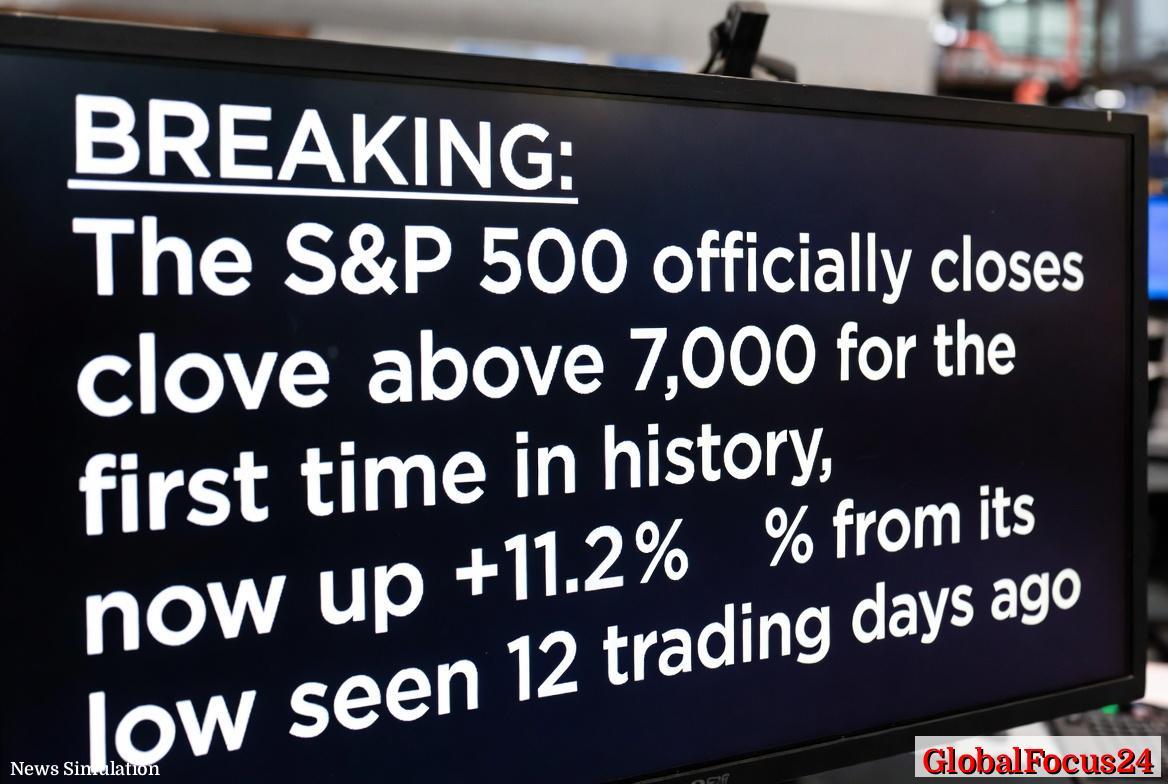
The S&P 500 has crossed 7,000 for the first time in history, marking another milestone in a market advance that has reshaped investor expectations and underscored the scale of the U.S. equity rebound. The index’s rise of 11.2% from its recent low, reached just 12 trading days earlier, highlights both the speed of the recovery and the persistence of demand for large-cap American stocks.
A New Milestone on Wall Street
The move above 7,000 adds a fresh psychological marker to a benchmark that has spent the past several years repeatedly pushing into unfamiliar territory. The S&P 500 first finished above 6,000 in November 2024, and its climb to 7,000 has come in the context of strong corporate earnings, resilience in technology shares and a steady willingness among investors to buy dips.
The latest break above 7,000 also reflects the way modern market milestones tend to arrive in clusters. In earlier decades, a 1,000-point move in the index took years; more recently, gains have come faster as the index has grown in nominal terms and as large technology firms have carried more weight in the benchmark.
Why The Rally Has Accelerated
A major force behind the latest advance has been the continued dominance of megacap technology and artificial intelligence-related companies. Those firms have remained central to market leadership, helping the broader index absorb periods of volatility elsewhere in the economy and in other sectors.
Investor sentiment has also been supported by the broader pattern of U.S. equity performance over time. Since 1957, the S&P 500 has delivered average annual returns of 10.56%, or 6.69% after inflation, a long-run record that continues to anchor expectations during moments of market exuberance and caution alike.
The speed of the latest rebound has been especially notable. A gain of 11.2% in just 12 trading days points to a market that is reacting quickly to improving risk appetite, stronger earnings momentum and a belief that the economy can keep expanding without derailing corporate profits.
Historical Context Matters
The S&P 500 has long served as a shorthand for the health of U.S. large-cap equities, but each major round-number milestone carries its own historical weight. The first close above 6,000 in late 2024 was followed by a series of new highs, and the move to 7,000 is the latest in a sequence that has unfolded against a backdrop of shifting interest-rate expectations, rapid advances in technology and changing sector leadership.
Market historians often note that nominal index levels can be deceptive without context. A 7,000 reading does not mean the market is “worth” seven times more than at 1,000; it reflects decades of earnings growth, share buybacks, reinvested dividends and inflation. Even so, the number matters because it helps shape investor psychology, media attention and trading behavior.
Economic Impact Beyond The Ticker
A record level in the S&P 500 often carries consequences well beyond the trading floor. Higher equity prices can lift household wealth through retirement accounts and brokerage portfolios, support consumer confidence and improve the financing environment for companies that use stock as currency for acquisitions, compensation or capital raising.
The effect is not evenly distributed. Gains in the benchmark are typically concentrated in larger public companies and in households with significant market exposure, which means the benefits are strongest for investors already positioned in stocks. That can widen the gap between financial market gains and the day-to-day experience of consumers facing housing, food and borrowing costs that do not always move in tandem with shares.
For corporations, a stronger market can reduce the cost of equity capital and make it easier to fund expansion, research and development, or strategic hiring. It can also support merger activity and encourage companies to keep investing in growth areas, especially when large technology firms continue to command premium valuations.
Regional Comparisons Show A Wider Gap
The U.S. market’s rapid march to 7,000 stands out when compared with many other major regions. American large-cap stocks have benefited from a concentration of globally dominant technology, communications and consumer companies, while several international markets have faced more modest earnings growth, slower domestic demand or different sector mixes.
That contrast has been especially visible in Europe and parts of Asia, where benchmarks have generally lacked the same level of exposure to mega-cap artificial intelligence beneficiaries. In commodity-linked markets, performance has often been more closely tied to energy, metals and trade cycles, producing a different rhythm from the U.S. equity advance.
Within the United States itself, the rally has also highlighted the difference between large-cap and small-cap performance. While the S&P 500 has continued to set records, the Russell 2000 has at times moved differently, underscoring how uneven market leadership can be even inside the same national economy.
What Investors Are Watching Next
The next question is whether the S&P 500 can hold above 7,000 on a closing basis and build a stable base at the new level. Traders often treat intraday touches and closing milestones differently, since a sustained close tends to carry more symbolic and technical importance than a brief move through a round number.
Investors will also be watching earnings guidance, inflation trends and the path of interest rates for clues about whether the rally can continue. When valuations are high, markets can remain elevated if profit growth stays strong, but momentum can reverse quickly if expectations begin to outrun fundamentals.
At the same time, the speed of the recent climb means the market is now carrying the burden of proof. A rise of 11.2% from a low just 12 trading days earlier is powerful evidence of demand, but it also leaves less room for disappointment if economic data soften or if leadership narrows further.
A Symbol Of Market Confidence
For many investors, the move above 7,000 is less about the number itself than what it represents: confidence in the resilience of American corporate earnings, the continuing influence of large technology firms and the market’s ability to absorb uncertainty. The S&P 500 has become a measure not only of stock performance but of how quickly capital can reprice optimism in a fast-moving economy.
The milestone arrives at a time when market gains remain closely tied to a handful of powerful themes, especially artificial intelligence, innovation spending and the durability of consumer and business demand. If those themes hold, the 7,000 level may soon look less like a ceiling than another waypoint in a longer climb.