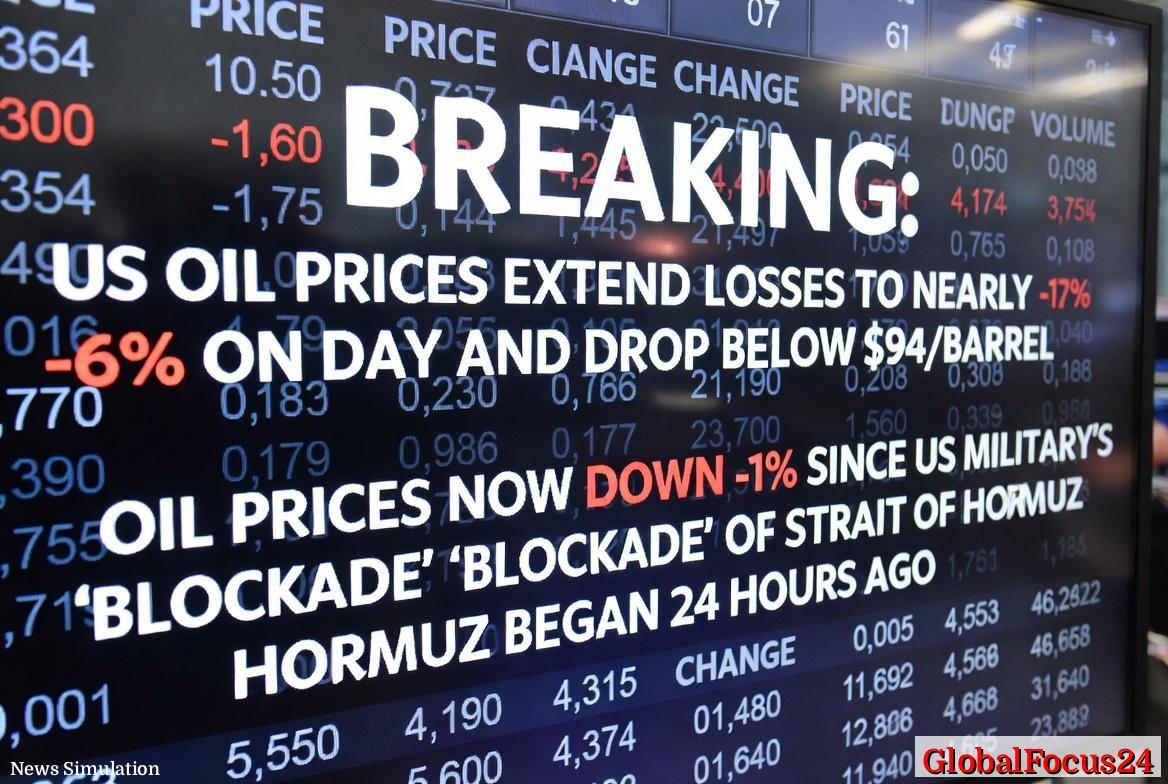
US Oil Prices Drop Below $94 as Strait of Hormuz Blockade Deepens Market Jitters
US oil prices extended losses on Tuesday, falling nearly 6% and slipping below $94$ dollars per barrel as traders continued to assess the fallout from the U.S. military blockade of the Strait of Hormuz. The benchmark crude has now fallen about $11%$ in just 24 hours, marking one of the sharpest short-term reversals in the energy market in recent months and underscoring how quickly geopolitical risk can reshape global commodity prices.
The slide reflects a market that is still struggling to balance two competing forces: the immediate threat of supply disruption in one of the world’s most important oil chokepoints and the fear that the conflict could damage demand across the broader economy. For consumers, businesses, and policymakers, the decline offers some short-term relief from earlier price spikes. But the volatility itself signals that the outlook remains highly unstable.
Strait of Hormuz Remains a Critical Energy Route
The Strait of Hormuz has long been one of the most strategically important waterways in the world. Roughly one-fifth of global oil shipments pass through it on an average day, alongside a major share of liquefied natural gas flows from the Persian Gulf. Because the passage is narrow and heavily trafficked, even limited disruption can send shockwaves through energy markets far beyond the region.
The current blockade has revived memories of past supply scares, when tensions in the Gulf repeatedly pushed traders to price in a wide range of outcomes, from temporary shipping delays to prolonged supply losses. In the 1970s and 1980s, oil markets were shaped by wars, embargoes, and political instability in producing regions. In more recent decades, fears over the Strait of Hormuz have repeatedly surfaced during regional conflicts, sanctions episodes, and attacks on tankers.
This time, the speed of the market response has been striking. Oil prices initially surged when the blockade was announced, but the rapid retreat suggests traders now see a mix of factors limiting the upside. Some are betting that strategic reserves, rerouting, and slower global demand growth could cushion the impact. Others are concerned that a broader economic slowdown would reduce consumption if the crisis persists.
Why Prices Fell After the Initial Spike
Oil market moves after geopolitical shocks are often counterintuitive. An immediate jump in prices is common when supply is threatened, but sharp drops can follow if traders conclude the disruption may not remove as much crude from the market as first feared, or if they begin to anticipate a demand hit from higher uncertainty.
Several forces appear to be weighing on prices now:
- Traders may believe spare production capacity outside the region can partially offset shortfalls.
- Governments could release emergency reserves if the blockade tightens physical supply.
- Shipping insurers and freight operators may raise costs, but not enough to freeze all trade.
- Higher fuel costs could slow economic activity, weakening demand for gasoline, diesel, and jet fuel.
- Some speculative positions built on the expectation of a longer-lasting price surge may be unwinding.
That combination can create fast reversals in oil futures. The benchmark’s $11%$ drop in a single day does not mean the crisis has faded; it means the market is still searching for a price that reflects both risk and resilience. In energy trading, uncertainty itself can be as powerful as the actual loss of barrels.
Historical Context Shapes Market Behavior
History offers a useful guide to the current reaction. Oil has a long record of reacting violently to geopolitical events, but those shocks do not always last in the same form. During the 1990 Gulf crisis, prices spiked sharply on fears of a prolonged supply collapse. In later episodes, however, markets often moved back down once it became clear that production elsewhere, stockpiles, and policy responses could blunt the damage.
The modern oil market is also more flexible than it once was. The rise of U.S. shale production, broader access to global shipping and refining networks, and the existence of larger emergency stockpiles have made the market less vulnerable to a single disruption. At the same time, that flexibility has not eliminated risk. The Strait of Hormuz remains unique because of the sheer volume of crude that depends on it.
Another important difference from earlier eras is the speed of information. Prices now react within minutes to military developments, satellite images, shipping alerts, and official statements. That rapid response can magnify short-term swings, especially when traders are forced to act before the full scale of the disruption is clear.
Economic Impact Could Reach Consumers Quickly
Even if crude prices remain below recent highs, the effects of the blockade could still ripple through the economy. Oil is not just a fuel input; it influences transportation costs, manufacturing, agriculture, chemicals, and air travel. When crude becomes more volatile, companies often hedge aggressively or pass costs along to customers.
The most immediate pressure would likely appear at the pump if refiners begin to pay more for replacement barrels or face higher shipping and insurance costs. Diesel prices are especially important because they affect freight, farm equipment, and industrial operations. Jet fuel could also become more expensive, creating margin pressure for airlines already dealing with tight schedules and seasonal demand swings.
Consumers tend to feel these changes first in fuel bills, but the broader impact can spread over time. Higher transportation costs can raise the price of delivered goods, from groceries to online retail shipments. Businesses with thin margins may delay hiring or investment if they expect energy costs to stay elevated. For households already coping with uneven inflation, even a temporary jump in fuel prices can affect spending decisions.
At the same time, the recent drop below $94$ dollars per barrel could ease some of the immediate strain. If the decline holds, it may reduce the urgency of fuel surcharges and help limit inflation in sectors tied to energy. For central banks and finance ministries, that matters because energy shocks can complicate the outlook for interest rates, consumer confidence, and growth.
Regional Markets Face Different Risks
The impact of the blockade will not be evenly distributed. Oil-producing nations in the Gulf face direct operational and shipping concerns, while import-dependent economies in Asia and Europe must weigh their exposure to higher freight and insurance costs. The United States occupies a more unusual position because it is both a major producer and a major consumer.
Compared with Europe, the U.S. is less reliant on crude imports from the Gulf than it was decades ago, thanks in part to domestic production growth. Yet American fuel prices still track global benchmarks, meaning a disruption in the Middle East can quickly affect domestic markets. Refining bottlenecks, regional fuel inventories, and transportation costs can all influence how rapidly the shock reaches consumers.
Asia is especially vulnerable because several of the world’s largest importers depend heavily on Gulf oil. Countries such as India, Japan, South Korea, and China have long treated Hormuz-related tensions as a strategic vulnerability. They have spent years diversifying suppliers and building reserves, but the geography of the route means there is no true substitute for the volumes that cross it.
Europe, meanwhile, has a somewhat more diversified supply mix but remains sensitive to any rise in global crude prices. Higher oil costs can pressure inflation at a time when many European economies are still working through weak industrial growth and uneven consumer demand. In practical terms, this means the same barrel price can produce different levels of stress depending on each region’s energy mix, refinery capacity, and transport network.
Shipping, Insurance, and Freight Costs Add Pressure
Crude prices are only part of the story. The blockade also affects the cost of moving oil. Tanker insurance premiums often rise sharply when vessels must pass near military activity or through restricted waters. Shipping delays can create bottlenecks at refineries and terminals, even if the crude itself is still available somewhere in the system.
Freight markets tend to respond quickly to these risks. A tighter supply of vessels or a longer route around the region can raise transport costs, which then feed into the price of delivered fuel. For refiners, the challenge is not only buying crude but also securing reliable and affordable shipping at a time when every leg of the supply chain carries more uncertainty.
That layered cost structure helps explain why energy markets can remain fragile even aftercrude prices retreat. A barrel priced below $94$ dollars may sound more manageable than a spike above $100$, but the final cost to consumers depends on many moving parts. In moments like this, the market is reacting less to a single number and more to the probability of further disruption.
Traders Watch For Policy Response and Reserve Moves
Market participants will now be watching closely for signs of policy response from major oil-consuming nations. Strategic petroleum reserve releases are one of the most common tools used to calm supply fears, especially if the disruption appears likely to last beyond a few days. Such moves do not create new production, but they can bridge temporary shortages and reassure markets that governments are prepared to act.
OPEC+ producers outside the immediate conflict zone may also come under pressure to signal capacity or increase exports if possible. Even when actual spare capacity is limited, verbal assurances can influence sentiment. Traders often price not only current supply but also the likelihood of a coordinated response from major producers.
The path forward will depend heavily on whether the blockade remains partial or expands into a broader interruption. A short-lived constraint could cause only a temporary jolt. A longer standoff, however, would likely force refiners, airlines, transport firms, and governments to make more difficult decisions about inventories, pricing, and emergency planning.
A Market Defined by Uncertainty
For now, the oil market is caught between immediate fear and longer-term adjustment. The sharp fall in US crude prices below $94$ dollars per barrel shows that traders are not simply assuming a straight-line climb in energy costs. Instead, they are weighing the resilience of supply chains against the possibility that a major geopolitical shock could still widen.
That tension is likely to keep markets volatile in the days ahead. Energy prices rarely move in a neat pattern during crises, and the current situation is no exception. What happens next will depend on how long the blockade lasts, whether shipping remains possible through alternate channels, and how quickly governments and producers respond.
For households and businesses, the message is mixed but important: lower prices today do not eliminate the underlying risk. In an oil market still shaped by geopolitics, a sudden drop can be as revealing as a sudden spike.