S&P 500 Reaches Record High, Adding $6 Trillion in Market Value Amid Investor Optimism
A Swift Climb to Unprecedented Heights
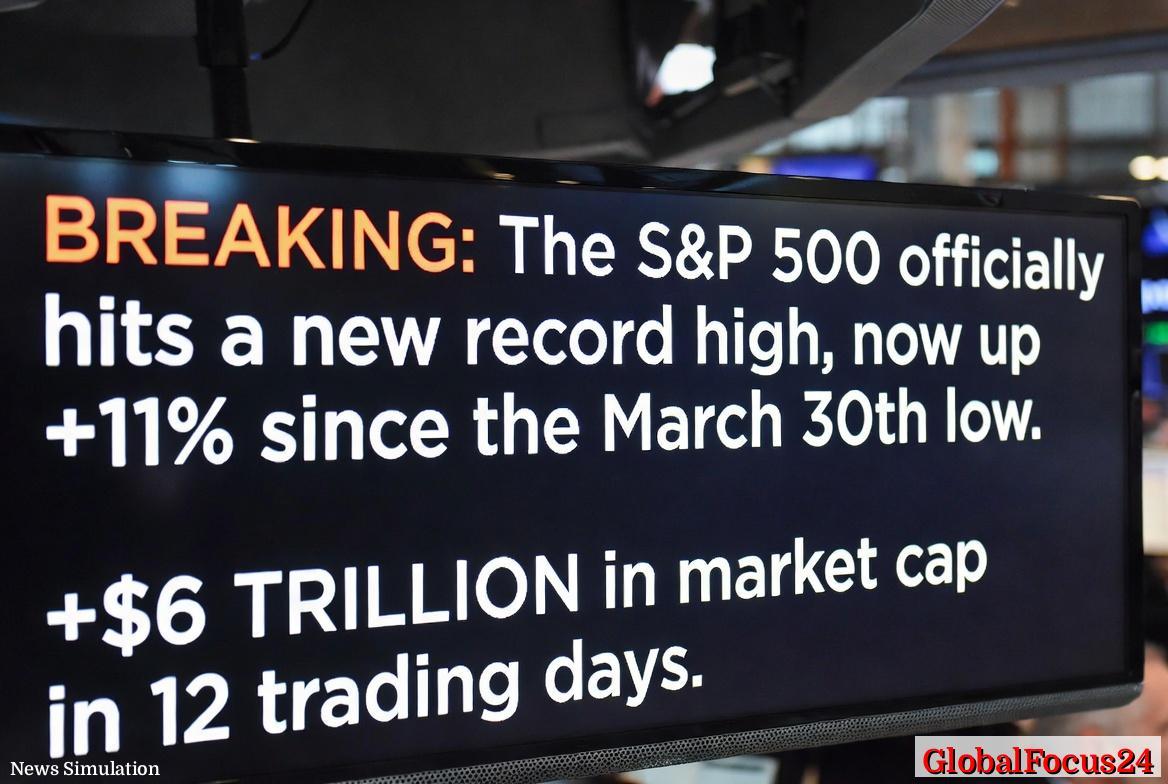
In a remarkable turnaround that has captured global attention, the S&P 500 has surged to an all-time record high, rising 11 percent from its low on March 30 and adding an extraordinary $6 trillion in total market capitalization in just 12 trading days. The index’s rapid ascent marks one of the most significant short-term recoveries in modern U.S. financial history, underscoring investors’ renewed confidence in corporate earnings strength, easing inflationary pressures, and expectations for a soft economic landing.
This rally—which has lifted nearly every major sector—reflects mounting optimism that the Federal Reserve’s tightening cycle may be ending, coupled with robust demand in technology and industrial stocks. As the benchmark index now sits comfortably above prior peaks set in late 2024, analysts and portfolio managers alike are reassessing what the new era of market leadership may look like.
Historical Context and Market Momentum
The S&P 500’s rally since late March places it among the fastest climbs to record levels since the recovery from the COVID-19 downturn in mid-2020. Historically, such bursts of momentum have often followed periods of investor uncertainty. In this case, a string of encouraging inflation readings, stabilizing Treasury yields, and a surprisingly resilient labor market have fueled hopes that the economic cycle remains durable even after two years of aggressive monetary policy tightening.
The historical pattern is clear: periods of market weakness followed by decisive rebounds often serve as launching points for longer-term bull markets. In the early 1980s, following the Federal Reserve’s war on inflation, stocks soared as interest rates normalized. A similar dynamic occurred after the 2008 global financial crisis, when stimulus measures and technological innovation reshaped the market’s outlook. The current phase shares several of these traits—an improving inflation backdrop, strong balance sheets among top corporations, and renewed consumer spending momentum.
Sector Leaders Powering the Rally
Technology continues to dominate as the primary engine of the market’s expansion, driven by investor enthusiasm around artificial intelligence, cloud computing, and semiconductor innovation. Major chipmakers have seen double-digit gains since the end of March, while large-cap software and internet firms have also rebounded sharply.
Financials have joined the surge, with large banks benefiting from improved credit outlooks and a potential pivot in monetary policy. Industrials and energy producers, often seen as barometers of real economic activity, have climbed as well—suggesting the rally extends beyond the often tech-heavy leadership of prior years.
Consumer discretionary stocks, buoyed by stronger-than-expected retail sales and household spending, are also contributing. The breadth of participation has encouraged analysts who interpret broad sector engagement as a sign of sustainable market health rather than a narrow, tech-driven spike.
Economic Drivers Behind the Upswing
Underlying the index’s rise is a combination of easing inflation data and confidence in continued U.S. economic growth. The latest consumer price index reports have shown a gradual softening in price increases across goods and services, while wage growth has moderated without undercutting employment levels. Investors see this as evidence that inflation is cooling fast enough to allow the Fed to consider rate cuts later this year.
Bond yields have stabilized, providing relief for both equity valuations and mortgage markets. The 10-year Treasury yield, which briefly topped 4.5 percent in late March, has retreated below 4.2 percent—helping lift growth-sensitive sectors such as housing and technology. Corporate earnings, meanwhile, have exceeded expectations, with several major U.S. companies raising forecasts for the remainder of 2026.
Despite lingering concerns around global demand and trade friction, domestic fundamentals remain comparatively strong. Consumer sentiment surveys have improved notably, with U.S. households displaying confidence in job security and income growth. Business investment, particularly in automation and clean energy infrastructure, has provided additional support for GDP expansion.
Comparison with Global Markets
The U.S. rally stands out particularly against a backdrop of more tempered performance in international markets. The major European indices have trended upward but at a slower pace, constrained by uneven growth across the eurozone and ongoing policy uncertainty. In Asia, markets remain mixed. Japan’s Nikkei index has also touched multi-decade highs this year, fueled by corporate reforms and robust export demand, while China’s mainland markets have struggled under the weight of a slow property recovery and subdued consumer confidence.
Investors worldwide are watching the S&P 500’s trajectory as an indicator of capital market resilience and global liquidity conditions. The index’s rebound has also encouraged renewed inflows into U.S. equities from foreign institutional investors, reversing outflows seen earlier in the quarter. For global asset managers, diversification strategies are being reviewed in light of the U.S. economy’s relative strength and consistent productivity growth.
Corporate Outlook and Investment Flow
Earnings season has reinforced the market’s bullish sentiment. Large technology and industrial companies have reported not only stronger profits but expanding margins, suggesting successful cost management and sustained consumer demand even in a slower global economy. Cash-rich balance sheets across major corporations have fueled share buybacks and dividend announcements, further underpinning investor enthusiasm.
Institutional investors, including pension funds and sovereign wealth entities, have accelerated their equity allocations amid improving risk appetite. Retail participation is also notable, with trading volumes climbing steadily since early April as investors re-enter positions they exited during the first-quarter volatility. Exchange-traded funds (ETFs) linked to the S&P 500 have seen some of the largest inflows since 2021.
Private equity and venture capital activity, which had cooled during the period of higher interest rates, are showing early signs of revival. Analysts note increased deal flow in technology infrastructure, renewable energy, and advanced manufacturing—all sectors that align with longer-term growth themes supported by federal industrial policy and private investment incentives.
Economic and Policy Implications
The sharp appreciation in market capitalization—adding $6 trillion in under two weeks—has wider implications beyond Wall Street. For the U.S. Treasury, higher asset valuations have potential downstream effects on capital gains tax revenues, while for corporations, increased stock prices can lower borrowing costs and bolster investment capacity. The rally also boosts household wealth through 401(k)s, IRAs, and brokerage accounts, contributing to broader economic confidence.
Monetary policymakers are watching closely. The Federal Reserve has signaled its intention to remain data-dependent, but the rise in equity valuations could reignite debate over potential “asset overheating.” Still, most economists agree that the strength of underlying earnings and absence of broad speculative excess differentiates today’s rally from past bubbles.
In the labor market, the wealth effect from appreciating equities may spur additional consumer spending, but wage and price stability remain priorities for policymakers seeking to balance growth with inflation control. If corporate performance continues to exceed expectations, the probability of a soft landing scenario—lower inflation without major job losses—may strengthen.
Lessons from Past Market Highs
History offers cautionary tales and encouragement alike. Previous record-setting rallies often sparked concerns about valuations, only to be followed by extended advances when macroeconomic conditions aligned. In the mid-1990s, for instance, similar doubts preceded several years of uninterrupted growth as technological transformation reshaped productivity and business efficiency. Likewise, in the aftermath of the 2020 pandemic crash, the market’s rapid recovery reflected both unprecedented stimulus and long-term shifts toward digital infrastructure.
Today’s environment features echoes of both periods—innovative industries redefining productivity, monetary conditions reaching a turning point, and investors adjusting to a maturing bull market still supported by robust fundamentals. Analysts suggest that while volatility could persist, the underlying drivers of corporate profitability remain intact.
Regional Comparisons and Future Outlook
Compared with peer economies, the U.S. equity market has displayed remarkable agility in adapting to shifting macroeconomic signals. Canada’s TSX, though up modestly, trails the S&P 500 as energy prices have moderated. In contrast, some emerging markets, particularly in Latin America, have benefited from commodity demand but face currency risk. The U.K. market continues to deliver steady but slower gains amid subdued growth and higher financing costs.
For American investors, the S&P 500’s record high serves as both a milestone and a potential inflection point. With valuations rising, attention will turn to whether earnings growth can sustain investor expectations through the remainder of the year. Much will depend on inflation trends, Federal Reserve decisions, and global supply chain stability.
Despite the swift pace of recent gains, most portfolio strategists maintain a cautiously constructive view. They anticipate moderate pullbacks as natural after such a steep ascent but continue to see long-term opportunity driven by innovation, productivity improvements, and stable consumer fundamentals.
A Defining Moment for U.S. Equities
The S&P 500’s record-breaking climb has reaffirmed the enduring resilience of U.S. markets amid rapidly changing economic conditions. Adding $6 trillion in market capitalization in less than two weeks underscores both investor conviction and the powerful influence of confidence, data, and policy alignment on modern markets. As the world’s largest equity benchmark enters a new phase of expansion, attention now turns to how corporations and policymakers balance growth with stability in an increasingly interconnected global economy.
What began as a tentative recovery in late March has evolved into a defining chapter of 2026’s financial story—a potent reminder that optimism, once sparked, can spread swiftly across both trading floors and households alike.