Foreign Investors Flock to Chinese Bonds as Global Markets Rebalance
Surge in Overseas Demand Reaches Historic Highs
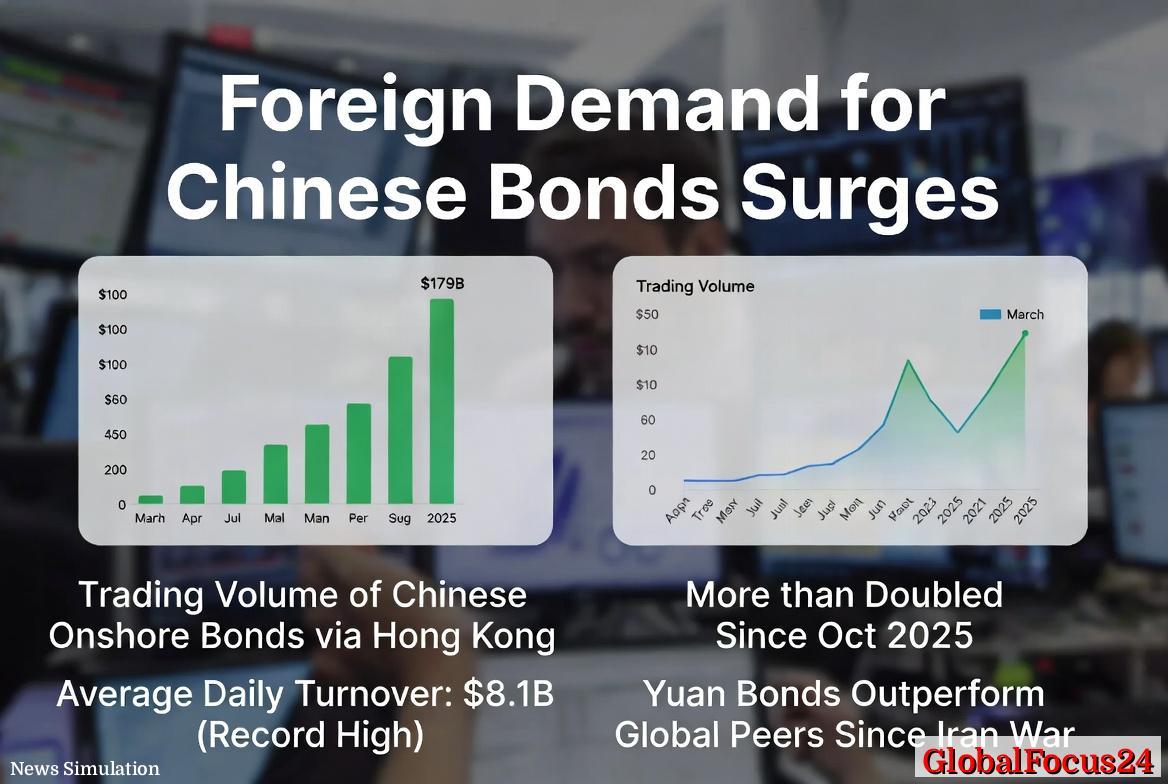
Foreign demand for Chinese onshore bonds has climbed to unprecedented levels, signaling a notable shift in global capital flows amid rising geopolitical uncertainty. In March, overseas investors traded a record $179 billion worth of yuan-denominated bonds through Hong Kong’s cross-border access channels, marking the highest monthly volume on record.
Average daily turnover reached $8.1 billion, another milestone that underscores the intensity of foreign participation. Trading activity has more than doubled since October 2025, reflecting both heightened investor interest and changing perceptions about the role of Chinese fixed-income assets in global portfolios.
The surge comes as international investors increasingly look beyond traditional safe-haven assets, particularly U.S. Treasuries, in response to ongoing geopolitical tensions and shifting macroeconomic conditions.
Safe-Haven Status Under Review
Historically, U.S. government bonds have served as the cornerstone of global safe-haven investing, attracting capital during times of uncertainty. However, recent geopolitical developments, including the ongoing Iran conflict, have prompted investors to reassess risk exposure and diversification strategies.
Concerns about inflation volatility, fiscal deficits, and fluctuating interest rate expectations in Western economies have contributed to a gradual repositioning. In this context, Chinese government and policy bank bonds—denominated in yuan—have emerged as a compelling alternative.
Unlike many global markets, China’s bond market has shown relative stability during the recent period of turmoil. Analysts point to several factors driving this trend, including controlled inflation, ample domestic liquidity, and a monetary policy stance that has remained comparatively accommodative.
Performance Advantage Amid Global Turbulence
Chinese bonds have outperformed many global peers since the onset of the Iran conflict, attracting attention from institutional investors seeking consistent returns with lower volatility. While yields in developed markets have fluctuated amid policy uncertainty, Chinese bonds have maintained a more stable trajectory.
This performance has been supported by China’s limited direct exposure to energy price shocks, which have disrupted economies heavily reliant on imported fuel. In contrast, China’s diversified energy strategy and state-managed pricing mechanisms have helped buffer the domestic economy from sharp external swings.
Additionally, the People’s Bank of China has maintained a liquidity environment that supports bond market stability. Targeted policy measures and controlled credit expansion have ensured that funding conditions remain favorable for both issuers and investors.
Hong Kong’s Role as a Financial Gateway
Hong Kong continues to play a central role in facilitating foreign access to China’s onshore bond market. Programs such as Bond Connect have streamlined the process for overseas institutions, allowing them to trade mainland bonds without the need for full domestic market entry.
The record $179 billion in March trading volume underscores the effectiveness of these channels. International asset managers, sovereign wealth funds, and central banks have increasingly utilized Hong Kong-based infrastructure to gain exposure to yuan-denominated securities.
Market participants note that improvements in settlement systems, transparency, and regulatory alignment have further enhanced investor confidence. These developments have contributed to the rapid scaling of foreign participation over the past several years.
Historical Context: Gradual Opening of China’s Bond Market
China’s bond market, now the second largest in the world, has undergone a gradual process of internationalization over the past two decades. Initially dominated by domestic banks and state institutions, the market began opening to foreign investors in the early 2010s through quota-based programs.
Subsequent reforms simplified access rules and expanded eligibility, culminating in the launch of Bond Connect in 2017. Since then, foreign holdings of Chinese bonds have steadily increased, though they still represent a relatively small share of the overall market.
The recent surge in activity represents a significant acceleration of this long-term trend. It reflects not only improved access but also a shift in global investment strategies, as institutions seek diversification beyond traditional Western markets.
Economic Implications for China
The influx of foreign capital into Chinese bonds carries several economic implications. Increased demand for government and policy bank securities can help stabilize borrowing costs and support fiscal initiatives, particularly during periods of economic adjustment.
Stronger foreign participation also contributes to the internationalization of the yuan, as cross-border transactions and holdings expand. While the currency remains less widely used than the U.S. dollar or euro, sustained investment inflows could gradually enhance its global role.
Moreover, deeper integration with global financial markets may encourage further reforms in transparency, governance, and risk management within China’s financial system. These changes could, in turn, reinforce investor confidence and sustain long-term growth in foreign participation.
Regional Comparisons and Global Positioning
Compared to other emerging markets, China’s bond market offers a unique combination of scale, liquidity, and relative stability. While countries in Southeast Asia and Latin America have also attracted foreign inflows, their markets are generally smaller and more sensitive to external shocks.
In Japan, government bonds remain a major safe-haven asset, but ultra-low yields have limited their appeal to return-seeking investors. European sovereign bonds, meanwhile, face ongoing challenges related to fiscal fragmentation and uneven economic performance across the region.
Against this backdrop, Chinese bonds occupy a middle ground—offering higher yields than developed markets while maintaining lower volatility than many emerging market peers. This positioning has made them increasingly attractive as part of diversified global portfolios.
Risks and Considerations
Despite the strong inflows, investors remain mindful of potential risks associated with Chinese bonds. Currency fluctuations, regulatory changes, and geopolitical developments could all influence market dynamics.
The yuan’s exchange rate, while relatively stable in recent months, remains subject to policy management and external pressures. For foreign investors, currency risk is a key consideration when evaluating returns.
Additionally, differences in market structure and legal frameworks can pose challenges. While access has improved significantly, some investors continue to monitor issues related to transparency, credit risk assessment, and settlement processes.
Nevertheless, many institutional investors view these risks as manageable within a diversified portfolio, particularly given the potential benefits of exposure to a large and evolving market.
Outlook for Global Bond Markets
The record surge in foreign demand for Chinese bonds highlights a broader transformation in global fixed-income markets. As geopolitical tensions reshape investment flows and economic conditions diverge across regions, investors are increasingly seeking new sources of stability and return.
China’s bond market, once relatively isolated, is now playing a more prominent role in this evolving landscape. Continued inflows will likely depend on a combination of domestic policy stability, global economic trends, and the ongoing development of financial infrastructure.
If current conditions persist, analysts expect foreign participation to remain strong in the near term, potentially setting new records in trading volume and holdings. Over the longer term, the trajectory of China’s bond market will be shaped by both internal reforms and its integration into the global financial system.
The recent surge in activity marks a significant moment in that process, reflecting not only immediate market dynamics but also deeper structural changes in how and where global capital is deployed.