Iran Parliament Speaker Draws Parallels Between Oil “Vibe-Trading” and Treasury Market Sentiment Amid Hormuz Volatility
Rising Tensions Spotlight Market Behavior
Recent remarks from Iran’s Speaker of Parliament have brought renewed attention to how global financial markets react during periods of geopolitical stress, particularly around the strategically vital Strait of Hormuz. The Speaker compared what he described as “vibe-trading” in digital crude oil markets with “vibe-hedging” in U.S. Treasury markets, arguing that both systems rely heavily on perception and sentiment rather than purely on physical supply or macroeconomic fundamentals.
The comments followed reports that approximately $760 million in oil short positions were placed just 21 minutes before Iran reopened the Strait of Hormuz after a temporary disruption. That timing has intensified scrutiny of speculative trading behavior and the role of anticipatory positioning in energy and financial markets.
Understanding “Vibe-Trading” in Oil Markets
The concept of “vibe-trading,” as referenced in the remarks, reflects a broader trend in modern commodity markets where algorithmic trading, sentiment analysis, and geopolitical signals can move prices rapidly—even in the absence of immediate supply changes.
Crude oil, traditionally considered a fundamentals-driven commodity, has increasingly become sensitive to real-time information flows. Traders monitor shipping routes, satellite imagery, political statements, and even social media signals to anticipate disruptions. In high-risk regions like the Strait of Hormuz, where roughly one-fifth of global oil supply passes daily, even the perception of instability can trigger sharp price movements.
However, the Speaker emphasized that oil markets still maintain a structural anchor: the Dated Brent benchmark. This pricing mechanism reflects physical cargo transactions in the North Sea and serves as a global reference point for crude oil pricing. Despite short-term volatility driven by speculative positioning, Dated Brent provides a tangible link to real-world supply and demand.
Treasury Markets and Sentiment-Driven Dynamics
In contrast, U.S. Treasury markets—widely regarded as the safest asset class globally—operate differently. During periods of geopolitical uncertainty, investors often move capital into Treasuries in a classic “risk-off” trade. This behavior can push yields lower and prices higher, sometimes independent of underlying economic indicators.
The Speaker’s characterization of Treasuries as driven “solely by market sentiment” reflects a critique often voiced by analysts who argue that safe-haven flows can become self-reinforcing. When risk perception rises, demand for Treasuries increases, further validating the initial move regardless of actual economic conditions.
While this view simplifies a complex market—Treasuries are influenced by monetary policy, inflation expectations, and fiscal dynamics—it underscores a key point: both oil and bond markets can experience rapid shifts driven by collective psychology.
Hormuz as a Global Chokepoint
The Strait of Hormuz has long been one of the most critical maritime corridors in the world. Connecting the Persian Gulf with the Gulf of Oman and the Arabian Sea, it serves as a primary export route for oil producers including Saudi Arabia, Iraq, the United Arab Emirates, Kuwait, and Iran itself.
Historically, disruptions in the strait have triggered immediate reactions in global energy markets. During the Iran-Iraq War in the 1980s, tanker attacks led to sharp price spikes. More recently, incidents involving seized vessels, drone strikes, and military tensions have periodically rattled markets.
The latest episode, which saw a temporary closure followed by a reopening, fits into this broader pattern. What distinguishes the current environment is the speed at which financial markets react—and the scale of capital involved in short-term positioning.
The $760 Million Question
The reported $760 million in oil short positions placed shortly before the reopening has raised questions about information flow and market efficiency. Such trades suggest that certain participants anticipated a de-escalation, betting that oil prices would fall once the strait resumed normal operations.
Short selling in oil markets is not unusual, particularly during periods of elevated prices. However, the timing of these positions—just minutes before a major geopolitical development—has drawn attention from analysts and market observers.
Whether these trades were based on sophisticated analysis, insider knowledge, or probabilistic risk assessment remains unclear. What is evident is that large-scale speculative activity can amplify price swings, especially in markets already on edge.
Digitalization and the Evolution of Oil Trading
The Speaker’s reference to “digital crude oil prices” points to the increasing digitization of commodity trading. Electronic platforms, high-frequency trading systems, and data-driven strategies now dominate the landscape, reducing the role of traditional floor trading.
This transformation has brought greater liquidity and efficiency but has also introduced new complexities. Price movements can occur in milliseconds, driven by algorithms that respond to keywords,s, and statistical patterns.
In this environment, the line between fundamental trading and sentiment-driven speculation can blur. A singleabout a potential disruption in Hormuz can trigger automated buying or selling, creating a feedback loop that amplifies volatility.
Economic Implications for Energy Markets
Fluctuations in oil prices have far-reaching economic consequences. For oil-exporting countries, higher prices can boost revenues and support fiscal stability. For import-dependent economies, however, price spikes can increase inflationary pressures and strain trade balances.
The recent volatility linked to Hormuz underscores the fragility of global energy supply chains. Even temporary disruptions—or the perception of them—can ripple through markets, affecting everything from fuel prices to transportation costs.
In the United States, for example, oil price movements influence gasoline prices, which in turn affect consumer spending and inflation metrics. In Asia, where many countries rely heavily on imported energy, sustained price increases can impact industrial output and economic growth.
Regional Comparisons: Middle East vs. Other Energy Corridors
While the Strait of Hormuz remains the most prominent chokepoint, other regions also play critical roles in global energy logistics.
The Strait of Malacca, connecting the Indian Ocean to the Pacific, is another vital route for oil shipments դեպի East Asia. Disruptions there could similarly impact global markets, though the geopolitical dynamics differ.
In contrast, North America benefits from a more diversified energy infrastructure, including pipelines and domestic production. The U.S. shale revolution has reduced reliance on imported oil, insulating the economy to some extent from external shocks.
Europe, meanwhile, has faced its own energy challenges in recent years, particularly following disruptions in natural gas supplies. The region’s experience highlights the importance of diversification and strategic reserves in managing supply risks.
Market Psychology and the “House of Cards” Analogy
The Speaker’s description of both oil and Treasury markets as “one house of cards that works on paper” reflects a broader चिंता about the stability of modern financial systems. While the analogy may be provocative, it captures a real tension between perceived value and underlying fundamentals.
Financial markets, by design, are forward-looking. Prices reflect expectations about future events, not just current conditions. This makes them inherently sensitive to changes in sentiment, especially during periods of uncertainty.
However, markets also have mechanisms that anchor them over time. In oil, physical supply and demand eventually assert themselves. In Treasuries, central bank policy and economic data provide a framework for valuation.
The interplay between these forces—sentiment and fundamentals—defines market behavior, particularly in volatile environments.
The Role of Benchmarks in Stabilizing Markets
One of the key distinctions highlighted in the remarks is the role of benchmarks. The Dated Brent index serves as a cornerstone of global oil pricing, providing a reference point that reflects actual cargo transactions.
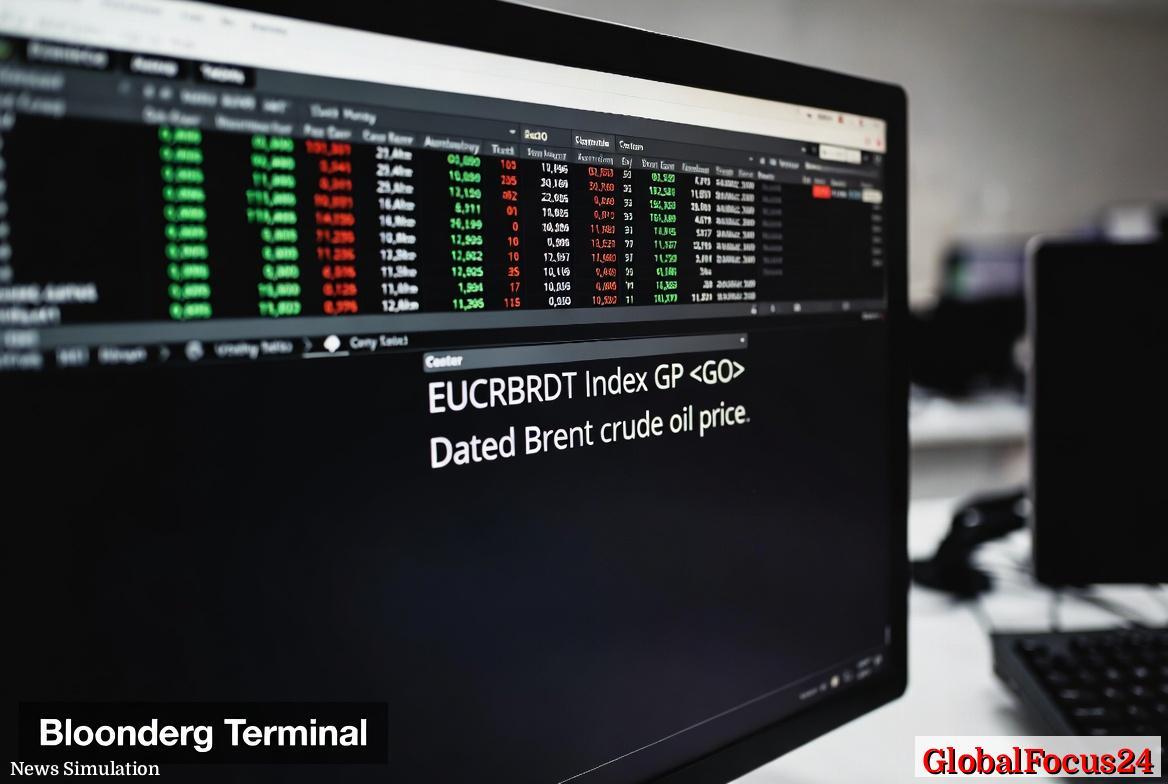
The mention of the Bloomberg Terminal command “EUCRBRDT Index GP <GO>” underscores the centrality of this benchmark in professional trading environments. By offering transparency and consistency, such indices help stabilize markets, even amid short-term volatility.
In contrast, the Treasury market lacks a single equivalent benchmark tied to physical transactions. While yields on specific maturities—such as the 10-year Treasury—serve as reference points, they are influenced by a wide range of factors, including investor behavior.
Looking Ahead: Volatility as the New Normal
As geopolitical tensions persist and financial markets continue to evolve, episodes like the recent Hormuz disruption are likely to become more frequent—and more impactful.
The combination of digital trading platforms, globalized capital flows, and real-time information dissemination means that markets can react faster than ever before. This increases both opportunities and risks for investors.
For policymakers and market participants, the challenge lies in balancing efficiency with stability. Ensuring transparency, monitoring speculative activity, and maintaining robust benchmarks will be critical in navigating an increasingly complex landscape.
The latest developments serve as a reminder that in today’s interconnected world, the line between physical events and financial reactions is thinner than ever—and the consequences of that connection can be both immediate and far-reaching.