Global Markets Tumble as Strait of Hormuz Closure Sends Oil Prices Soaring
U.S. stock market futures fell sharply in early trading as escalating tensions in the Middle East rattled global investors, following reports that Iran has closed the Strait of Hormuz and ceasefire negotiations with the United States have stalled. The sudden geopolitical shock triggered a broad selloff across equities while sending energy prices sharply higher, underscoring the fragility of global markets amid renewed conflict risks.
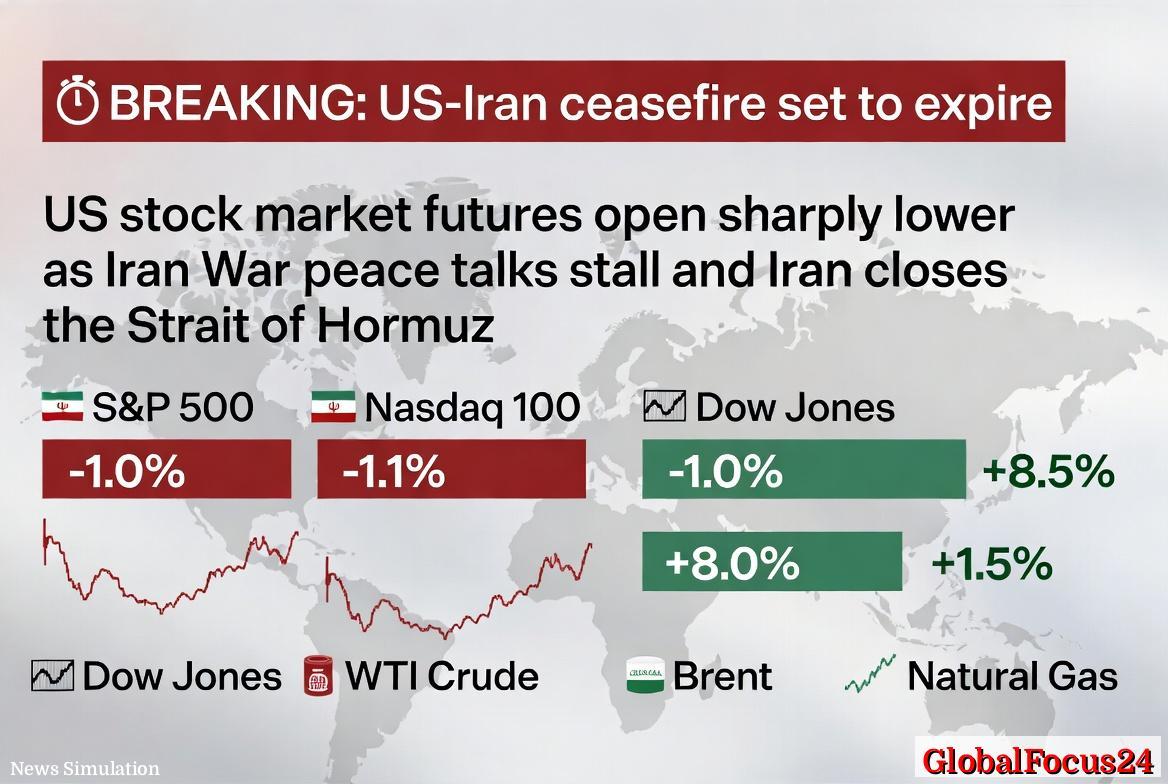
Futures tied to the S&P 500 dropped 1.0 percent, while Nasdaq 100 futures declined 1.1 percent. Dow Jones Industrial Average futures also fell by 1.0 percent, reflecting widespread concern across sectors. Meanwhile, oil markets surged in response to the supply disruption, with West Texas Intermediate crude jumping 8.5 percent and Brent crude rising 8.0 percent. Natural gas prices posted a more modest increase of 1.5 percent.
Strategic Waterway at the Center of Global Energy Flows
The Strait of Hormuz, a narrow passage connecting the Persian Gulf to the Arabian Sea, is one of the most critical chokepoints in global energy infrastructure. Roughly 20 percent of the world’s oil supply passes through this corridor daily, making any disruption to shipping traffic an immediate concern for energy markets and global trade.
Iran’s move to close the strait marks a significant escalation in regional tensions. The action comes just days before a temporary ceasefire between Iran and the United States is set to expire, raising fears of a broader military confrontation. Shipping firms and energy companies have already begun rerouting vessels or halting transit altogether, amplifying concerns over supply shortages.
Historically, even the threat of disruption in the Strait of Hormuz has triggered volatility in oil markets. During the 1980s Iran-Iraq War, attacks on oil tankers in the Gulf led to what became known as the “Tanker War,” significantly affecting global oil prices. More recently, incidents involving tanker seizures and drone strikes in the late 2010s underscored how quickly tensions in the region can reverberate through financial markets.
Energy Prices Surge Amid Supply Shock Fears
The sharp rise in oil prices reflects immediate concerns about reduced supply and logistical bottlenecks. Traders are pricing in the possibility that a prolonged closure of the strait could remove millions of barrels per day from the global market.
Brent crude, the international benchmark, surged 8.0 percent in early trading, while U.S.-based WTI crude climbed 8.5 percent. Analysts note that energy markets are particularly sensitive to geopolitical risks involving major oil-producing regions, and the Middle East remains central to global supply dynamics.
Natural gas prices also edged higher, though less dramatically, as markets assess whether disruptions in oil transportation might spill over into broader energy supply chains. In regions such as Europe and Asia, where energy imports are heavily reliant on Middle Eastern shipments, the impact could be more pronounced in the coming days.
Stock Markets React to Heightened Uncertainty
Equity markets responded swiftly to the escalating situation, with investors moving away from riskier assets. Technology stocks, which dominate the Nasdaq 100, were among the hardest hit, reflecting their sensitivity to interest rates and global economic stability.
The S&P 500’s decline highlights a broader pullback across sectors, including industrials, financials, and consumer discretionary stocks. The Dow Jones Industrial Average, often seen as a barometer of traditional industries, also posted a significant drop.
Market participants are increasingly concerned about the potential for higher energy costs to feed into inflation, which could complicate monetary policy decisions. Rising oil prices have historically contributed to inflationary pressures, as they increase transportation and production costs across the economy.
Economic Ripple Effects Across Regions
The economic implications of the Strait of Hormuz closure extend far beyond the United States. In Asia, major energy importers such as China, Japan, and South Korea are particularly vulnerable to disruptions in Middle Eastern oil supplies. These economies rely heavily on stable energy imports to sustain industrial output and economic growth.
European markets are also bracing for impact. Although the region has diversified its energy sources in recent years, particularly following disruptions linked to the Russia-Ukraine conflict, Middle Eastern oil remains a critical component of its energy mix.
In contrast, the United States, now one of the world’s largest oil producers, may be relatively insulated from direct supply shortages. However, global oil prices still influence domestic fuel costs, meaning American consumers could face higher gasoline prices in the near term.
Emerging markets, many of which are net energy importers, could experience the most acute economic strain. Higher energy costs can exacerbate trade deficits, weaken currencies, and increase inflationary pressures, potentially leading to tighter financial conditions.
Historical Context of Market Reactions to Geopolitical Crises
Financial markets have long demonstrated sensitivity to geopolitical events, particularly those involving energy supply disruptions. The 1973 oil embargo, for example, led to a quadrupling of oil prices and triggered a global economic downturn. Similarly, the Gulf War in 1990 caused a sharp spike in oil prices and significant volatility in equity markets.
More recent conflicts have shown a similar pattern, though often with shorter-lived effects. Advances in energy production, including the rise of U.S. shale oil, have somewhat mitigated the long-term impact of supply shocks. However, sudden disruptions still have the power to unsettle markets in the short term.
The current situation bears similarities to past crises but also reflects new dynamics, including the interconnectedness of global supply chains and the increasing role of algorithmic trading in amplifying market movements.
Investor Sentiment and Safe-Haven Assets
As uncertainty grows, investors are shifting toward traditional safe-haven assets. Gold prices have shown signs of upward movement, while U.S. Treasury bonds are attracting increased demand. These assets are typically seen as more stable during periods of geopolitical tension.
Currency markets are also reacting, with the U.S. dollar strengthening against several major currencies. A stronger dollar can have mixed effects, benefiting American consumers through cheaper imports while potentially weighing on U.S. exports.
Volatility indices, often referred to as fear gauges, have risen as traders brace for continued market swings. Analysts expect heightened volatility to persist until there is greater clarity بشأن the geopolitical situation and the status of the ceasefire.
Outlook as Ceasefire Deadline Approaches
With the U.S.-Iran ceasefire set to expire in two days, markets are likely to remain on edge. Diplomatic efforts to de-escalate tensions are ongoing, but the closure of the Strait of Hormuz suggests a hardening of positions.
Energy companies, shipping firms, and financial institutions are closely monitoring developments, preparing contingency plans for a range of scenarios. The potential reopening of the strait or a renewed ceasefire agreement could quickly reverse some of the market’s losses, while further escalation could deepen the economic impact.
For now, the convergence of geopolitical risk and market sensitivity has created a volatile environment, with investors navigating a complex landscape shaped by both immediate الأحداث and longer-term uncertainties.