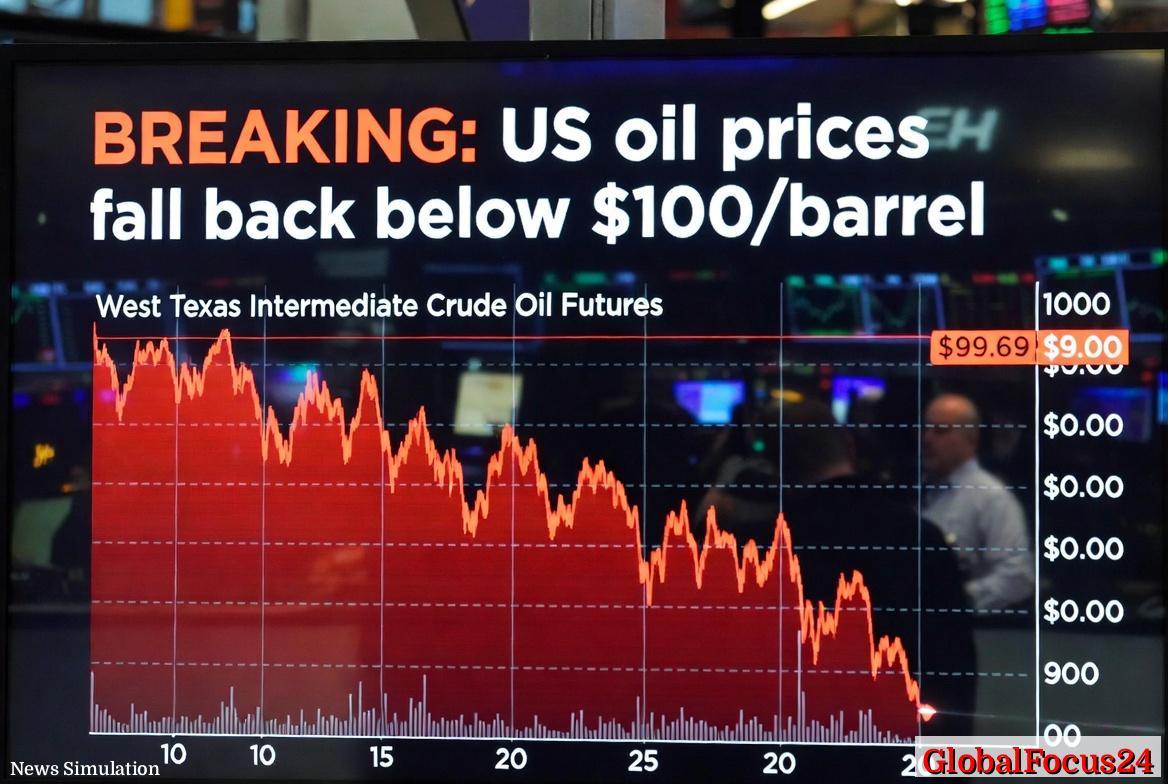
U.S. Oil Prices Slip Below $100 as Market Reverses on Global Supply Outlook
U.S. oil prices fell sharply on Monday, pulling West Texas Intermediate (WTI) crude futures below $100 per barrel in a sudden reversal that caught traders off guard. The benchmark U.S. contract dropped 4.3% intraday, settling near $99.69 per barrel after briefly touching session highs above $104 earlier in the morning. The move erased nearly all of last week’s gains, underscoring the market’s growing sensitivity to shifting supply expectations and broader global economic signals.
Market Reversal Reflects Shifting Supply Concerns
The decline marked one of the largest single-day reversals for crude this month, highlighting how swiftly sentiment can swing in energy markets driven by geopolitical tension and economic uncertainty. Oil futures had climbed in early trading amid renewed concerns over shipping disruptions in the Red Sea and potential supply constraints from the Middle East. Those gains unwound as reports circulated suggesting that crude production and export routes remained more stable than expected, easing immediate fears of a major supply shock.
Traders also cited stronger U.S. inventory data and increasing output from non-OPEC producers as key reasons for the selloff. In particular, the U.S. Energy Information Administration’s recent data indicated domestic production remains near record highs, exceeding 13 million barrels per day. Rising North American output continues to serve as a counterweight to global disruptions, anchoring prices even as geopolitical uncertainties persist.
A Volatile Year for Energy Markets
The sudden reversal came at a time when oil markets have already experienced intense price swings throughout 2026. Crude futures surged above $110 per barrel in February following escalations in Middle Eastern conflicts and attacks on commercial vessels transiting major chokepoints. Prices then moderated in March as diplomatic efforts temporarily eased fears of prolonged disruptions.
Analysts say these price gyrations reflect both geopolitical risk premiums and the inherent tension between short-term market psychology and longer-term fundamentals. While global demand remains healthy, particularly in the United States and parts of Asia, questions about economic growth in Europe and China have tempered bullish sentiment.
“Traders are navigating a complex mix of supply shocks and demand uncertainties,” said one New York–based commodities analyst. “Every minor development in shipping security or production outlook can trigger large swings because the market is skittish and highly reactive after two years of elevated volatility.”
Economic Implications for U.S. Consumers
For American consumers, the pullback in crude offers some potential relief after several weeks of climbing gasoline and diesel prices. At the pump, national averages have hovered just below $3.90 per gallon, according to industry surveys. If crude remains under $100, analysts expect those prices could ease modestly heading into late April, providing a limited but welcome buffer against broader inflation pressures.
However, refiners tend to adjust retail fuel prices more slowly during downswings, meaning any immediate consumer benefit may be muted. The U.S. government’s Strategic Petroleum Reserve, which was partially replenished earlier this year, gives policymakers some flexibility, but officials have signaled no plans to intervene in the current market, viewing the price movement as a natural correction rather than a crisis.
Economists note that while energy costs represent a smaller share of overall inflation than during the 1970s or early 2000s, sustained fluctuations in oil still influence everything from transportation expenses to manufacturing inputs. Lower prices may also ease freight costs, potentially improving profit margins across logistics and consumer goods sectors.
Historical Context: Cycles of Boom and Correction
Oil’s latest retreat echoes past episodes where price spikes driven by geopolitical fear have eventually given way to corrections once actual supply data failed to confirm worst-case scenarios. A similar pattern emerged in 2011 during the Arab Spring, when Brent crude briefly surged above $125 before correcting to below $100 within weeks as supply disruptions proved limited.
Historically, WTI crude prices above $100 per barrel have rarely held for long outside of exceptional disruptions or global crises. Analysts point to three distinct periods in modern history — 2008, 2011–2014, and early 2022 — when sustained triple-digit oil prices coincided with either rapid demand growth, severe supply constraints, or policy-driven sanctions. Each time, a combination of rising U.S. production and weakening global growth ultimately triggered reversals.
The U.S. shale revolution in the 2010s fundamentally reshaped this dynamic. As domestic producers became more capable of scaling output in response to higher prices, the ceiling for long-term oil price spikes effectively lowered. This built-in “supply elasticity” has again emerged in 2026’s market response, dampening the impact of regional instability on global prices.
Global Comparisons and Regional Market Divergences
Oil price movements have varied significantly by region this month. Brent crude, the international benchmark, also declined but held slightly stronger than WTI, trading near $103 per barrel on Monday afternoon. The smaller drop reflected tightening European inventories and intermittent North Sea maintenance, which have constrained local supply temporarily.
Asian buyers, meanwhile, remain cautious amid reports of softer demand growth from China. Refiners there have been drawing down existing stockpiles rather than making large new purchases, signaling expectations that prices could ease further. In contrast, Indian importers have maintained steady buying, viewing the recent dip as an opportunity to secure cheaper feedstock for the summer driving and power generation season.
Latin American producers, particularly Brazil and Guyana, continue to expand output volumes, further adding to global supply. Their growing presence on the export market has subtly shifted global trade flows, with more Atlantic Basin crude competing directly with Gulf Coast shipments to Europe and Asia.
The Role of OPEC+ Policy and U.S. Shale Dynamics
Attention now turns to the Organization of the Petroleum Exporting Countries and its allies, collectively known as OPEC+, which are scheduled to meet later this month. The group faces renewed pressure to balance market stability with revenue needs. Some analysts speculate that Saudi Arabia and its partners may delay any production cuts until prices stabilize to avoid intensifying volatility.
At the same time, U.S. shale operators, benefiting from improved drilling efficiency and lower per-barrel costs, have shown discipline in not overexpanding despite favorable price conditions earlier in the year. Many producers continue to prioritize balance-sheet strength and shareholder returns over aggressive volume growth — a shift from the rapid expansion mindset that defined the industry a decade ago.
Should WTI prices remain near or below $100 through the second quarter, producers may scale back capital expenditure plans marginally, though the impact would likely be modest given current hedging strategies and strong cash flows accumulated during the price surge of early 2026.
Broader Global Market Outlook
International energy forecasters remain divided on the medium-term trajectory for oil prices. The International Energy Agency recently maintained its forecast for moderate demand growth through the rest of 2026, supported by continued travel recovery and industrial consumption. However, slower growth in China and Europe could offset gains elsewhere, limiting the potential for sustained price rallies.
In financial markets, investors have grown less bullish on commodities overall. Hedge funds cut their net long positions in crude futures for the second consecutive week, reflecting both profit-taking and heightened caution. Analysts say this positioning shift could amplify price declines in the short run if additional bearish momentum builds.
Gold and U.S. Treasury yields also edged higher Monday, suggesting that investors are seeking safer assets amid ongoing uncertainty in the broader macroeconomic outlook. Meanwhile, the U.S. dollar strengthened slightly, adding further downward pressure on dollar-denominated commodities such as crude.
The Road Ahead for Energy Stability
The drop below $100 represents a psychological milestone for traders and policymakers alike. It reinforces the fragility of the energy market’s balance between fear and fundamentals. As supply routes in the Middle East remain vulnerable and a U.S. economic slowdown looms on the horizon, price volatility is likely to persist through the coming months.
For now, market observers expect WTI to trade within a relatively broad range between $95 and $105 per barrel until clearer signals emerge on both global demand recovery and geopolitical stability. Seasonal factors such as North American driving activity and refinery maintenance schedules could also add short-term fluctuations.
Ultimately, the sharp reversal in oil prices serves as a reminder of how quickly market sentiment can shift in an interconnected global economy. Despite technological advances, improved communication, and diversified supply chains, energy markets remain prone to abrupt corrections whenever confidence wavers. The challenge for producers and consumers alike lies in navigating that uncertainty — managing costs and expectations in a world where $100 oil may no longer mean what it used to.