US Stock Futures Slide as Iran Peace Talks Collapse; Oil Prices Surge Amid Looming Strait of Hormuz Blockade
Market Overview: Futures Tumble as Tensions Escalate
U.S. stock futures opened lower on Monday following reports that high-stakes peace talks between the United States and Iran ended without an agreement. The breakdown in negotiations has rattled global financial markets and triggered a sharp rise in energy prices, reflecting renewed geopolitical uncertainty in one of the world’s most critical oil transit corridors.
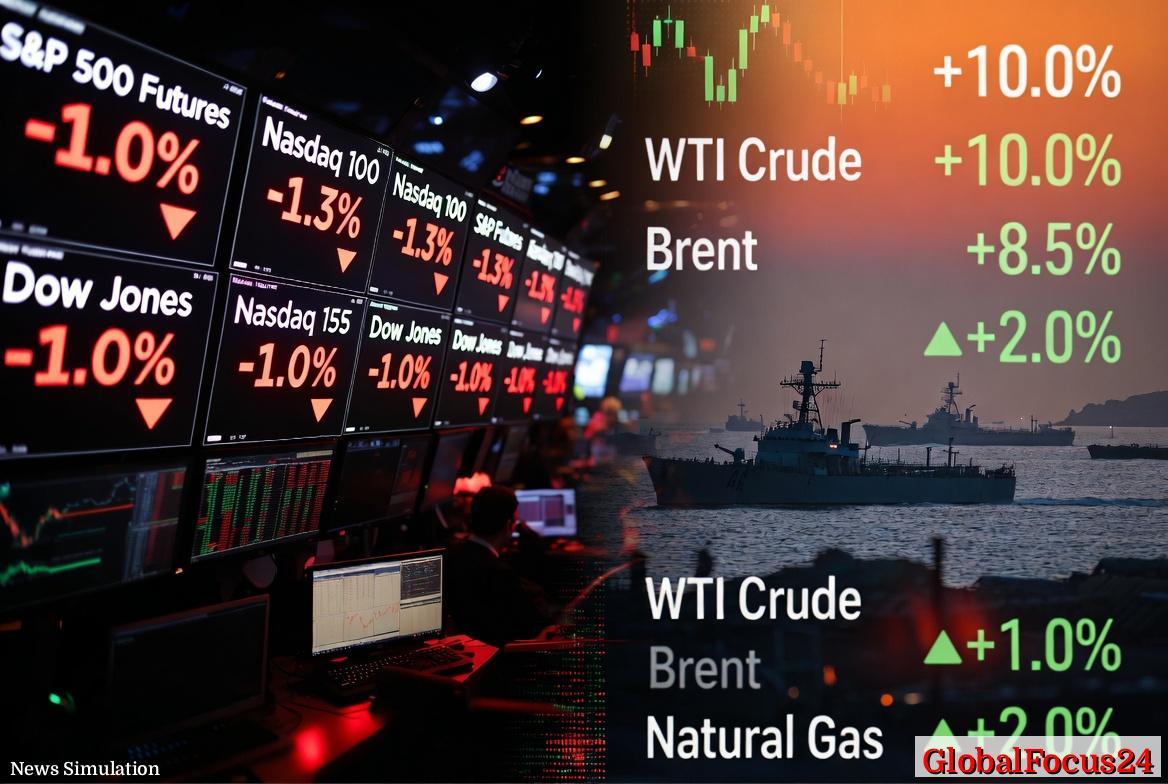
Shortly after premarket trading began, S&P 500 futures fell 1.0 percent, Nasdaq 100 futures declined 1.3 percent, and Dow Jones Industrial Average futures slipped 1.0 percent. The downturn comes amid fears that a military operation in the Middle East could disrupt global supply chains and intensify inflationary pressures already weighing on the global economy.
The U.S. military confirmed plans to begin a naval blockade of the Strait of Hormuz within 16 hours, a strategic choke point through which roughly one-fifth of the world’s crude oil passes. Investors are bracing for heightened volatility as markets price in the potential consequences of a prolonged standoff.
Energy Prices Soar as Traders Brace for Supply Shocks
Oil prices surged on the news, with West Texas Intermediate (WTI) crude jumping 10.0 percent to trade above $94 per barrel and Brent crude climbing 8.5 percent to nearly $98. Natural gas prices rose 2.0 percent, extending gains from last week’s rally.
The sharp move underscores how sensitive global energy markets remain to geopolitical disruptions. The Strait of Hormuz—situated between the Persian Gulf and the Gulf of Oman—is the lifeline of regional oil exports from Iran, Saudi Arabia, the United Arab Emirates, and Iraq. A blockade would likely restrict tanker movements and amplify supply bottlenecks that could reverberate far beyond the Middle East.
Energy analysts say traders are rushing to hedge against potential losses. “Every time there’s a credible military risk in the Gulf, crude futures react instantly,” said one commodities strategist based in Houston. “The fear isn’t just about lost barrels—it’s about duration. If this blockade lasts weeks rather than days, global inventories will tighten quickly.”
Global Financial Repercussions: Inflation and Volatility Risks
The timing of this escalation could not be more precarious. Global markets have been recovering from a year of uneven growth and sporadic inflation spikes stemming from pandemic-era fiscal support and supply chain challenges. Rising oil prices now threaten to reintroduce energy-driven inflation, which had recently shown signs of cooling.
Higher fuel costs could ripple across industries, from transportation and manufacturing to retail logistics, ultimately pushing consumer prices higher. Market strategists warn that sustained energy price pressure might complicate the Federal Reserve’s efforts to calibrate interest rate policy. Investors who had expected a steady glide toward rate cuts may now face renewed uncertainty.
Historically, geopolitical crises involving Iran have produced immediate and pronounced market reactions. During the 1979 Iranian Revolution, crude prices doubled within months, triggering stagflation in several Western economies. A similar dynamic emerged after the U.S. withdrawal from the Iran nuclear deal in 2018, when heightened sanctions spurred a temporary oil rally and increased regional instability.
Economically, such tensions often produce bifurcated results: energy exporters gain from price increases, while import-dependent economies face mounting fiscal strain. The U.S., though relatively insulated by domestic production, still bears indirect costs through global price linkages and heightened market volatility.
The Strait of Hormuz: Historical and Strategic Significance
The Strait of Hormuz has long been one of the world’s most sensitive maritime flashpoints. Roughly 20 percent of global oil shipments—about 21 million barrels per day—transit through its narrow passage. Any disruption could have cascading effects across global oil markets and regional trade.
Past incidents underscore the region’s fragility. In 2019, a series of tanker attacks near the strait sent crude prices soaring as the U.S. and Iran exchanged accusations of sabotage and retaliation. Naval confrontations and drone strikes have repeatedly tested the security infrastructure around this vital route.
With the U.S. military poised to begin a blockade, logistical experts warn that even short-term disruptions could stall crude flows. Oil-producing nations may reroute shipments via pipelines through Saudi Arabia and the UAE, but capacity remains limited compared with seaborne transport. As tensions mount, insurers are reportedly raising premiums for tankers operating in the region, adding additional pressure to global freight rates.
Investor Reaction: Seeking Safe Havens and Alternative Plays
In early Monday trading, investors appear to be shifting toward safer assets. Gold prices rose 1.8 percent, approaching $2,200 per ounce, while the dollar strengthened modestly against major currencies. Treasury bond yields edged lower as traders sought stability amid the geopolitical tumult.
Wall Street strategists anticipate increased hedging activity across equity and commodity derivatives. Energy sector shares—particularly firms involved in exploration and refining—are expected to outperform broader indices if crude remains elevated. Conversely, transportation and consumer discretionary stocks may face selling pressure as oil-linked input costs climb.
Market sentiment has turned sharply defensive, reminiscent of late 2022’s volatility during similar episodes of Middle Eastern unrest. Analysts note that uncertainty, rather than the precise scale of military operations, tends to drive immediate portfolio rebalancing.
Comparing Regional Impacts: Europe, Asia, and the Americas
The reverberations of a potential Gulf blockade extend beyond U.S. markets. European economies, already contending with energy price instability following reduced Russian gas flows, could see renewed strain as global oil benchmarks rise. In Asia, major importers such as Japan, South Korea, and China may face surging fuel costs, adding pressure to balance fragile post-pandemic recoveries.
Emerging economies, particularly those dependent on imported energy, are considered most vulnerable. A sustained spike in oil prices often widens trade deficits and weakens currencies, prompting central banks to intervene with rate hikes that can stifle growth. Latin American energy exporters like Brazil and Venezuela, however, may benefit from improved export revenues if global benchmarks remain elevated.
In North America, the response will be mixed. U.S. shale producers may gain from higher prices, though supply-chain constraints could limit short-term output increases. Canadian crude, which typically trades at a discount to global benchmarks, may narrow that spread as global buyers seek alternative sources.
Historical Parallels and Outlook
Market historians draw parallels between the current turmoil and previous oil shocks that reshaped economic strategy worldwide. The 1973 oil embargo by Arab producers against Western nations caused a quadrupling of oil prices and forced governments to rethink energy independence. Similarly, the Gulf War in 1990 briefly disrupted supply channels, sending crude up more than 50 percent before stabilizing months later.
While the present situation remains fluid, economists caution that modern markets are better equipped to absorb temporary disruptions. Diversified energy supplies, improved storage infrastructure, and strategic reserves can cushion the immediate blow. Nonetheless, the psychological impact of military escalation in the world’s most important oil artery tends to amplify market reactions beyond fundamentals.
Should the blockade proceed as announced, analysts expect oil prices to remain volatile throughout the week. Refinery operators may preemptively ramp up output to secure supplies, while airlines and shipping companies could implement fuel surcharges. Global attention will remain fixed on diplomatic channels to assess whether renewed negotiations might defuse the situation before more significant disruptions occur.
Broader Economic Implications and Next Steps
The interplay between financial markets and geopolitical developments will dominates in the coming days. For investors, the focus now centers on risk management—balancing exposure to energy commodities against potential losses in equities. Policymakers must simultaneously navigate the delicate equilibrium between maintaining military posture and avoiding global economic fallout.
Business leaders are reportedly monitoring logistical developments closely. Several multinational manufacturers with Middle Eastern supply routes have activated contingency plans to reroute shipments or secure emergency fuel contracts. Shipping companies have begun warning clients of potential delays and cost overruns should maritime restrictions tighten further.
In Washington, economic advisors are said to be evaluating potential measures to mitigate domestic energy inflation, including release options from the Strategic Petroleum Reserve. Any policy announcement could have immediate influence on futures prices and investor sentiment.
Outlook: Fragile Calm Amid Uncertain Waters
As global markets digest the failed talks and looming blockade, traders are bracing for a turbulent week. The convergence of geopolitics and economics highlights the ongoing vulnerability of interconnected supply systems. Even as negotiations remain stalled, many hope diplomatic intermediaries will reopen dialogue to prevent deeper conflict and long-term market instability.
For now, investors face a precarious balancing act—managing inflation risk, geopolitical exposure, and market volatility—all unfolding within hours of a military maneuver that could redefine global energy flows for months to come.