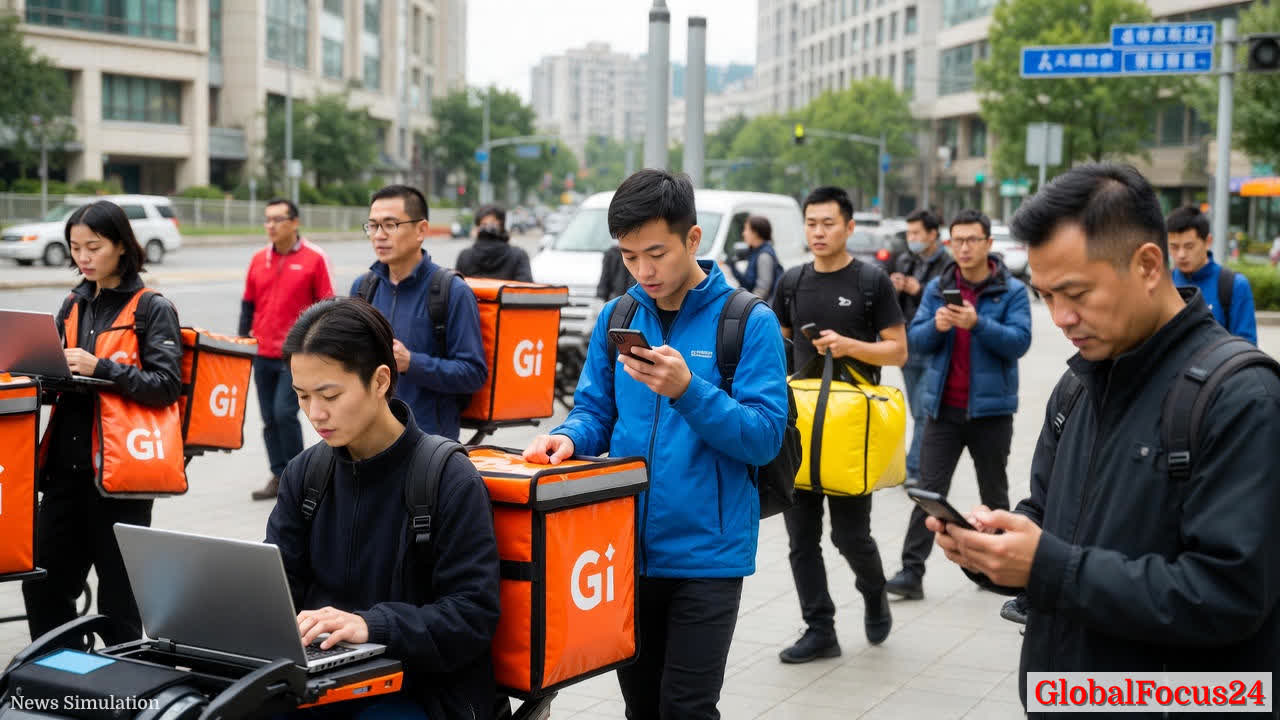
China’s Gig Economy: A Modern Labor Surge Reconfiguring Growth, Risk, and Resilience
China’s labor market is undergoing a sweeping transformation as a vast gig economy reshapes how work is found, performed, and valued. An estimated 200 million workers—roughly 40% of the country’s urban labor force—now rely on flexible, short-term engagements coordinated through digital platforms. This shift, fueled by smartphone ubiquity, industry digitization, and urban migration, marks a historic pivot away from traditional, long-term employment toward a more fluid, platform-enabled model. While the arrangement offers opportunities for income diversification, it also raises questions about stability, social protection, and long-term economic resilience.
Historical context: from planned certainty to flexible adaptability
China’s economic ascent over the past four decades has been driven by a blend of manufacturing scale, export orientation, and urban labor mobility. In the early years of reform and opening, secure factory jobs and state-led provisioning provided predictable ladders to middle-class status. As the economy diversified and technology accelerated, firms increasingly turned to agile labor arrangements to respond quickly to demand shifts, seasonal cycles, and regional development gaps. The rise of the gig economy sits at the intersection of these forces: the need for scalable manpower without the costs of full-time employment, coupled with workers seeking autonomy, supplemental income, and flexible schedules.
The current landscape reflects a layered ecosystem. At the bottom are delivery and logistics tasks that demand rapid response and geographic reach. Mid-level roles involve on-demand services such as errands, staffing for events, and micro-task work that can be completed remotely or locally. Higher-end platforms increasingly blend freelance specialization with digital brokerage, connecting professionals in areas like design, software development, content creation, and consultative services with clients who prize speed and niche expertise. This breadth underscores a broader redefinition of what constitutes “employment” in a digital era.
Economic impact: productivity gains, consumer behavior, and regional dynamics
The gig economy has produced measurable efficiencies for both firms and customers. For businesses, on-demand labor allows for cost alignment with real-time demand, reduced overhang during off-peak periods, and enhanced scalability across geographic markets. For consumers, gig work has translated into faster delivery times, more flexible service options, and broadened access to goods and experiences, particularly in urban centers where digital networks are dense.
Yet the macroeconomic implications extend beyond unit cost savings. The gig model influences household income composition, consumption patterns, and credit markets. When workers depend on multiple short-term gigs rather than a single long-term employer, income streams can become episodic or uneven. This volatility can ripple through consumer spending, housing markets, and financial services demand. In some urban economies, the immediacy of gig earnings sustains daily expenditures, while in others, long-term savings and investment planning may be hampered by uncertain pipelines of work.
From a regional perspective, tiered urban areas display divergent outcomes. Metropolitan hubs with mature digital ecosystems and robust platform penetration tend to generate higher gig-driven income opportunities and faster integration of services. Secondary cities, newly connected to logistics networks and e-commerce channels, may experience rapid job creation but also face growing pains in social protections, local regulation, and platform governance. The regional spread of gig work thus becomes a diagnostic of infrastructure readiness, digital literacy, and policy clarity.
Social and financial inclusion considerations
The rapid expansion of gig employment has illuminated both opportunities and gaps in social safety nets. Flexible work can empower students, caregivers, and second earners to participate in the labor force without sacrificing personal commitments. It also offers a lifeline for migrants and informal workers seeking income diversification in cities where traditional employment may be scarce.
However, the lack of universal employment benefits—health coverage, pension accrual, unemployment support, and access to credit under standard underwriting criteria—creates vulnerabilities. Many gig workers face income volatility, limited savings capacity, and restricted access to property loans or mortgages, undermining long-term financial security. This dynamic has drawn attention from policymakers and researchers who advocate for portable benefits, contributory schemes tied to earnings from multiple platforms, and more transparent wage standards.
Policy responses and regulatory considerations
Governments and institutions are increasingly examining how to preserve innovation while enhancing worker protections. Potential policy tools include:
- Portable benefits: systems that accumulate benefits across multiple gigs and platforms, ensuring health coverage, retirement contributions, and paid leave regardless of employer status.
- Earnings transparency: clearer disclosure of pay rates, platform fees, and average annual income to help workers plan and compare opportunities.
- Social protection linkage: bridging mechanisms that integrate gig earnings into broader social insurance programs, with flexible contribution structures aligned to fluctuating workloads.
- Tax and regulatory clarity: streamlined tax reporting for gig workers and guidelines for platform governance to prevent misclassification and ensure a level playing field among firms.
- Training and upskilling: accessible programs that help workers transition between gig roles and traditional employment when desired, aligning skill development with evolving market needs.
These measures aim to balance the dynamic benefits of flexible work with the security and predictability that underpin durable household financial health. Jurisdictions that design adaptable, forward-looking policies may foster environments where innovation and worker welfare reinforce each other, sustaining productivity gains without eroding social cohesion.
Global comparisons: lessons beyond national borders
China’s gig economy offers instructive parallels for other economies navigating similar transitions. In many large and mid-sized economies, digital platforms reshape labor demand by reducing search and transactional costs, enabling micro-entrepreneurship, and distributing tasks across a dispersed labor pool. The core tensions—income volatility, access to benefits, and the need for scalable governance—are shared concerns globally.
In Europe and North America, there is growing experimentation with portable benefits and portable retirement accounts that workers can carry across employers and platforms. In several Asian economies, rapid urbanization and expanding e-commerce mirror the Chinese experience, prompting policy innovation in social protection design. The central takeaway is that future job markets will demand policies that are flexible yet protective, ensuring that workers can adapt to shifting roles without sacrificing financial security or social participation.
Industry dynamics and technology trends
The gig economy’s momentum is closely tied to advances in digital platforms, data analytics, and mobile infrastructure. Real-time demand signaling, route optimization, and dynamic pricing enable platforms to match supply with demand efficiently. For workers, the interface between human labor and algorithmic management can determine earnings, scheduling, and task allocation. This relationship underscores the importance of transparency in algorithmic decision-making, fair compensation practices, and user-friendly interfaces that reduce cognitive load for workers.
Additionally, automation and artificial intelligence are likely to influence the gig landscape by automating routine tasks and enabling higher-skilled freelancing. As robots, sensors, and software handle more repetitive activities, the value proposition for human gig workers may shift toward roles requiring adaptability, creativity, and complex problem-solving. This evolution reinforces the case for continuous learning and career progression pathways within or alongside gig work.
Public perception and worker sentiment
Public reaction to gig work is nuanced. Many appreciate the autonomy and potential for diversified income streams, especially during times of economic flux. Others express concern about stability, wage adequacy, and the long-term sustainability of a work life dominated by short-term engagements. Community organizations, unions, and worker advocacy groups are increasingly vocal about the need for safeguards that protect earnings, reduce income gaps, and ensure access to essential services regardless of employment status. A balanced approach—one that fosters innovation while providing reliable security—appears to be the most widely supported public stance.
Conclusion: navigating toward a resilient, inclusive future of work
China’s vast gig workforce embodies a pivotal moment in the history of work. The scale of the shift—from stable, employer-driven career ladders to flexible, platform-enabled engagements—has the potential to redefine productivity, consumption, and social welfare for generations. The economic upside is clear: cost efficiency for businesses, rapid service delivery for consumers, and new avenues for income diversification for workers. The challenges, equally clear, center on stability, access to benefits, and long-term financial security.
As policymakers, businesses, and workers navigate this transition, the focus should be on constructing adaptive frameworks that encourage innovation while embedding social protections. Portable benefits, transparent earnings information, and targeted upskilling programs can help bridge the gap between flexibility and security. At the regional level, investing in digital infrastructure, financial inclusion, and education will maximize the positive spillovers of gig work, ensuring that growth is inclusive and sustainable.
The path forward will require collaboration among platform operators, government agencies, financial institutions, and civil society. By aligning incentives and clarifying responsibilities, it is possible to harness the benefits of a dynamic gig economy while safeguarding the welfare of the workers who fuel it. In doing so, China—and other nations watching closely—can chart a course to a more resilient, productive, and fair world of work in the decades ahead.