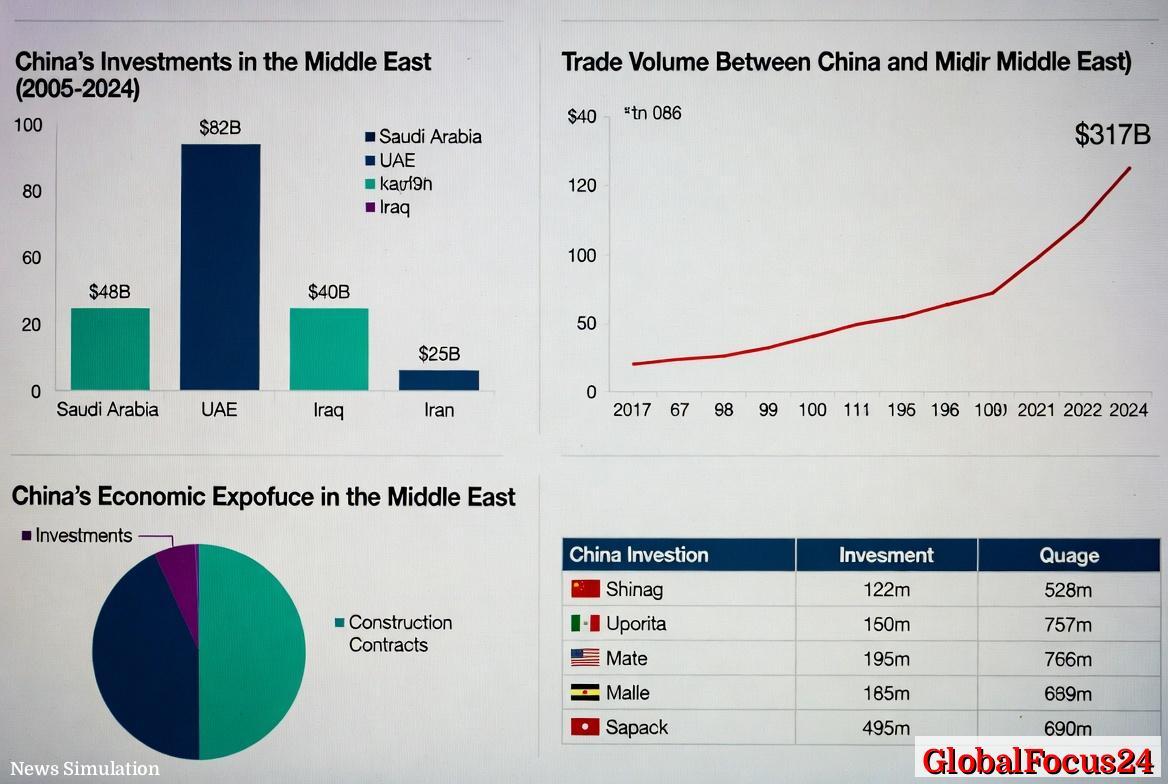
China Deepens Economic Footprint in the Middle East with $269 Billion in Investments and Construction Contracts
Expanding Economic Influence Across the Middle East
China’s accelerating financial presence in the Middle East has reached remarkable levels, with more than $269 billion committed to investments and construction contracts since 2005. The country’s growing involvement has positioned it as one of the most influential external economic partners in a region traditionally dominated by Western powers. The latest figures underscore Beijing’s long-term strategy to strengthen trade, infrastructure, and energy ties with Gulf nations amid shifting global economic alignments.
According to regional data, Saudi Arabia remains the largest recipient of Chinese capital, attracting nearly $82 billion in projects and deals. The United Arab Emirates (UAE) follows with $48 billion, while Iraq has secured $40 billion. Meanwhile, Iran, despite ongoing international sanctions and diplomatic strains, has drawn $25 billion in Chinese investments and infrastructure contracts.
This intensifying engagement reflects a deepening interdependence between China and Middle Eastern economies — a complex relationship driven by energy security, diversification goals, and a shared interest in infrastructure modernization.
Strategic Partnerships in Energy and Infrastructure
Energy remains the foundation of China’s engagement with the Middle East. As the world’s largest importer of crude oil, China sources a substantial share of its energy supply from the Gulf region. Saudi Arabia alone provides roughly one-fifth of China’s oil imports. This energy relationship has evolved beyond simple trade; it has expanded into joint refinery projects, renewable energy cooperation, and technology exchanges.
One of the flagship examples is the strategic partnership between Saudi Aramco and Chinese state-backed corporations in developing refining and petrochemical facilities both in Saudi Arabia and within China’s own borders. These ventures serve dual purposes—helping China secure stable energy routes while enabling Gulf nations to move up the value chain of energy production and reduce dependency on crude exports.
Infrastructure is another pillar of Chinese involvement. Beijing’s Belt and Road Initiative (BRI), launched in 2013, has injected significant momentum into the development of ports, highways, industrial zones, and digital infrastructure across the Middle East. In Dubai and Abu Dhabi, Chinese firms have participated in logistics and urban development projects aimed at transforming these hubs into global trade gateways connecting Europe, Asia, and Africa.
In Iraq, Chinese companies have contributed to rebuilding war-damaged infrastructure, particularly in the oil-rich southern regions. Meanwhile, Iran’s ongoing partnership with China has focused on energy production, transportation networks, and telecommunications—a pragmatic collaboration that offers Tehran much-needed foreign investment despite limited access to Western financing.
Trade Volume Quadruples as Regional Ties Deepen
The trade relationship between China and the Middle East has undergone exponential growth over the last decade. In 2024, bilateral trade surpassed $317 billion, marking more than a twofold increase since 2017. For comparison, trade between the Middle East and the United States in the same year totaled around $85 billion, highlighting the shifting economic balance in the region.
This rapid expansion underscores China’s success in positioning itself not only as an importer of oil but also as a key supplier of technology, consumer goods, and industrial equipment. Chinese firms have capitalized on rising demand in the Middle East for smart infrastructure, electric vehicles, and renewable energy technology.
Beyond trade figures, China’s financing of large-scale construction and technology projects has helped build stronger economic ecosystems in Gulf states, particularly those seeking to diversify their economies away from oil. These ventures have become foundational to national visions such as Saudi Vision 2030 and UAE Centennial 2071, both of which prioritize innovation, sustainability, and tourism.
Economic Diversification and Regional Development
For Middle Eastern nations, China’s growing financial role offers an avenue for achieving long-term diversification goals. The Gulf states, facing an eventual decline in fossil fuel revenues, are turning toward renewable energy, logistics, and digital technology as core areas of growth. Chinese partnerships in these sectors have become indispensable.
In Saudi Arabia, agreements with Chinese companies have supported major renewable energy projects, including large-scale solar farms. The UAE has also embraced Chinese investment to bolster its technology parks, artificial intelligence initiatives, and green-energy sectors. These developments align closely with Beijing’s own emphasis on sustainable growth and green infrastructure under its BRI framework.
Meanwhile, in countries recovering from conflict or sanctions—such as Iraq and Iran—Chinese engagement provides capital and technical expertise often unavailable from Western sources. Baghdad’s reconstruction plans, for instance, rely heavily on Chinese engineering firms, which have undertaken projects in oil extraction, housing, and power generation.
While such investments bring much-needed employment and rebuilding opportunities, they also raise discussions about long-term dependency and debt sustainability, issues that have surfaced in other BRI partner nations worldwide.
Comparing China’s Role to Other Global Powers
Historically, the Middle East’s key external economic relationships were dominated by Western nations, particularly the United States and Europe. However, Beijing’s strategic entry has reshaped the regional landscape. The earlier focus of Western countries on military cooperation and energy imports has been complemented—if not challenged—by China’s emphasis on infrastructure, trade, and industrial collaboration.
In economic terms, China’s trade with the Middle East now far outpaces that of the U.S. This shift reflects not only changing patterns of global demand but also a broader recalibration of economic diplomacy. The United States remains a critical security partner for many Gulf nations, yet China’s pragmatic and commercially oriented engagement has proven attractive to governments pursuing growth and stability without entangling political conditions.
European states continue to play vital roles in finance and advanced technology exports, but Chinese firms have outcompeted many Western counterparts in construction, manufacturing, and renewable energy projects by offering competitive pricing and faster delivery schedules.
Long-Term Strategic Implications
Looking ahead, China’s deepening presence in the Middle East suggests long-term structural changes in global trade networks. The integration of Middle Eastern ports and rail systems into the Belt and Road Initiative could redefine trade routes linking Asia, Europe, and Africa, potentially diminishing the relative dominance of traditional maritime corridors.
Energy cooperation is likely to expand into cleaner technologies, reflecting shared interests in hydrogen development and carbon reduction. Beijing’s commitment to achieve carbon neutrality by 2060 aligns with Gulf states’ ambitions to lead the global transition to sustainable energy, creating overlapping incentives for collaboration.
However, the increasing interdependency between China and Middle Eastern economies also introduces strategic sensitivities. Balancing Chinese partnerships with existing Western alliances poses an ongoing challenge for regional policymakers. Nations like Saudi Arabia and the UAE must navigate potential friction between vital security relationships with the U.S. and growing economic reliance on China.
Regional Reaction and Economic Outlook
Public and official reactions across the Middle East to China’s expanding footprint have been largely positive. Many view Chinese investment as a catalyst for modernization and economic diversification. Governments have emphasized that collaboration with China complements—rather than replaces—existing alliances.
On the ground, the benefits are tangible. Thousands of jobs have been created through construction projects, while upgraded transportation links have improved regional trade connectivity. Urban developments such as smart city projects in Riyadh, Dubai, and Abu Dhabi highlight the potential for technology-driven growth supported by Chinese expertise.
Yet economic analysts note that the long-term success of these ventures will depend on transparency, local capacity building, and diversification beyond large-scale infrastructure. The challenge for both sides lies in ensuring that partnerships foster sustainable development rather than one-sided dependency.
As of 2026, the economic relationship between China and the Middle East stands as one of the most dynamic in the world. With trade nearing record highs and investment continuing across multiple sectors, the partnership illustrates how pragmatic cooperation can reshape economic geography, linking Asia and the Arab world in a new era of global interconnectivity.