Hedge Fund Bearishness on Yen Reaches Near-Record Levels as Pressure Mounts
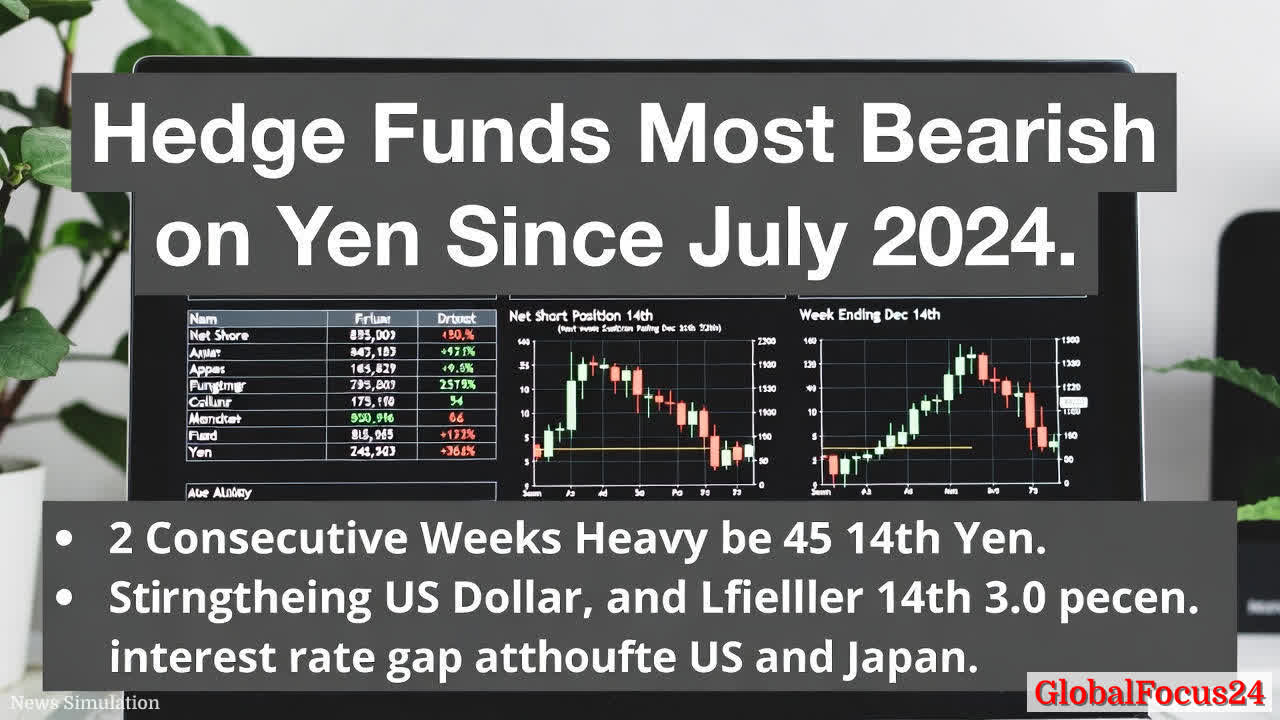
In a developing market dynamic that underscores the ongoing tug-of-war between monetary policy, currency valuations, and investor sentiment, hedge funds have positioned themselves with an exceptionally bearish view on the Japanese yen. Data through mid-December show net short positions hovering around 85,000 contracts for the week ended December 14, marking the second-highest total since July 2024 and continuing a pattern of two consecutive weeks of intensified bearishness. This followed a peak of roughly 92,000 net short contracts recorded in the week ended December 9, illustrating a gradual, persistent build in yen shorts over several months.
Historical context provides a useful lens for understanding the current stance. The yen has long served as a vehicle currency and a barometer for global risk appetite, but it has also been acutely sensitive to differences in monetary policy and real interest rates between Japan and the United States. Throughout 2024, Bank of Japan policy shifts, occasional rate hikes, and the divergence in central bank trajectories contributed to volatility in USD/JPY. The market’s bearish tilt toward the yen appears tied not only to technical positioning but to a broader macro framework in which the US Federal Reserve has maintained relatively higher policy rates, while real Japanese rates have remained deep in negative territory as inflation in Japan has outpaced the central bank’s rate adjustments.
The key economic forces behind this stance include the wide gap in interest rate levels between the United States and Japan, currently around 3.0 percentage points in favor of the U.S. dollar. In practical terms, higher U.S. rates tend to attract capital flows into dollar-denominated assets, supporting the greenback while putting depreciation pressure on the yen. Yet the dynamic is nuanced. The Bank of Japan has implemented targeted rate adjustments and policy tools intended to stabilize domestic financial conditions, while global inflation trajectories and supply-chain considerations continue to shape risk and return on Japanese assets. Despite any recent rate hikes by the BOJ, real interest rates in Japan have struggled to turn positive, a situation that discourages investment in yen-denominated instruments relative to other currencies with more attractive real yields.
A parallel thread in the narrative is the broader policy response witnessed last year when the USD/JPY exchange rate breached notable thresholds, including a move above 160. That level triggered heightened government intervention, signaling a willingness to counter speculative excesses and preserve currency stability. The current environment has reignited concerns about whether such intervention would be required again should yen depreciation accelerate, or if stabilization measures might emerge from the BOJ or other policy authorities. The balance between maintaining policy independence and providing market stability remains delicate, with investors watching carefully for hints of any new strategic footing.
From a market structure perspective, the persistence of bearish expectations on the yen has been reinforced by several factors. Hedge funds and other leveraged players often use currency futures and options to express directional views, and the accumulation of net short positions can itself influence market psychology, creating a self-reinforcing cycle where fear of further depreciation prompts additional hedging and selling. In addition, the yen’s sensitivity to global risk sentiment means that episodes of geopolitical tension, commodity price shifts, or unexpected economic data from major economies can have amplified effects on USD/JPY. Traders are weighing not only domestic Japanese data but also foreign inflation metrics, energy prices, and the evolving outlook for supply chain resilience as they position for potential currency moves in the near term.
Regional comparisons illuminate the broader landscape in which the yen operates. Among major Asian currencies, the yen’s performance has often diverged from peers that benefit from different policy trajectories or trade dynamics. For example, where some regional currencies may gain from improving domestic demand or export-led growth, the yen’s path is frequently influenced by the currency pair’s role as a funding currency and its sensitivity to U.S. monetary policy expectations. This creates a complex interplay for investors who must contend with both domestic Japanese data and the external pressures exerted by U.S. monetary policy, global risk appetite, and capital flows.
Historical context also offers a lens into potential future trajectories. The yen’s behavior in past episodes of sharp depreciation has prompted a mix of policy responses, market adaptation, and strategic recalibration by institutional investors. If the current pattern of net short positions persists, traders will likely monitor for signs of turning points—such as shifts in relative inflation dynamics, improved prospects for Japanese growth, or unexpected changes in BOJ communication that signal a new stance on rate policy or asset purchases. Conversely, stronger-than-expected U.S. data or a more aggressive stance from the Federal Reserve could extend the depreciatory pressure on the yen, reinforcing the bearish positioning seen among hedge funds.
Market participants remain attentive to the broader implications of yen strength or weakness for the Japanese economy. A weaker yen can have multifaceted effects: it can support export competitiveness by reducing the relative cost of Japanese goods abroad, but it can also raise import costs, contributing to domestic price pressures and potentially affecting consumer sentiment. For a country with significant import exposure to energy and raw materials, exchange rate movements can translate into meaningful shifts in inflation dynamics and monetary policy considerations. Investors and policymakers alike must balance the potential benefits of a more competitive export sector against the risks of cost-push inflation and imported price pressures.
The current environment also raises questions about risk management and portfolio diversification strategies for international investors. An environment of heightened yen volatility can affect cross-border investment decisions, hedging costs, and the relative attraction of Japanese equities and bonds. For institutional investors with exposure to Japanese assets, the focus may shift toward hedging strategies, duration considerations, and the overall risk profile of currency exposure within multi-asset mandates. These considerations underscore the interconnectedness of currency movements with broader asset allocation, risk budgeting, and liquidity planning.
Looking ahead, analysts will be closely watching a few pivotal indicators. Key economic releases from Japan, including inflation data, wage growth, and industrial activity, will shed light on the sustainability of the negative real interest rate environment and the potential for policy adjustments. Meanwhile, U.S. macro data, including labor market strength, inflation trends, and the trajectory of interest rates, will shape expectations for the USD/JPY path. Market participants will also monitor central-bank communications for hints about policy normalization timelines, which could recalibrate speculative positioning and influence the pace of currency movements.
Public reaction to currency volatility often follows a pattern of concern mixed with cautious optimism. Businesses engaged in export-oriented sectors may view a weaker yen as a relief for margins, particularly if input costs are relatively stable or if hedging programs are in place. Import-heavy sectors may experience pressure from higher import prices, prompting price adjustments or supply chain adjustments. Consumers could be affected indirectly through inflationary pressures and the broader implications of currency movements on the cost of living. Policymakers, meanwhile, may emphasize stability, resilience, and the importance of a well-communicated policy framework to mitigate abrupt shifts in market expectations.
In sum, the yen remains at the center of a complex, high-stakes equation involving monetary policy, global risk sentiment, and cross-border capital flows. The two-week stretch of heavy bearish positioning by hedge funds highlights a prevailing view that the currency could face continued depreciation pressures in the near term, barring any unforeseen shifts in U.S. rate dynamics, Japanese inflation trajectories, or policy interventions. As markets digest incoming data and await central-bank signals, the yen’s destiny will likely hinge on the evolving balance of interest rate differentials, inflation outcomes, and the reflexive behavior of traders navigating a landscape of uncertainty and opportunity.