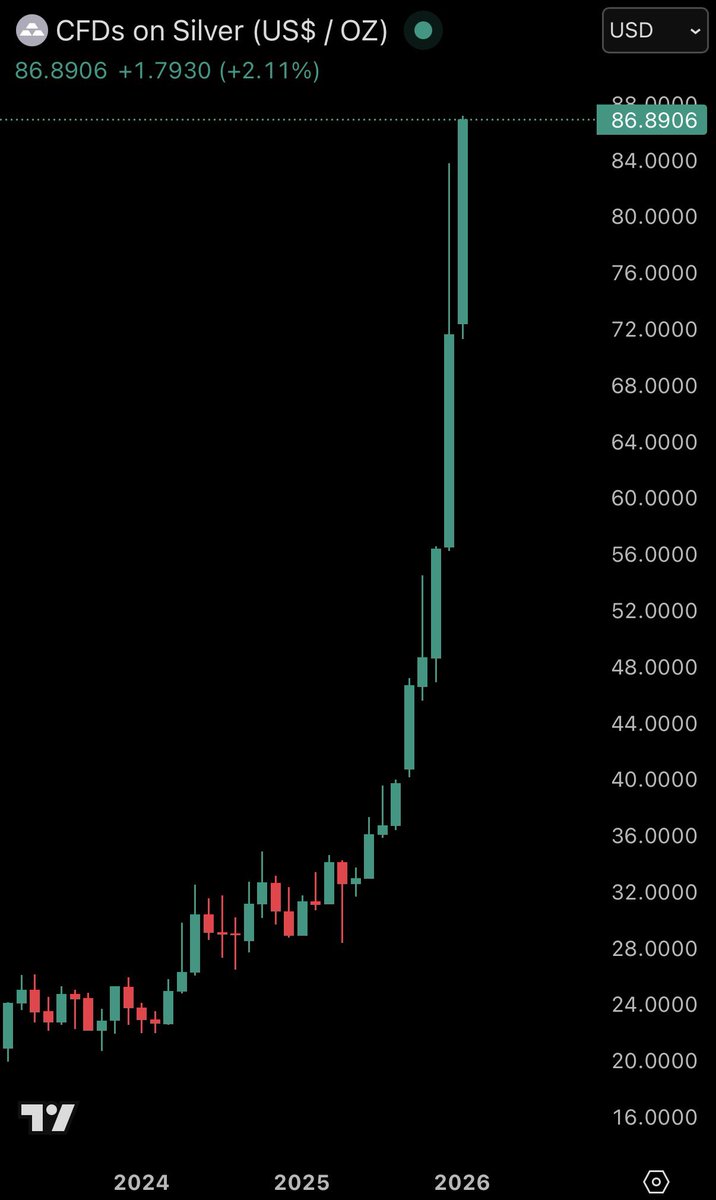
Silver Prices Surge Past $87 per Ounce, Marking Historic High
Record-Breaking Rally Redefines Global Commodity Markets
Silver prices have reached an unprecedented milestone, breaking above $87 per ounce for the first time in market history. The metal’s meteoric rise—up more than 210% in just 13 months—has ignited renewed attention from investors, industrial producers, and central banks alike. The rally marks a watershed moment for a commodity often overshadowed by gold but now seen as a key indicator of shifting global market dynamics.
The Path to Record Silver Prices
Silver’s sharp ascent began in late 2024, when tightening supplies collided with surging investment demand. Initially driven by global inflationary pressures and uncertainty in foreign exchange markets, the rally gathered momentum as industrial consumption accelerated. Demand from sectors such as renewable energy, electric vehicles, and electronics manufacturing has grown at an extraordinary pace, placing additional pressure on constrained mine output.
By mid-2025, silver prices had already doubled from their early-year lows. Investor sentiment strengthened further after a series of global policy shifts—most notably moves by several central banks to diversify reserve holdings away from traditional assets. These developments set the stage for the metal’s historic breach of the $87 threshold in early 2026, a level that analysts had not anticipated even under optimistic scenarios.
Historical Context: Silver’s Volatile Legacy
Silver has long occupied a unique position in world economics, embodying both monetary and industrial value. Historically, the metal has experienced cycles of extreme volatility, swinging sharply in response to geopolitical, technological, and fiscal developments.
In 1980, silver prices hit a then-record near $50 per ounce during the infamous Hunt brothers' attempt to corner the market. That episode ended in collapse when regulatory interventions and margin hikes triggered a dramatic sell-off. More than three decades later, the 2011 rally—fueled by post-recession stimulus measures—brought silver to $48 per ounce before cooling amid profit-taking and a stable U.S. dollar.
The current surge stands apart in both scale and scope. Unlike previous spikes tied to speculative activity, today’s rally is underpinned by global structural changes: technological transformation, supply chain fragility, and rising monetary hedging amid ongoing economic realignment.
The Industrial Dimension: Silver’s Expanding Role
Modern industry relies heavily on silver’s exceptional conductivity and reflectivity. Its indispensable role in energy transition technologies—solar panels, batteries, and power distribution systems—has transformed it from a mere precious metal into a cornerstone of industrial innovation.
According to recent production estimates, photovoltaic demand alone now accounts for nearly one-quarter of global silver consumption. Rapid growth in solar energy infrastructure, particularly in Asia and the Middle East, has compounded pressure on supply chains already stretched by limited new mining capacity. The automotive and electronics sectors have also expanded their silver use, driven by rapid electrification and the proliferation of smart devices.
Mineral exploration companies have ramped up production efforts, especially in primary silver-producing countries such as Mexico, Peru, and China. However, ramping up new supply takes years, not months. Many ore bodies have become more challenging to access, requiring advanced technologies and higher costs of extraction—factors that could keep prices elevated even if demand moderates.
Investor Behavior and Market Dynamics
The surge in silver prices has also reshaped portfolios across the investment community. Exchange-traded funds (ETFs) backed by physical silver holdings saw record inflows in recent months, while futures markets registered unprecedented open interest. Institutional investors have increasingly treated silver as a hedge against inflation and currency depreciation, particularly in light of volatile bond yields and uneven economic growth forecasts.
Retail investors, too, have entered the market in force. Online trading platforms report rising volumes of small-scale silver purchases, echoing elements of past retail-driven commodities booms. Analysts caution, however, that while silver remains attractive for diversification, its volatility can expose unseasoned investors to rapid reversals if macroeconomic sentiment shifts.
Compared to Gold: Diverging Paths in Precious Metals
While silver’s rally has dominateds, gold prices have also trended higher—but at a slower pace. The gold-to-silver ratio, a traditional metric of relative value, has narrowed sharply to below 30:1, its lowest level in more than half a century. Historically, this ratio averaged near 60:1, suggesting that silver’s current performance has far outstripped that of gold on a relative basis.
Market participants note that silver’s industrial use gives it a more complex economic profile than gold. This dual nature—both a hedge and a resource—allows it to respond to economic trends differently. Whereas gold often rallies on market fear, silver’s price reflects both macroeconomic sentiment and real-world production cycles. The convergence of both factors in the current environment has produced an unusually powerful bull run.
Global and Regional Impacts
The repercussions of silver’s surge are being felt across continents. In Latin America, the silver-producing heartland, the rally has provided a crucial economic boost amid fluctuating energy and commodity exports. Mexico, the world’s largest silver producer, has seen renewed foreign investment in mining operations, job creation, and infrastructure development.
In Asia, industrial demand continues to dominate outlooks. China’s solar and electronics manufacturing sectors have responded by adjusting procurement contracts and exploring recycling alternatives to mitigate rising raw material costs. India, historically one of the largest consumers of physical silver for jewelry and investment, has recorded a decline in retail demand due to rising prices, though interest in silver ETFs has grown.
In North America and Europe, economic effects are more nuanced. For manufacturers, elevated silver costs translate into higher production expenses for electric vehicles and renewable energy infrastructure. However, the rally has also invigorated mining sectors in the United States and Canada, prompting expansions and exploration initiatives in previously underutilized deposits.
Economic Implications for Inflation and Currency Markets
Silver’s historic ascent arrives against a backdrop of global inflationary unease. Elevated commodity prices often feed into consumer costs through higher production and transportation expenses. Analysts suggest that if silver remains above $80 for an extended period, spillover effects could emerge in sectors such as renewable energy, consumer electronics, and industrial equipment.
Currency markets have also reacted to the surge in precious metals. The U.S. dollar, typically inversely correlated to silver, has softened slightly as investors diversify into hard assets. Meanwhile, in emerging markets, stronger silver demand has contributed to trade balance adjustments and revived discussions around resource nationalism in resource-rich nations seeking to capitalize on high prices.
Why Silver Could Stay Elevated
Several structural factors suggest silver’s rally may have durability beyond a short-term speculative phase. First, global decarbonization efforts imply robust ongoing demand for silver-intensive technologies. Second, mining investment cycles lag commodity price shifts by years, meaning supply cannot quickly expand to meet new consumption levels. Third, persistent geopolitical tensions and de-dollarization trends have encouraged central banks and investment funds to broaden their reserve compositions, which may continue to support precious metals.
At the same time, risks remain. A slowdown in industrial output, easing inflation, or strengthening fiat currencies could trigger corrections. But even in such cases, few analysts expect silver to retreat anywhere near pre-rally levels given the structural revaluation of metals within modern supply chains.
A Pivotal Moment for Precious Metals
The silver market’s historic breach of $87 per ounce marks more than just a price record—it signals a fundamental reappraisal of value across global commodities. With its dual identity as both an industrial resource and a store of wealth, silver has become a bellwether for the evolving relationship between technology, finance, and the physical economy.
For now, the market shows little sign of losing momentum. Traders, manufacturers, and policymakers are all watching closely for clues about where the next phase of the rally might lead. Whether this historic high marks the beginning of a new long-term equilibrium or the crest of a speculative wave, one fact is clear: silver has reasserted its place at the center of the world’s economic story.