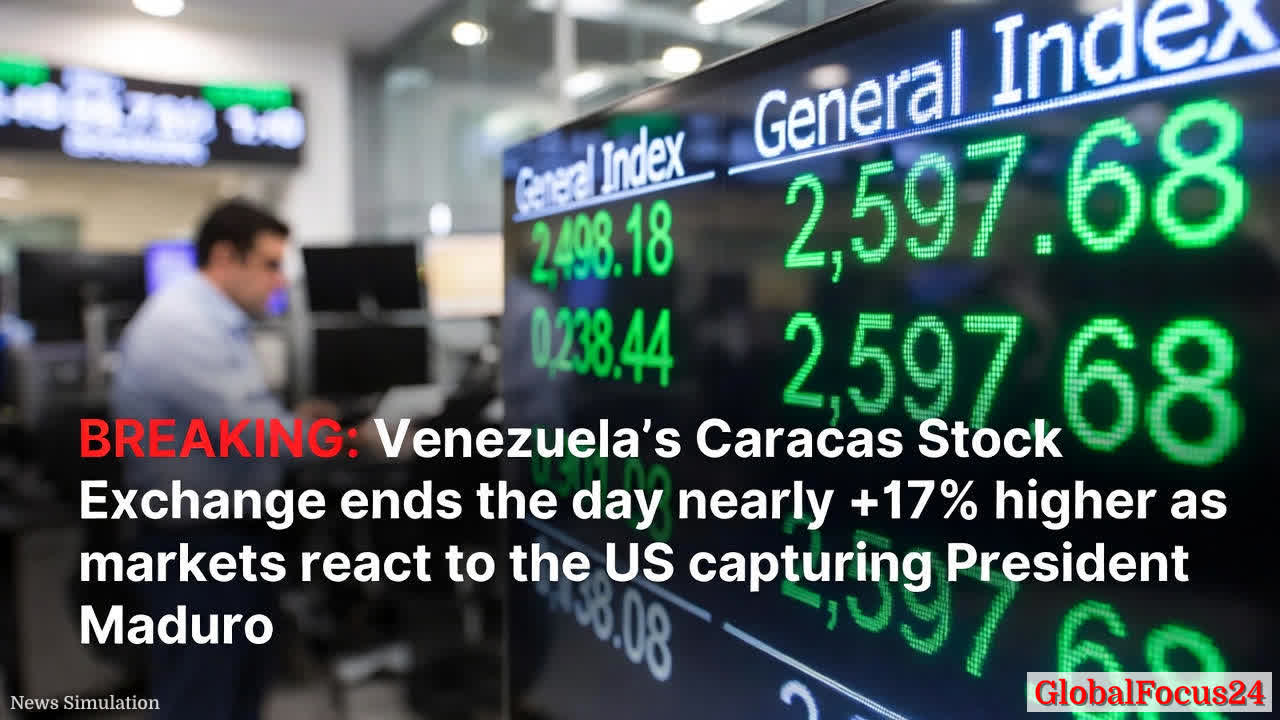
Caracas Stock Exchange Soars on Unverified Reports of Maduro Capture, Market Reacts in Real Time
The Caracas Stock Exchange General Index surged almost 17% on Monday, closing at 2,597.68 after opening at 2,230.81 and reaching a session high of 2,621.77. The sharp advance took place amid circulating, albeit unconfirmed, reports that U.S. authorities had captured President Nicolás Maduro. Traders and analysts emphasized the volatility inherent in a market closely tied to political developments, yet the day’s movement underscored a broader dynamic: financial markets in volatile political environments can swing dramatically ons, even when the underlying fundamentals remain uncertain.
Historical context helps illuminate how such episodes fit into a longer arc of Venezuelan market behavior. The Caracas Stock Exchange, established in the mid-20th century, has long reflected the country’s economic cycles, which have included periods of oil-driven growth, inflationary pressures, and policy shifts that periodically recalibrate investor expectations. In recent years, the exchange has experienced periods of liquidity constraints and sectoral concentration, with financials, energy-related firms, and consumer goods companies comprising a substantial portion of trading activity. This week’s session must be read against that backdrop: investors often respond to news that could presage shifts in governance, policy direction, or sanctions regimes, even when such news lacks official confirmation at the moment of trading.
The day’s price move invites comparison with regional stock-market behavior under political uncertainty. In neighboring markets across Latin America, equities often react to geopoliticals with swift momentum, but the sustainability of gains frequently hinges on corroboration, macroeconomic indicators, and policy signals from national authorities. Analysts point out that the Caracas exchange operates within a larger macroeconomic ecosystem characterized by inflationary trends, currency volatility, and monetary policy adjustments. Whens touch on potential changes in leadership or policy, traders may push indices higher or lower as risk appetites shift among domestic and foreign investors who monitor the balance between risk and return.
From an economic standpoint, the immediate impact of a one-day surge in the Caracas General Index can be both symbolic and practical. A rising index enhances market sentiment, potentially easing some access-to-capital frictions for listed companies by signaling investor interest and improving liquidity. It can, in turn, influence perception of the broader economy, attracting portfolio inflows or at least stabilizing domestic trading activity. Yet market observers warn against equating a single session’s gains with durable economic improvement. The underlying drivers—commodity prices, fiscal policy, and macroeconomic stability—remain essential determinants of sustained performance. In Venezuela, where oil exports and public sector spending have historically shaped the economic landscape, investors closely watch energy sector indicators, sovereign risk assessments, and currency dynamics to gauge longer-term trajectories.
Regional comparisons reveal both parallels and notable differences. In markets with similar exposure to volatile political cycles, such as some Andean economies, investors often price in potential regime changes, sanctions risks, or reform packages. However, those economies frequently enjoy clearer policy commitments or more transparent data, which can temper abrupt moves and provide clearer pathways for reform or stabilization. Venezuela’s market, by contrast, has endured extended periods of uncertainty, with sanctions frameworks and domestic policy shifts adding layers of complexity to risk modeling. Monday’s rally may reflect a temporary reassessment of risk or a demand for hedges against ongoing volatility, rather than a definitive pivot in the country’s investment climate.
Market participation on the day appeared broad, with gains spanning multiple sectors of the index. Traders cited heightened activity in financials, energy-related equities, and consumer goods firms as contributors to the overall uptick. The transactional tempo suggested that some investors were repositioning portfolios in response to-driven sentiment, while others sought to capitalize on perceived mispricings that can emerge when news flow is uncertain or rapidly evolving. For market watchers, this dynamic underscores the importance of diversification and disciplined risk management, particularly in environments where information flows are rapid and sometimes conflicting.
Public reaction to the reported development encompassed a spectrum of views. Some market participants viewed the price movement as a barometer of confidence in political stability, while others cautioned thats could be misleading or incomplete. Local commentators and observers emphasized that genuine resolution to political questions could only come through official channels and verifiable information, and that markets should not be viewed as a proxy for real-time governance. In the broader public sphere, social media discourse and traditional outlets alike reflected both optimism and skepticism, illustrating how financial markets can intersect with civic sentiment in ways that amplify the stakes of political developments.
The interplay between macroeconomic fundamentals and political uncertainty remains central to understanding this week’s activity. Venezuela’s inflation trajectory, currency regime, and fiscal policy stance will continue to shape investor expectations as the market digests incoming data and potential policy announcements. Analysts recommend watching for indicators such as inflation rates, consumer price trends, and central bank signals regarding interest rates and liquidity management. These factors, combined with international sanction dynamics and commodity price movements, will likely determine whether the current momentum translates into a longer-lasting market narrative or whether volatility resumes as information evolves.
From an investment strategy perspective, risk-aware participants might focus on liquidity and diversification to navigate ongoing uncertainty. While the day’s gains demonstrate capacity for rapid appreciation, they also highlight the risk of sharp reversals ifs fail to materialize into concrete policy changes or if negative geopolitical developments emerge. For long-term investors, the emphasis remains on fundamental valuations, sectoral prospects, and the resilience of local businesses in the face of macroeconomic headwinds. A disciplined approach—grounded in careful analysis of earnings, cash flow, and balance sheet strength—continues to be essential for navigating a market that can swing ons as readily as on earnings reports.
The broader implications for Venezuela’s financial system are nuanced. A temporary uptick in the Caracas General Index could improve liquidity in the short term, potentially making it easier for companies to raise capital through equity offerings or secondary offerings. It could also bolster confidence among local fund managers and retail investors, reinforcing the role of the stock exchange as a barometer of market sentiment even when the underlying fundamentals remain in flux. Over the longer horizon, however, sustainable improvement will likely depend on a combination of policy clarity, structural reforms, and concessions that foster a predictable investment climate. In this context, the day’s movements may be remembered as a snapshot of market psychology under duress, rather than a definitive turning point.
Industry experts emphasize the importance of transparent information and credible reporting in shaping market outcomes. In times of political turbulence, investors rely on verified data and official statements to calibrate risk and construct portfolios. Market participants are advised to monitor governmental communications, central bank guidance, and international market signals that influence commodity pricing, exchange rates, and trade dynamics. Whiles can trigger immediate reactions, the lasting effect on the economy will hinge on verifiable actions and policy trajectories that provide a credible path toward stability and growth.
In sum, Monday’s surge in the Caracas Stock Exchange General Index reflects a moment of heightened sensitivity to political developments, coupled with a broader pattern of volatility that characterizes markets in transition. The swift rise and subsequent intraday peak demonstrate the market’s responsiveness tos, even as investors remain cautious about whether such developments will translate into sustained gains. For policymakers, regulators, and investors alike, the episode underscores the ongoing need for transparent communication, robust data, and a pragmatic approach to risk management in a country navigating complex economic and political headwinds.
As week-by-week market dynamics unfold, observers will track how the Caracas exchange absorbs new information and adjusts to evolving conditions. The resilience of the market, its capacity to absorb shocks, and its alignment with the broader economy will continue to be tested in the days ahead. Investors, analysts, and the public will watch closely for confirmation ofs, policy signals, and the emergence of data that can anchor expectations in a volatile but increasingly connected regional financial landscape.