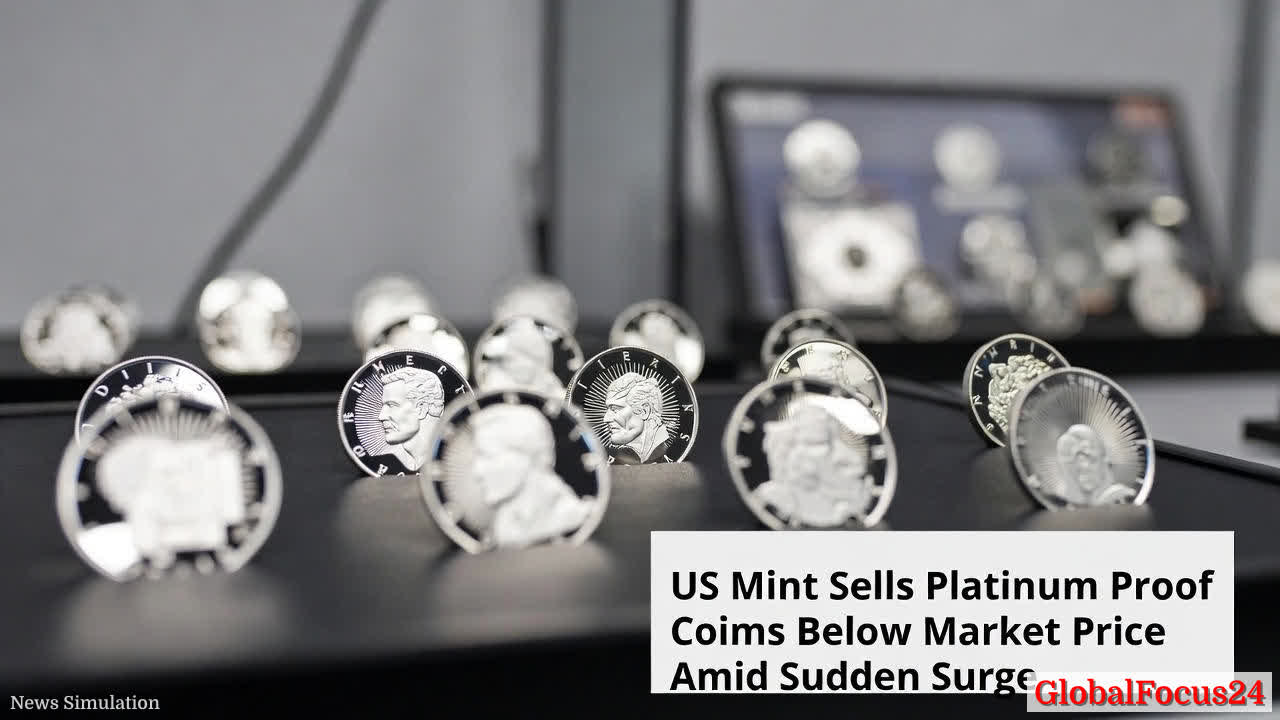
US Mint Sells Platinum Proof Coins Below Market Price Amid Sudden Surge
In a rapid turn of events that drew immediate attention from collectors, investors, and industry analysts, the United States Mint briefly offered platinum proof coins at a fixed price of $2,345 per ounce on its official platform while the underlying market price for platinum surged well above that level. The episode unfolded over a few hours in the morning, starting around 6:30 AM Eastern Time, as the metal’s spot price climbed beyond the Mint’s fixed price and eventually peaked near $2,470 per ounce by 10:15 AM ET. The coins remained available at the lower price for a window of time, creating what observers described as a meaningful, if unintended, discount relative to prevailing market prices.
To understand the incident, it helps to place it in historical context. Platinum has long occupied a unique niche in precious metals markets, often trading at a premium to more familiar metals like gold during periods of strong industrial demand. The metal’s price dynamics are closely tied to sectors such as automotive catalytic converters, jewelry, and various industrial applications, making it sensitive to shifts in both global production, supply disruptions, and investment interest. In recent years, platinum has exhibited greater volatility than some peers, with price movements reflecting broader macroeconomic trends, fluctuating demand from manufacturing hubs, and evolving investor sentiment toward precious metals as a store of value.
The brief price discrepancy highlighted several key considerations for market participants. First, it underscored the potential for misalignment between fixed, institutionally administered pricing and real-time market dynamics. While the Mint’s fixed price aimed to standardize purchasing terms for collectors and ensure availability of premium-quality coins, rapid swings in the reference market exposed the risk that fixed-price offerings could diverge from prevailing market realities. Such a scenario can influence consumer behavior, prompting buyers to act quickly to take advantage of perceived arbitrage opportunities, and it may also affect perceptions around the reliability of fixed-price government products in the urgent, fast-moving environment of today’s markets.
From an economic perspective, the incident prompts a broader discussion about the balance between public program transparency and market responsiveness. The Mint’s primary mission includes minting coins for circulation, support for numismatic collecting, and revenue generation to fund part of its operations. When fixed prices inadvertently depart from market benchmarks, there is a potential impact on government revenue, particularly if a large volume of sales occurs at prices below current market quotations. In this instance, officials and analysts estimated that the government could incur losses commensurate with the volume of sales that occurred before price adjustments were made. The impact, while potentially significant in aggregate terms, depends on the scale of the discount relative to overall mint sales and the value of the coins in question.
Industry observers note that fixed-price sales mechanisms are often designed to simplify the purchasing process for collectors and to stabilize inventory management. However, the rapid escalation in platinum prices during the same window suggests a temporary fracture between fixed pricing and market reality. The Mint’s response—adjusting pricing to align with market conditions—reflects an operational pivot that many government agencies may consider in situations where real-time price movements could materially affect revenue recognition or procurement costs. The broader implication is a potential reexamination of how fixed-price programs are structured, monitored, and adjusted in response to market volatility.
Regional comparisons provide additional perspective on the episode. Platinum markets in North America have historically been influenced by global supply chains, with major production centers in South Africa and Russia playing prominent roles in midday price movements. The US Mint’s experience mirrors similar episodes seen in other sectors where fixed-price sales interact with volatile commodity prices. In markets for precious metals, fixed-price platforms—whether from sovereign mints, private dealers, or exchange-traded instruments—must weigh the benefits of price certainty against the risk of mispricing during rapid market moves. The incident thus resonates with a broader global pattern in which fixed-price offerings encounter real-time price signals that can diverge markedly from the initial terms of sale.
From a consumer behavior standpoint, the episode generated both interest and caution among buyers. Collectors often seek value under favorable conditions, particularly when premium coins are offered at a discount relative to the metal’s spot price. The temporary discount may have been viewed as a potential arbitrage play: purchase under the fixed price and hold for resale at higher market prices. Yet, given the complexity of numismatic valuations—where coin collectibility, proof finishes, and mintage thresholds influence price—the actual resale value can vary widely. Market participants typically account for factors such as rarity, grade, and demand among collectors when assessing potential profitability.
The incident also invites reflection on the role of government procurement and sales channels in financial markets. Government agencies that issue or sell assets—whether precious metals, collectibles, or other commodities—must maintain robust controls to prevent unintended mispricing and to ensure revenue integrity. The Mint’s pricing mechanism, which allowed a window of opportunity before corrective actions were implemented, underscores the importance of real-time monitoring, rapid response capabilities, and transparent communications. While the immediate outcome included a potential short-term revenue impact, the long-term lesson centers on refining pricing algorithms, improving price surveillance, and ensuring that fixed-price structures remain aligned with evolving market conditions.
Looking ahead, analysts expect a careful review of pricing governance within the Mint’s sales framework. Key questions include how fixed-price inventories are set, how real-time price feeds are integrated into sale terms, and what contingency measures are in place to mitigate similar occurrences in the future. Some industry voices advocate for tighter synchronization between government sale terms and global benchmarks, particularly for commodities with high price volatility. Others suggest implementing dynamic pricing mechanisms that adjust automatically within predefined bands, reducing the risk of mispricing while preserving the accessibility and predictability that collectors value.
The regional and international implications extend beyond the United States. Global buyers and institutions participate in platinum markets that are deeply interconnected with metallic supply, industrial demand, and financial market psychology. As investors monitor precious metals landscapes, incidents like this can influence perceptions about the reliability of fixed-price offerings and the risk appetite associated with collecting assets linked to commodity prices. For regions with robust bullion and coin markets, the event serves as a reminder of the delicate balance between accessibility, affordability, and market integrity in government-backed sales.
In the near term, stakeholders will be watching for official clarifications regarding the scope of the pricing discrepancy, the total volume of coins affected, and the precise financial impact on government revenue. While the immediate situation has been described as a temporary misalignment resolved through price adjustments, the broader narrative centers on how public institutions can maintain trust and consistency in their sales practices when commodity markets are subject to rapid fluctuation. Public reaction, which often blends curiosity with skepticism, will likely inform ongoing discussions about best practices for fixed-price sales and the governance structures that support them.
For collectors and investors who track precious metals, the episode reaffirms the enduring appeal of platinum as both an industrial input and a potential store of value. Market participants continue to weigh the metal’s diversification benefits against its price volatility. The Mint’s interaction with market dynamics does not alter the fundamental value drivers of platinum but highlights how fixed-price mechanisms interact with real-time price discovery. In markets where transparency and accountability are paramount, such episodes contribute to ongoing dialogue about how public assets are priced and sold to the public.
Historical context frames the present event as part of a broader evolution in how governments manage collectibles and bullion programs. Over decades, fixed-price sales have served as a bridge between public policy objectives and market engagement, helping to democratize access to premium assets while supporting national revenues. Each episode of price misalignment prompts a re-evaluation of risk, forecasting, and operational resilience—areas where improvements can bolster system-wide trust and efficiency.
In conclusion, the brief Platinum Proof Coin pricing episode demonstrates the dynamic interface between fixed-price public offerings and live market movement. While the Mint’s fixed price offered an attractive entry point for some buyers during the surge, the eventual correction underscores the importance of adaptive pricing strategies and robust market monitoring. As regional markets and global supply chains continue to influence precious metals, stakeholders can expect ongoing discussions about best practices in pricing governance, transparency, and the optimal balance between accessibility and market integrity in government-backed coin programs.