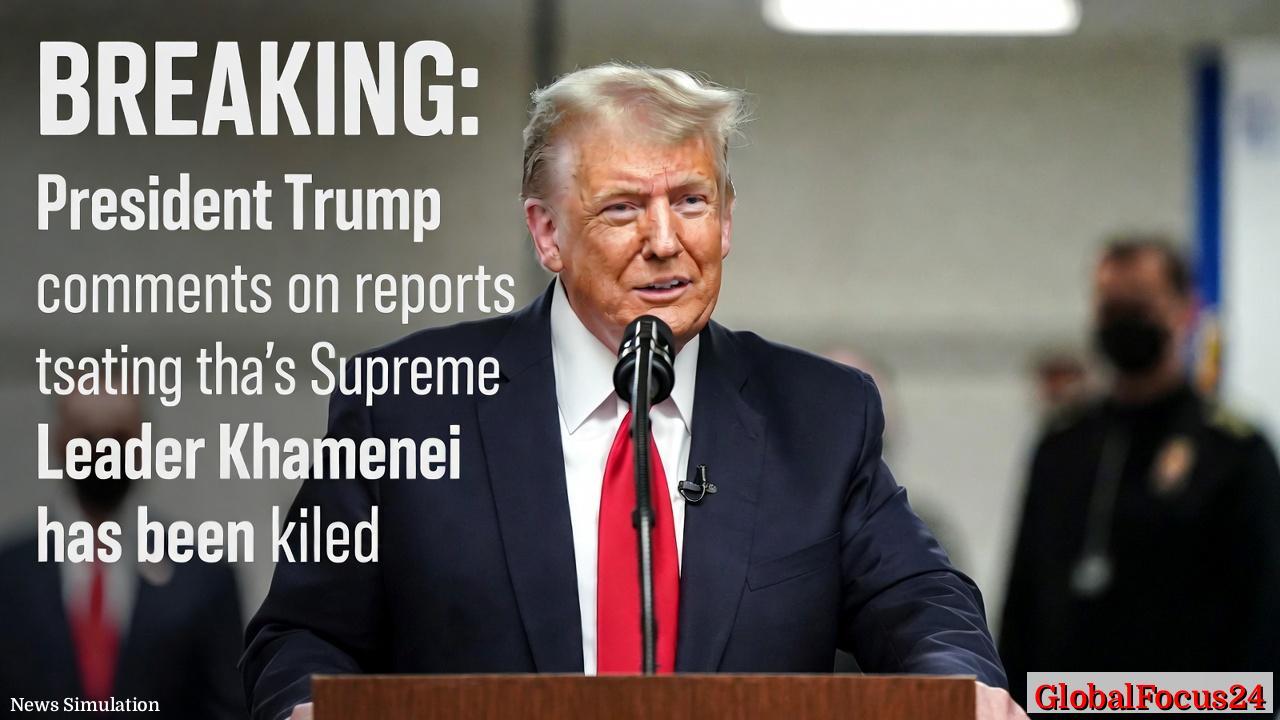
Trump Signals Confirmation After Reports of Iran’s Supreme Leader Khamenei’s Death Following Israeli Strikes
Rising Tensions After Senior Iranian Officials Reportedly Killed
Former U.S. President Donald Trump stated on Saturday that reports of Iran’s Supreme Leader Ayatollah Ali Khamenei’s death “appear to be correct,” following multiple Israeli strikes that reportedly eliminated several of the Islamic Republic’s top military and security leaders. His remarks mark one of the most definitive confirmations yet from a major Western figure regarding the fate of Iran’s most powerful authority.
According to preliminary information circulating among diplomatic and intelligence communities, the strikes struck high-level targets in Tehran and other cities, allegedly killing key figures such as Ali Shamkhani, Secretary of Iran’s Supreme National Security Council; Mohammad Pakpour, commander of the Islamic Revolutionary Guard Corps’ ground forces; and Air Force Chief Aziz Nasirzadeh. These operations, if confirmed, represent one of the most significant blows to the Iranian leadership structure since the 1979 Islamic Revolution.
Israel’s Expanding Campaign Against Iran’s Military Network
The reported attacks follow months of heightened hostilities between Israel and Iran. Since late 2025, Israel has intensified both overt and covert operations aimed at degrading Iran’s regional military capabilities, particularly its network of drone, missile, and proxy forces spread across Syria, Iraq, Lebanon, and Yemen. Israeli officials have long argued that such measures are necessary to prevent Iran from consolidating a ring of influence threatening its borders.
Military analysts note that these strikes appear to have achieved a degree of penetration and precision not seen in prior years. Multiple reports suggest Israel employed advanced tactical drones and deep-penetration munitions, likely involving real-time intelligence coordination. The strikes reportedly bypassed much of Iran’s missile defense network, indicating a significant intelligence advantage or possible insider cooperation.
The Vacuum at the Top of Iran’s Power Structure
If Ayatollah Khamenei’s death is confirmed, Iran faces its most profound leadership crisis in nearly half a century. As Supreme Leader since 1989, Khamenei controlled nearly every lever of the state — the military, judiciary, and political elite — and his passing would leave a daunting power vacuum.
Under Iran’s constitution, a provisional leadership council consisting of the president, the judiciary chief, and a clerical representative from the Guardian Council is expected to oversee the nation until a new supreme leader is chosen. However, with several of these officials reportedly among the casualties, Iran’s constitutional process is now in uncharted territory.
Domestically, the loss of a figure central to Iran’s identity could trigger both political fracture and nationwide unrest. Hardline and reformist factions, held in check by Khamenei’s authority, may begin maneuvering for control. The most likely successors—such as Mojtaba Khamenei, the Supreme Leader’s son, and Ebrahim Raisi, Iran’s president before reports of his death last year—now appear out of contention, further complicating any transition.
Historical Parallels and Political Implications
Iran has weathered leadership shocks before but not at this scale. When Ayatollah Ruhollah Khomeini died in 1989, the state swiftly installed Khamenei, then a mid-ranked cleric and president, to prevent instability. That process, orchestrated through elite consensus, contrasts with the current moment, where much of the elite apparatus may have been decimated.
This event recalls moments of abrupt regime change seen across the Middle East in the late 20th and early 21st centuries — such as the unexpected collapse of Saddam Hussein’s Iraq in 2003 or the decapitation of militant networks through precision strikes in Syria and Libya. But unlike those scenarios, Iran possesses both a complex bureaucracy and powerful ideological foundations, suggesting that a prolonged struggle for authority, rather than an immediate collapse, is most probable.
Economic Ripples Through the Global Energy Market
The immediate consequence of the reports has been intense volatility in global energy markets. Brent crude prices briefly surged past USD 130 per barrel before slightly retracting as traders awaited official confirmation from Tehran and Washington. Iran, though heavily sanctioned, still exerts indirect influence on global oil supply through proxy allies and its strategic chokehold over the Strait of Hormuz — a passage that handles roughly one-fifth of the world’s petroleum.
If domestic instability spreads, the Iranian oil sector could grind to a halt, further tightening global energy supply already under strain from conflicts in Eastern Europe and North Africa. Major importers such as China, India, and several EU nations have begun emergency consultations on strategic oil reserves to cushion potential shortfalls.
The Iranian rial, meanwhile, has reportedly entered freefall in unofficial trading, with early estimates suggesting a depreciation of over 30 percent within hours of the initial news. This financial shock threatens to deepen inflation within Iran, already at near-record levels due to years of economic sanctions and mismanagement.
Regional Reactions and Shifting Alliances
Reactions across the Middle East have been swift but cautious. Gulf nations, many of which maintain a precarious balance between cooperation with the West and detente with Tehran, have placed their militaries on elevated alert. Saudi Arabia, the United Arab Emirates, and Qatar have reportedly held urgent security consultations, fearing potential retaliation through asymmetric attacks on regional infrastructure.
Israel has not officially claimed responsibility for the strikes, consistent with its long-standing ambiguity policy. However, Israeli officials have emphasized in recent weeks that any opportunity to degrade “the command chain orchestrating threats to Israel and the region” would be seized decisively.
In Iraq and Lebanon, proxy militias aligned with Iran have reportedly begun mobilizing, issuing statements warning of reprisal against Israeli or American targets. U.S. installations across the region, particularly in Kuwait, Bahrain, and Iraq, have raised their security levels, though the Pentagon has yet to issue a formal statement acknowledging the incident.
International Diplomatic Fallout
Western governments have responded cautiously, urging restraint while scrambling to verify the situation. European Union officials called for “transparency and calm,” while China and Russia, both close partners of Tehran, condemned what they termed a “serious violation of sovereignty.”
In Washington, the State Department has remained officially silent, though early leaks suggest emergency briefings are underway at both the National Security Council and the Pentagon. President Trump’s comment, made during an evening appearance at his Mar-a-Lago residence, marks the most definitive acknowledgment yet from a senior U.S. figure, suggesting intelligence agencies have enough confirmation to take the reports seriously.
The United Nations Security Council is expected to convene an emergency session within the next 24 hours to address potential regional instability and humanitarian concerns, particularly in Iraq and Syria, where Iranian-backed forces could retaliate.
The Path Forward for Iran
Beyond the immediate political and military consequences, Iran’s long-term trajectory now hangs in uncertainty. For more than three decades, Ayatollah Khamenei shaped Iran’s ideological framework, encouraging economic self-reliance while extending Tehran’s geopolitical footprint through proxy networks. His death could open space for political recalibration, either toward moderation or deeper authoritarian consolidation under surviving security factions.
Experts differ on whether the Revolutionary Guard Corps will attempt to assume direct political control or whether surviving members of the clerical establishment will reassert authority. The outcome may hinge on whether continuity or fragmentation prevails within Iran’s security hierarchy.
For Iran’s 85 million citizens, the next days may prove decisive. A power vacuum at the highest level could trigger both public unrest and repression, depending on the cohesion of remaining institutions. Communications restrictions have already been reported in Tehran and Shiraz, and social media monitoring indicates widespread anxiety and confusion among Iranians both inside the country and abroad.
An Uncertain New Chapter in the Middle East
If verified, the death of Ayatollah Ali Khamenei would mark a defining rupture in Middle Eastern geopolitics. For more than three decades, he embodied Iran’s revolutionary doctrine and anti-Western stance, profoundly influencing the region’s balance of power. His potential removal, compounded by the simultaneous loss of top military leaders, could usher in a period of instability unseen in decades.
In the short term, Israel’s military escalation and Trump’s assertive remarks signal a new phase of confrontation — one with unpredictable consequences for global security, economic stability, and diplomacy. As governments worldwide monitor developments in Tehran with growing urgency, the Middle East once again stands at the threshold of a historic transformation.