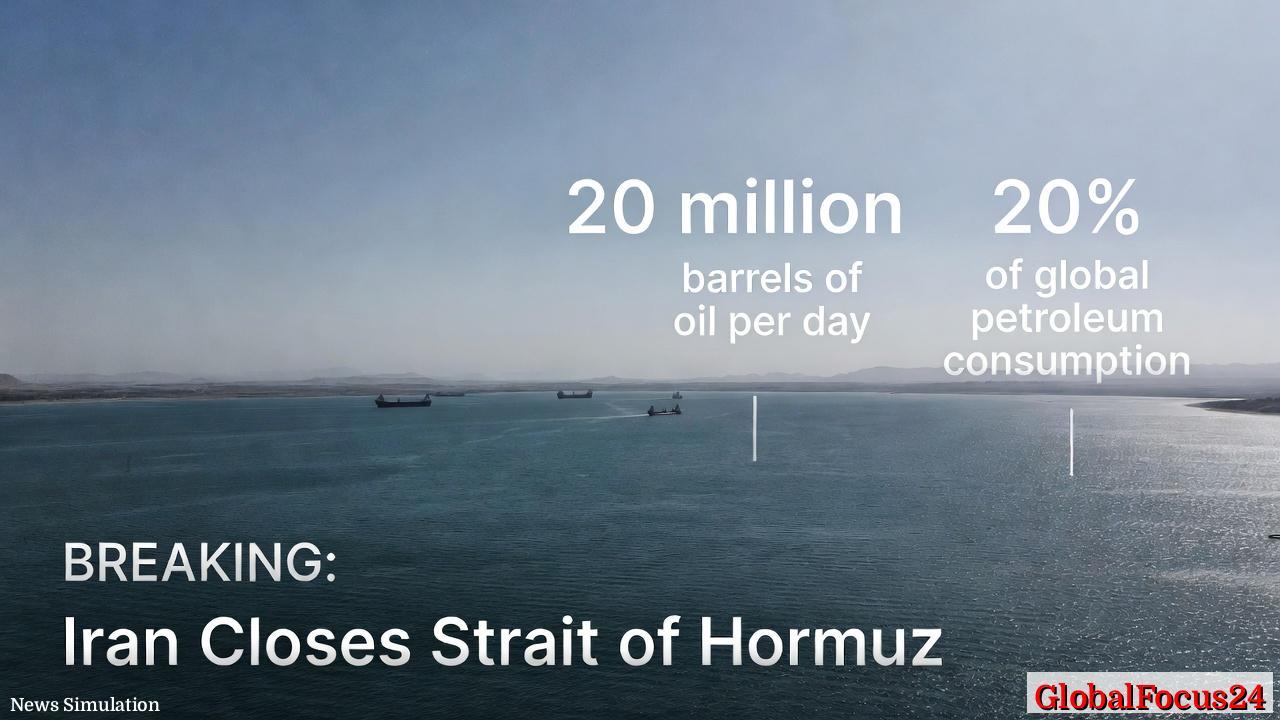
Iran Issues Warnings to Vessels, Signaling Potential Closure of Strait of Hormuz
The waters of the Strait of Hormuz, one of the world’s most crucial maritime chokepoints, have become the focus of renewed global anxiety after Iran’s Revolutionary Guards reportedly transmitted warnings to ships stating that passage through the strait is “not allowed.” The development, coming amid escalating U.S.-Iran tensions and regional instability, has sparked fears of a potential disruption to global oil supplies and a rapid surge in prices.
A Strategic Bottleneck at the Heart of Global Energy Trade
The Strait of Hormuz connects the Persian Gulf with the Gulf of Oman and ultimately the Arabian Sea, serving as the main maritime artery for oil exports from major producers such as Saudi Arabia, Iraq, the United Arab Emirates, Kuwait, and Iran. Every day, an estimated 20 million barrels of oil—about 20 percent of the world’s petroleum liquids consumption—passes through this narrow waterway, only about 21 miles wide at its narrowest point.
Its geography makes it uniquely vulnerable. Unlike other international shipping routes, there are no alternative sea passages to the Indian Ocean for Gulf exports, leaving the global energy market heavily dependent on the strait’s uninterrupted operation. A single obstruction, even for a matter of days, could ripple across financial markets, intensify supply shortages, and drastically raise fuel and transportation costs worldwide.
Rising Tensions and Immediate Global Reactions
The reported warnings to vessels come just days after recent U.S. military strikes on Iranian sites, part of an escalating cycle of confrontation between Tehran and Washington. The United States has advised shipping companies to avoid the area, with several major tanker operators confirming that they are either rerouting voyages or temporarily suspending operations pending further clarity.
Maritime tracking data shows numerous tankers idling off the coasts of the UAE and Oman, awaiting instructions. Some oil producers have begun exploring longer, more costly routes around the Arabian Peninsula, while others have shifted exports via pipelines that circumvent the strait—though these alternatives provide only limited capacity.
Analysts estimate that existing pipelines across Saudi Arabia, the UAE, and Iraq could handle between 6.5 and 7.5 million barrels of oil per day, less than half of the strait’s daily throughput. The resulting shortfall threatens to create immediate upward pressure on crude prices. Futures markets reacted swiftly, with Brent crude climbing above $115 per barrel within hours of the warning reports, and projections now suggesting prices could reach as high as $120 to $130 if the crisis persists.
Historical Context of the Strait’s Volatility
While the Strait of Hormuz has a long history of geopolitical tension, it has never been completely closed in modern times. The last major disruption took place during the 1980s “Tanker War,” a phase of the Iran-Iraq conflict during which both sides targeted oil shipments and mining operations in the Gulf. Despite significant damage and loss, even then the vital route remained at least partially open.
In subsequent decades, Iran has frequently issued threats or conducted naval exercises in the area to demonstrate its influence over the waterway. Each episode has prompted sharp reactions from global markets, leading to temporary spikes in energy prices, though actual shipments typically continued. The current warnings, however, have prompted particular concern given the scale of modern oil dependency and the fragile state of global markets still recovering from earlier supply disruptions and inflationary pressures.
Economic Consequences and Market Impact
A sustained disruption in the Strait of Hormuz would send shockwaves through the global economy. The immediate effect would be a shortfall in oil supply of up to 10–12 million barrels per day, pushing energy prices to levels not seen since the early 2010s. Countries heavily dependent on imported crude, particularly in Asia, would face rising costs. China, Japan, South Korea, and India—all major buyers of Middle Eastern oil—are already assessing contingency plans to secure alternative sources, from Russia to Africa and the Americas.
Shipping costs have surged dramatically, with charter rates for very large crude carriers (VLCCs)—capable of carrying 2 million barrels—reportedly reaching $200,000 per day, the highest level since 2020. Insurance premiums for vessels transiting near Iranian waters have also soared, as maritime risk underwriters reassess exposure to potential conflict zones.
Economic analysts warn that even if passage through the strait remains technically open, the mere perception of instability is enough to disrupt global trade flows. Traders tend to respond preemptively to geopolitical threats, amplifying volatility across energy markets, currencies, and equities. The situation also poses renewed challenges for central banks grappling with inflation, as rising oil prices filter through to consumer goods and transportation costs.
Regional and International Responses
Regional powers have moved swiftly to address the growing uncertainty. Saudi Arabia has announced it is ramping up output through its East-West pipeline system, which transports oil from fields in the Eastern Province to the Red Sea port of Yanbu. The UAE, meanwhile, is expanding the capacity of its pipeline from Abu Dhabi’s oilfields to the Fujairah terminal outside the Strait of Hormuz. However, neither infrastructure system can fully offset a complete closure.
In Washington, defense officials have confirmed increased surveillance flights and naval patrols near the strait, while European and Asian governments have called for restraint and dialogue to prevent an escalation. The International Energy Agency (IEA) has placed member states on alert for coordinated oil release measures if global supplies are severely disrupted.
Iran’s government has not publicly confirmed the communications attributed to its Revolutionary Guards but has stated that it “reserves the right” to ensure its national security and maritime sovereignty. Analysts interpret this language as a signal that Tehran intends to project strength while maintaining deniability, preserving space for negotiation while testing international reaction.
Geopolitical Implications
Beyond its immediate energy implications, the crisis underscores the strategic significance of the Strait of Hormuz as a focal point of power projection in the Persian Gulf. Control over—or even perceived control of—the passage grants Iran leverage in its dealings with Western powers and regional adversaries. The waterway functions not only as an economic artery but also as a geopolitical pressure valve that Iran can tighten or loosen depending on diplomatic circumstances.
The U.S. Fifth Fleet, based in Bahrain, has long maintained a strong presence to ensure freedom of navigation through the strait. Joint naval exercises with partners such as the United Kingdom, France, and Japan underline the shared international interest in keeping the shipping lanes open. However, the possibility of miscalculation remains high. A single incident—such as the interception of a tanker or a clash between patrol boats—could rapidly escalate into a broader confrontation affecting an already volatile region.
Comparisons to Other Global Chokepoints
The Strait of Hormuz is often compared to other strategic maritime passages like the Suez Canal and the Strait of Malacca. Yet in terms of volume and vulnerability, Hormuz remains unparalleled. While the Suez Canal handles about 12 percent of global trade, alternative routes exist if transit is blocked, albeit at considerable additional cost. In contrast, there is no true maritime substitute for Hormuz; its closure would effectively remove a fifth of global oil supply from circulation overnight.
By comparison, disruptions in the Strait of Malacca—between Malaysia and Indonesia—could affect Asian trade but would not have the same immediate global energy repercussions. This asymmetry explains why energy markets are acutely sensitive to Iranian actions in the Gulf at even the smallest scale.
The Road Ahead: Uncertainty and Volatility
As tension deepens, global markets face a period of heightened volatility and uncertainty. Analysts suggest that if diplomatic channels fail to ease the standoff, nations may be forced to rely on strategic oil reserves, potentially triggering government interventions to stabilize prices. Energy importers are already exploring long-term diversification through renewables and non-Gulf suppliers, though such measures offer little short-term relief.
For now, the world watches closely. The Strait of Hormuz remains open, but the warnings have introduced a new level of risk that could shape global economic conditions for months to come. The crisis highlights not only the fragility of modern energy systems but also the enduring geopolitical weight of a narrow strip of water at the crossroads of the Middle East.