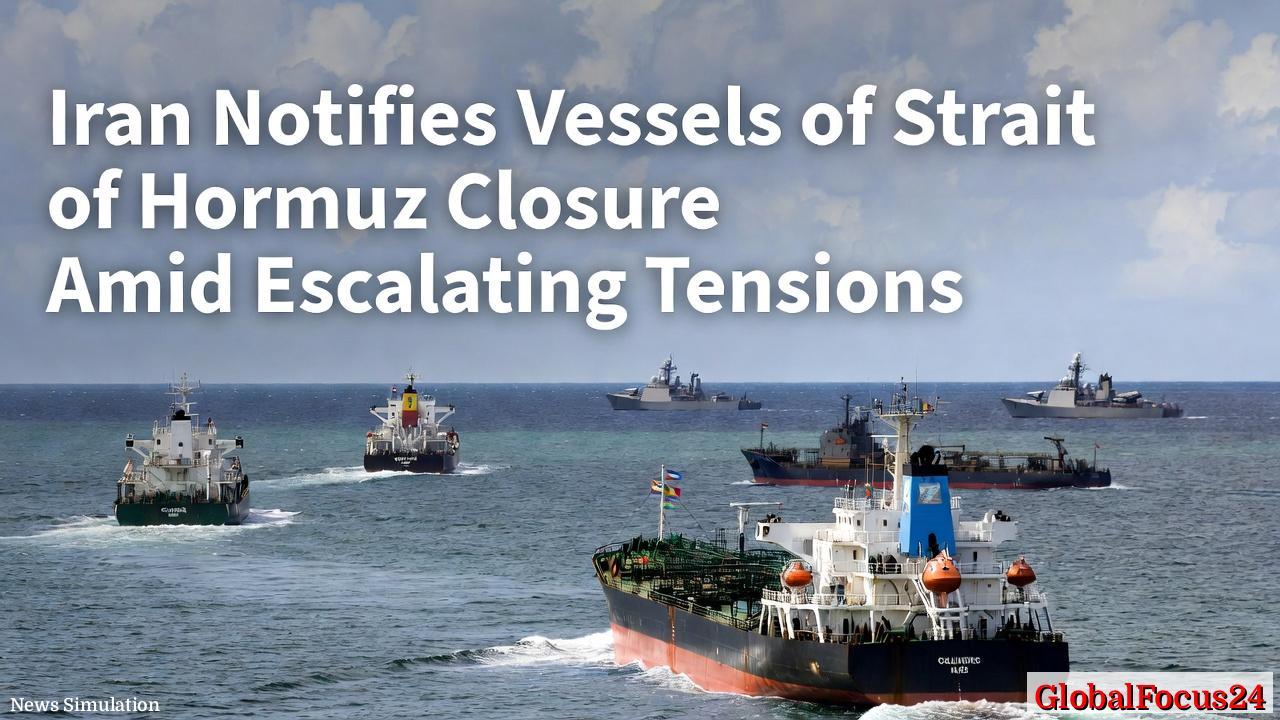
Iran Notifies Vessels of Strait of Hormuz Closure Amid Escalating Tensions
A Global Shipping Artery Under Threat
Iran has begun notifying commercial vessels of its intent to close the Strait of Hormuz, the narrow maritime chokepoint linking the Persian Gulf to the Gulf of Oman and the Arabian Sea. The decision follows overnight U.S. military strikes on Iranian positions, raising fears of a broader regional conflict that could disrupt the global energy supply chain. The Strait of Hormuz is widely regarded as one of the world’s most critical trade arteries: approximately one-fifth of all oil consumed globally passes through its 21-nautical-mile-wide channel.
Early reports from maritime tracking services indicate that ships transiting near the strait have received warning broadcasts to alter course, while tankers awaiting passage at the entrance to the Persian Gulf are idling or diverting toward alternate routes. The U.S. Maritime Administration has issued a concurrent advisory urging vessels to avoid the area until further notice, citing “credible threats to commercial shipping and naval traffic.”
With rising tensions and the potential closure of the strait, energy markets are bracing for shockwaves that could reverberate far beyond the Middle East.
The Economic Stakes of a Strategic Chokepoint
The Strait of Hormuz handles more than 20 million barrels of oil every day—roughly 20% of global petroleum consumption. Beyond crude oil, the route also accommodates massive volumes of liquefied natural gas (LNG), refined petroleum products, and condensates. Analysts estimate that if the strait were fully closed, oil prices could soar to between $120 and $130 per barrel, sparking global inflationary pressures and rekindling supply chain disruptions reminiscent of early pandemic volatility.
For context, every $10 increase in oil prices contributes approximately 0.2 percentage points to the U.S. Consumer Price Index (CPI). Current projections suggest that sustained prices above $120 per barrel could pushinflation near 5%, complicating monetary policy and potentially delaying interest rate cuts in major economies. European nations—already facing tight gas markets—would likely confront renewed energy uncertainty, while Asian importers such as Japan, South Korea, and China would need to draw on strategic reserves or pivot toward long-term supply contracts with non-Middle Eastern producers.
The shock would not be evenly distributed. Developing economies heavily dependent on imported energy could face steeper costs and balance-of-payment pressures. For major oil importers, a disruption in the Hormuz corridor represents not just a market event but a critical test of energy security.
Historical Context: The Shadow of the “Tanker Wars”
The Strait of Hormuz has long stood as a symbol of both opportunity and vulnerability in global trade. Although it has never been fully closed in modern history, its waters have repeatedly witnessed conflict. During the Iran-Iraq War in the 1980s, both nations targeted oil tankers in a series of confrontations known as the “Tanker Wars.” The United States and allied navies intervened to escort commercial vessels, establishing freedom of navigation as a strategic priority.
In more recent years, incidents of harassment, vessel seizures, and sabotage have periodically rattled the region. In 2019, several oil tankers were attacked or seized near the strait, prompting temporary military buildups and an immediate spike in oil prices. However, such disputes were ultimately contained before escalating into full-scale blockades.
This current standoff differs in both scope and gravity. The combination of direct U.S.-Iranian military clashes and explicit navigation warnings signals a potential shift from brinkmanship to outright maritime confrontation.
Regional Energy Dependencies and Limited Alternatives
A closure of the Strait of Hormuz would impact nearly every major oil producer in the Persian Gulf. Saudi Arabia, Kuwait, Qatar, Bahrain, and the United Arab Emirates rely heavily on the route for their crude and gas exports. In 2024, roughly 5.5 million barrels per day of Saudi oil exited through the strait—representing 38% of total flows. While Saudi Arabia possesses the East-West Pipeline, which connects its fields to the Red Sea port of Yanbu, this infrastructure can only handle a fraction of total output.
Kuwait, Qatar, and Bahrain have even fewer options, as the strait serves as their only direct maritime outlet. The UAE can reroute some shipments through the Abu Dhabi Crude Oil Pipeline to the Fujairah terminal on the Gulf of Oman, bypassing the chokepoint entirely, but global capacity to compensate remains limited. Energy analysts estimate that existing pipelines across the region could carry between 6.5 and 7.5 million barrels per day—still leaving a shortfall of more than 10 million barrels if Hormuz remained sealed.
Such limitations underscore why international markets react sharply to even the hint of instability in the region. The world’s dependence on the strait is structural, not circumstantial. Its closure would not merely disrupt trade routes; it would fundamentally alter the logistics of global energy supply.
Shipping Markets React with Surging Rates
Even before official confirmation of the strait’s closure, freight markets have begun to reflect escalating risk. Charter rates for Very Large Crude Carriers (VLCCs) transporting oil from the Middle East to Asia have surged to $200,000 per day for 2 million-barrel loads—a 584% increase since early January. Insurance premiums for vessels entering the Gulf region have also skyrocketed, with some underwriters temporarily suspending coverage for transits through the area.
Marine traffic reports show that several major shipping firms are already rerouting long-distance voyages around the Cape of Good Hope, a journey that can add nearly three weeks to delivery schedules and significantly increase fuel costs. For Asian refineries that depend on steady imports from the Persian Gulf, this extended transit time could cause acute supply shortages within weeks.
The last time shipping rates spiked to such levels was in 2020, amid pandemic-era supply restrictions and global storage shortages. Unlike that event, however, today’s crisis is geopolitical rather than logistical—in other words, policy action or diplomatic intervention may be the only path toward stabilization.
Global Energy Markets Brace for Turbulence
As markets prepare for reopening, traders anticipate sharp volatility across oil futures, equities, and currencies linked to energy exports. The geopolitical risk premium—a surcharge embedded in market pricing to account for instability—has already been priced into Brent and West Texas Intermediate benchmarks. Analysts expect that uncertainty around both duration and intensity of the conflict will dictate whether prices settle into a new plateau or surge further.
The ripple effects could extend to natural gas and coal as well. Asian utilities might turn to alternative fuels if LNG supplies falter, pushing up demand in secondary markets. Meanwhile, central banks from Washington to Tokyo are expected to closely monitor inflation expectations and energy-related stress on consumer prices.
The International Energy Agency (IEA) has indicated that member nations maintain strategic reserves capable of covering approximately 90 days of net imports—an emergency buffer meant to cushion shocks. However, the scale of flows through Hormuz means even strategic reserves offer only limited protection if exports remain disrupted for an extended period.
Comparisons to Past Regional Crises
The current escalation invites comparison to previous Gulf tensions, such as the 1990–91 Persian Gulf War and the 2019 tanker incidents. Yet in both historical cases, global trade managed to avoid a complete halt of Hormuz traffic. What distinguishes today’s situation is the clarity and scope of Iran’s advisories: direct notices to vessels to vacate or avoid the area, coupled with visible military mobilization in surrounding waters.
For neighboring states, particularly Oman and the United Arab Emirates, the implications are profound. Both countries have worked over decades to position themselves as stable logistics and energy hubs in an otherwise volatile neighborhood. A prolonged closure of the strait could threaten regional economic diversification strategies and compel new diplomatic alignments focused on maritime security.
The Broader Economic Impact
Beyond energy markets, a Hormuz shutdown would ripple through global manufacturing, transportation, and consumer sectors. Higher energy prices typically translate into more expensive goods across industries—from aviation and shipping to food production—since oil remains the primary input cost for both transportation and industrial heating. The resulting inflationary pressures could weaken consumer spending and slow post-pandemic recovery trajectories, particularly in Europe and emerging Asia.
Currency markets would likely respond with a flight to safe-haven assets, including the U.S. dollar and gold. Conversely, currencies of major oil-importing nations could depreciate as trade balances worsen. Stock markets are expected to register immediate volatility, especially in energy-intensive industries such as airlines, logistics, and chemicals.
What Comes Next for the Strait of Hormuz
As the situation unfolds, diplomatic channels are reportedly working to de-escalate tensions and preserve the free flow of maritime trade. Yet, uncertainty remains over how long Iran’s closure directives will be enforced and whether they herald a temporary maneuver or a sustained blockade. Regional analysts emphasize that even a short disruption could have lasting repercussions on global energy strategy, accelerating diversification away from Middle Eastern supply dependence and renewing investment in alternative routes and renewable energy sources.
The Strait of Hormuz has, for decades, stood as a fulcrum of economic interdependence—a narrow corridor binding producers, consumers, and governments across continents. Its present vulnerability is a reminder that energy security is inseparable from geopolitical stability. Whether the current crisis deepens or resolves swiftly will shape not only the price of oil but the broader rhythm of the global economy in the months ahead.