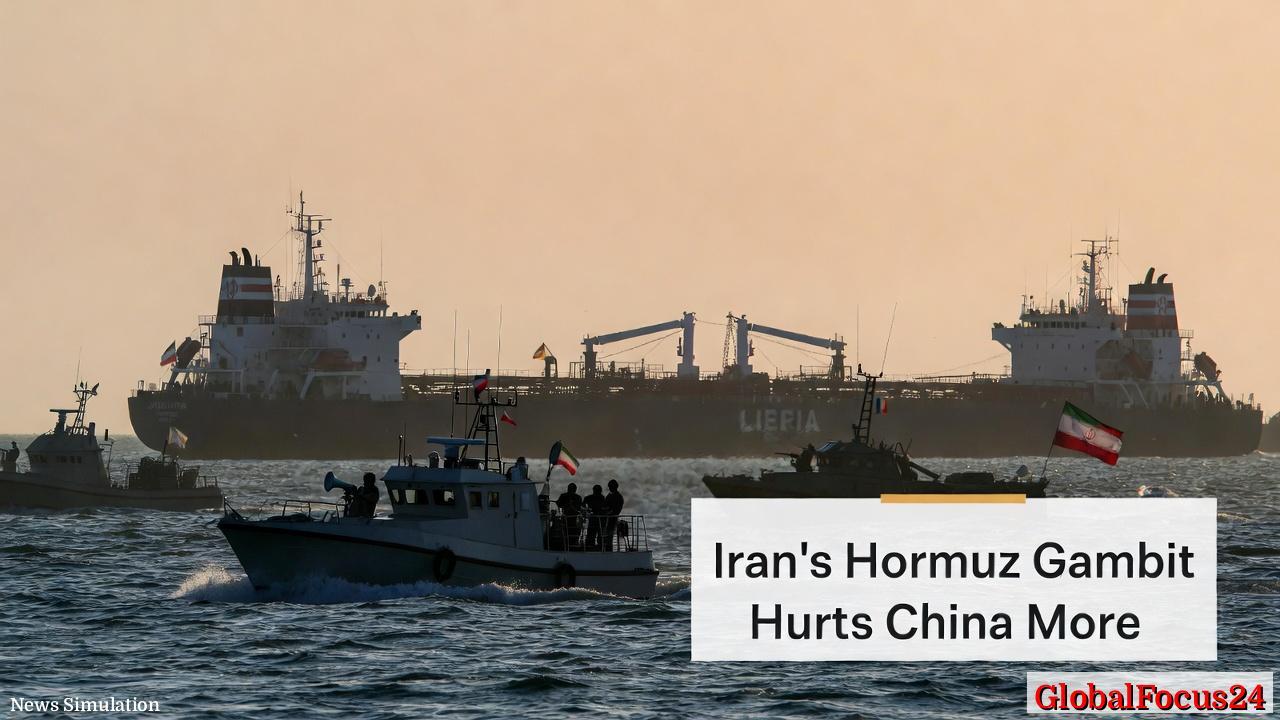
Iran Closes Strait of Hormuz, Halting Global Oil Flows and Spiking Prices Worldwide
The world’s most critical maritime chokepoint for energy trade has come to an abrupt standstill. Iran announced the full closure of the Strait of Hormuz on Saturday, halting all vessel traffic through the narrow waterway that carries roughly one-fifth of global oil supply. The action, declared through warnings broadcast on VHF radio by Iran’s Islamic Revolutionary Guard Corps (IRGC), immediately sent shockwaves across energy markets, with oil prices soaring 12 percent within hours.
The Guards cited an “insecure environment caused by foreign military aggression,” referencing recent U.S. and Israeli strikes on Iranian targets. The closure marks the most significant escalation in regional tensions in years, raising fears of a broader confrontation that could reverberate far beyond the Persian Gulf.
A Vital Artery of Global Commerce
The Strait of Hormuz, a narrow passage between Iran and Oman, serves as the only sea route linking the vast oil fields of the Persian Gulf to the open ocean. Measuring just 21 miles wide at its narrowest point, it has long been considered the heartbeat of the global energy network. Roughly 20 million barrels of oil—nearly one-fifth of world consumption—flow through its waters daily.
Major exporters, including Saudi Arabia, Kuwait, Iraq, the United Arab Emirates, and Qatar, rely on this corridor for their crude shipments to Asia, Europe, and the Americas. Any disruption has historically sent shockwaves through the global economy, inflating energy costs, unsettling equity markets, and threatening supply chains.
The latest closure, however, is unprecedented in its scope. Within hours of Iran’s broadcast, tracking data showed oil tankers halting or diverting courses miles from the strait’s entrance. Shipping companies issued emergency advisories to reroute vessels. Analysts warned that an extended shutdown could cripple supply chains and bring global trade to a crawl.
Historical Context and Longstanding Threats
Iran has repeatedly threatened to close the Strait of Hormuz over the past four decades, typically in response to sanctions or military pressure. The first major confrontation occurred during the Iran-Iraq War in the 1980s, when both nations targeted oil tankers in what became known as the “Tanker War.” U.S. naval forces intervened then to secure maritime lanes, underscoring the geopolitical importance of the strait.
Subsequent flare-ups—most notably in 2011 and 2019—saw similar rhetoric but stopped short of full closure. Until now, Iran had avoided such a drastic step, wary of devastating its own economy, which depends heavily on crude exports to fund public budgets and foreign reserves.
By enacting the closure, Tehran signals a willingness to absorb substantial economic damage, perhaps betting that the global disruption will pressure adversaries into de-escalation or concessions. Analysts say the move reflects both strategic desperation and calculated defiance following recent airstrikes on Iranian positions.
Economic Fallout and Market Reactions
Energy markets reacted with volatility unseen since the 2022 invasion of Ukraine. Brent crude briefly touched $112 per barrel on Saturday afternoon, while West Texas Intermediate surged above $108. Natural gas markets in Europe and Asia also spiked amid fears of cascading supply shortages.
The economic implications stretch well beyond oil producers. Rising fuel prices threaten to drive inflationary pressures anew, complicating efforts by central banks in the U.S., Europe, and Asia to stabilize post-pandemic growth. Airlines, shipping lines, and manufacturers braced for higher operational costs, while consumers faced the likelihood of steeper fuel and transportation prices within days.
Unlike previous disruptions, the present situation affects not only external buyers but also Iran’s own lifeline. Approximately 90 percent of Iran’s crude exports—mainly destined for China—move through the same waterway now under Iranian blockade. The irony is stark: Tehran’s attempt to project strength at sea effectively cuts off its principal revenue source.
Given ongoing sanctions, alternative routes remain limited. Pipelines through Iraq or Turkey lack sufficient capacity to offset the loss, and no major outlet currently connects Iran directly to the Indian Ocean outside the strait.
Regional and Global Ripples
Neighboring Gulf states scrambled to respond. Saudi Arabia accelerated contingency plans to route some exports through the East-West pipeline to the Red Sea, a measure used during earlier tensions. The UAE considered reopening dormant bypass channels to the Gulf of Oman. Iraq faced few options, while Qatar—heavily dependent on LNG shipments passing through the strait—reported suspended outbound deliveries.
Asian economies, especially China, Japan, South Korea, and India, felt immediate tremors. All rely on Gulf crude for a substantial portion of their energy needs. Beijing’s foreign ministry called for “restraint and dialogue,” while Japanese and South Korean energy ministries convened emergency meetings to assess strategic reserves.
In Europe, where dependence on Middle Eastern oil has declined since Russian import bans reshaped trade flows, officials nonetheless expressed concern that higher global prices could intensify inflation just as economies began to stabilize. The European Commission acknowledged “potential short-term disruptions” to energy markets but emphasized that diversification measures since 2022 have reduced vulnerability.
The Military and Strategic Calculus
Maritime security experts described the closure as the gravest threat to freedom of navigation since the late Cold War. The U.S. Navy’s Fifth Fleet, based in Bahrain, maintains a continuous presence in the Gulf to safeguard vital shipping lanes. Pentagon spokespeople confirmed awareness of Iran’s actions but did not disclose response plans. Observers anticipate heightened military patrols and multinational discussions on possible reopening measures.
However, the risks of escalation are severe. Direct military attempts to force open the strait could spark broader conflict involving multiple regional powers. Instead, experts expect diplomatic backchannels, possibly via Oman or Qatar, to seek rapid de-escalation.
In Tehran, IRGC officials framed the action as a “temporary defensive measure” but offered no timeline for reopening. The ambiguity leaves global policymakers and markets in suspense, uncertain whether the closure is meant as a short-lived warning or a sustained blockade.
Lessons from Past Energy Crises
Historical parallels loom large. When Egypt closed the Suez Canal during the 1967 Arab-Israeli War, global trade scrambled for months to adapt, triggering surging shipping costs and rerouted traffic around Africa’s Cape of Good Hope. The 1973 oil embargo similarly reshaped the world economy, proving how Middle Eastern geopolitics can ripple across every household.
Yet today’s global supply chains are far more interconnected. A prolonged interruption in the Strait of Hormuz could reverberate through sectors far removed from energy—agriculture, manufacturing, logistics, and technology—each tied to global transport efficiency.
Unlike in the 1970s, however, strategic petroleum reserves and diversified energy sources now provide partial insulation. The United States and several European countries maintain emergency stockpiles designed to cushion short-term shocks. Still, analysts warn these reserves could deplete rapidly if the blockade lasts more than a few weeks.
Domestic Pressure and Strategic Risk for Iran
Inside Iran, the move presents both political triumph and economic peril. State media hailed the closure as a “defense of sovereignty” while ordinary citizens expressed concern about economic fallout. Inflation, already above 40 percent, may soar as oil revenue collapses and international sanctions tighten further.
Iran’s largest trade partner, China, now faces a delicate balance: supporting a key energy supplier while maintaining stable relations with Western powers seeking free navigation. Should Beijing reduce oil purchases, Tehran could lose billions in export revenue each month.
For Iran’s leadership, the closure is both message and gamble—an assertion of defiance that underlines its regional influence but risks isolating the country further from the global economy.
What Comes Next
Diplomats across the world convened emergency consultations on Saturday night. The United Nations Security Council scheduled a closed session to discuss maritime security and potential peacekeeping proposals. Energy ministers from the G7 nations coordinated via teleconference, emphasizing the need to keep supply lines open and stabilizing markets.
Industry experts estimate that each day of closure removes roughly 18 to 20 million barrels of oil from global markets, a scale too vast to offset through immediate production increases elsewhere. Even if partially reopened, insurance costs for tankers could surge, effectively deterring traffic for weeks.
The world now faces a grim calculation: whether diplomatic pressure, limited sanctions relief, or international naval intervention can restore the flow of trade before the economic ripple turns into a worldwide shockwave.
A Global Crossroads
For decades, the Strait of Hormuz has symbolized the fragile intersection of geography, energy, and power. Its closure by Iran underscores how a single action in a narrow stretch of sea can reshape global dynamics within hours. As ships stand idle and oil markets tremble, the episode marks not merely a regional standoff but a defining moment in the world’s dependence on a few narrow arteries to fuel modern life.
How quickly diplomacy can reopen that passage may determine whether this crisis remains a warning—or becomes a turning point in global energy history.