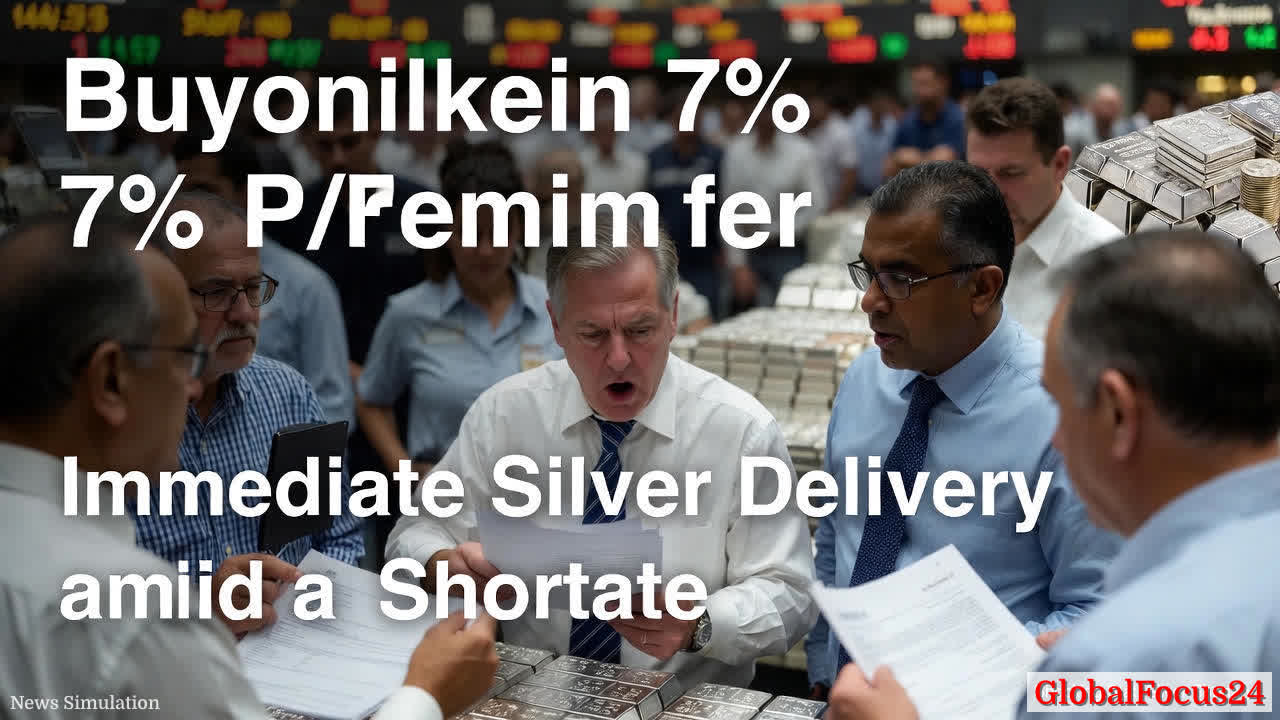
Buyers Pay 7% Premium for Immediate Silver Delivery Amid Shortage
A dramatic shift in the silver market signals a pronounced shortage of physical metal in London, as buyers now pay a 7% premium to receive silver immediately rather than waiting for delivery up to a year. The move, far from the usual backwardation or contango spreads that reflect storage, insurance, and financing costs over time, underscores tightening inventories and a renewed emphasis on prompt delivery. In a year characterized by heightened demand and supply constraints, the price dynamic between immediate metal and future delivery has rotated from a normally favorable carry to a premium for swift settlement.
Historical context and market evolution The current premium trend marks a notable departure from several decades of price structures in precious metals markets. Historically, silver has often traded with a spread that reflects the cost of financing and storage, with buyers accepting a delayed delivery in exchange for lower upfront costs. The present environment, however, reveals a decisive shift from reliance on paper contracts toward concrete, physical metal, driven by a confluence of supply disruptions, investor risk management, and strategic hedging by institutions.
In the mid-2010s, silver markets experienced cycles of volatility driven by industrial demand, jewelry fabrication, and mining supply. Yet the last eight months have wrought a distinct pattern: inventories in key hubs like London’s Precious Metals Vaults have tightened, and commercial banks alongside major end-users have escalated grabs for physical stock. Market observers note that this degree of immediacy demand mirrors episodes in which scarcity drives premiums higher as buyers attempt to lock in metal amid uncertainty about future availability.
Economic impact and price dynamics The 7% premium for immediate delivery signals not just a logistical tightness but a broader risk-off posture within the precious metals complex. When buyers are willing to incur a premium to secure metal today, it indicates confidence in the near-term utility of silver—whether as a hedge against inflation, a diversification tool for portfolios, or a strategic reserve in times of market stress. The immediate settlement dynamic also pressures price formation, potentially creating a ceiling on futures curves if spot demand remains robust.
Analysts point to a multi-factor backdrop for the surge in silver prices during 2025, including:
- Industrial demand: Silver’s role in electronics, solar panels, and other high-tech applications sustains demand even when prices rise.
- Investment flows: Exchange-traded products, over-the-counter trades, and private collections contribute to liquidity shifts that impact both spot and futures markets.
- Mining and refinery constraints: Disruptions or geopolitical factors affecting mining output and refining capacity can constrain available stock for immediate delivery.
- Central bank and institutional behavior: Large holders hedging against potential macroeconomic volatility may reduce the pool of readily deliverable metal.
The result is a price environment where silver’s year-to-date gains have reached a cumulative surge that broadens implications for related markets. While silver futures may reflect expectations about supply normalization, the persistent premium on immediate delivery suggests that market participants expect tighter physical availability in the near term.
Regional comparisons and supply chain considerations London has historically served as a pivotal global hub for precious metals, with the London Bullion Market Association (LBMA) supervising standards for bar quality, storage, and settlement. In recent months, the London market has seen heightened activity as bullion banks and large users accelerate storage and allocation strategies to guard against potential distribution gaps. Comparable centers in Zurich, Singapore, and New York are reporting similar strain indicators, though the London market remains a focal point due to its deep liquidity and established regulatory framework.
Regional dynamics underpinning the shortage vary by geography. In some regions, domestic refining bottlenecks have slowed the conversion of refined silver into the physical metal available for immediate delivery. In others, elevated demand from solar energy, automotive electronics, and medical technologies has sustained a robust baseline for physical stock, intensifying competition for what remains. The cross-border nature of silver markets means that inventory movements in one region can ripple through global supply chains within days, reinforcing the sense of urgency among buyers.
Price signals and investor behavior The 7% immediate-delivery premium effectively tightens the spread between spot and forward contracts, signaling a shift in risk assessment among market participants. Investors may interpret such premiums as a barometer of physical tightness rather than purely financial speculation. As a result, portfolios that previously relied on manufactured spreads for arbitrage now recalibrate toward securing immediate metal or diversifying across precious metals with correlated demand drivers.
From a risk-management perspective, the premium offers a practical lens into liquidity risk. Buyers who cannot access immediate stock may encounter delivery delays that complicate hedging strategies or industrial procurement plans. Banks and large buyers, in particular, appear to be prioritizing certainty over cost, a stance that could influence credit lines, collateral requirements, and contingency planning across sectors reliant on silver.
Implications for miners, refiners, and downstream users For mining entities, sustained high premiums for immediate delivery create incentives to accelerate production or optimize pipeline scheduling to align with market demand for fast settlement. Refineries and mints may face tighter throughput constraints if demand for physical stock outpaces capacity, potentially driving investment into new facilities or expansion of existing infrastructure. Downstream manufacturers that rely on predictable supply chains may adjust procurement cycles to balance cost, delivery speed, and inventory levels, reducing exposure to sudden price spikes.
Public reaction and market sentiment Public and industry sentiment in recent weeks has reflected a blend of concern and pragmatism. Investors familiar with the historical volatility of silver have noted that the metal’s dual role as both an industrial input and a store of value amplifies the impact of supply constraints. While some commentators frame the premium as a short-term anomaly, many market participants, including funds and regional distributors, are adopting a cautious posture, building inventories where feasible to mitigate the risk of supply disruption.
Broader context: silver’s performance within the metals complex Silver’s performance this year sits within a broader metals landscape that has seen elevated interest in precious metals as hedges against inflation and macroeconomic uncertainty. When silver outperforms gold, it often sparks renewed attention to the role of physical metal in diversified portfolios. The current environment, characterized by a surge in prices and a pronounced premium for immediate delivery, underscores the ongoing dialogue about the balance between financial instruments and real assets.
Outlook for the remainder of the year Analysts caution that while the immediate-delivery premium highlights current tightness, it does not automatically signal permanent scarcity. If refining capacity expands, mining output rebounds, or stock depositories replenish, the premium could moderate as spot availability improves. However, the persistence of elevated premiums would depend on sustained demand across industrial and investment channels, as well as the resilience of supply chains in key producing and consuming regions.
Market participants are watching several catalysts that could influence near-term dynamics, including regulatory developments affecting precious metals storage, macroeconomic indicators shaping risk appetite, and potential shifts in geopolitical risk that influence demand for safe-haven assets. The interplay between financial instruments and physical stock will continue to shape pricing, liquidity, and strategic planning for market participants well into the next quarter.
Key takeaways for investors and decision-makers
- Immediate-delivery premiums rising to 7% indicate tightening physical silver supply in major trading hubs.
- The premium reflects a shift from paper contracts to tangible stock, with banks and large buyers prioritizing certainty.
- Silver prices in 2025 have demonstrated strong momentum, reinforcing the metal’s appeal as an inflation hedge and diversification asset.
- Regional inventory dynamics and supply-chain constraints will continue to influence price behavior and delivery timelines.
- While the long-term trajectory remains uncertain, heightened attention to physical stock and liquidity is likely to persist through the coming months.
For readers seeking to understand the current state of the silver market, the core takeaway is clarity about demand for immediate settlement in the face of constrained supply. As buyers chase available inventories, market dynamics tilt toward faster delivery, potentially reshaping how refiners, traders, and end users approach pricing, procurement, and risk management in precious metals markets. The story of silver in 2025 is one of tension between the immediacy of demand and the slow, stubborn rhythms of physical-supply constraints, a balance that will continue to unfold in the days ahead.