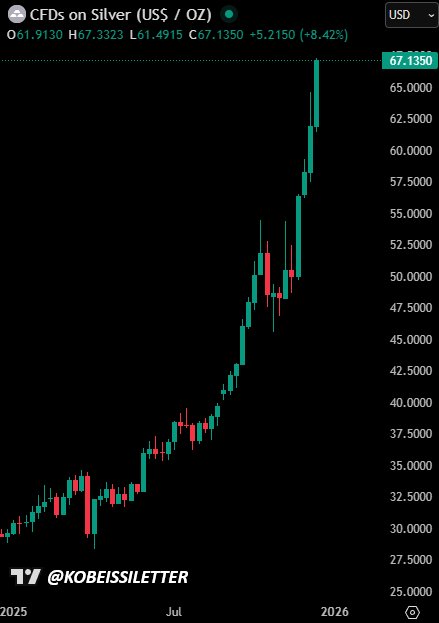
Silver Prices Surge Past $67 per Ounce in Historic Milestone
The silver market crossed a historic threshold this week as prices surged past $67 per ounce, marking an unprecedented peak for the precious metal. The milestone caps a disruptive year for silver, with a roughly 133% gain since the start of 2025. Traders, manufacturers, and analysts are parsing the forces behind the rally, including supply constraints, rising industrial demand, and shifting investor sentiment that has turned silver into a focal point for hedging risk in a volatile macro environment.
Historical context and market dynamics
Historically, silver has traded at the intersection of monetary uncertainty and industrial necessity. Unlike gold, which is often viewed primarily as a store of value, silver has a dual role as both an investment asset and a critical input for a wide array of industrial processes. The 2020s have underscored this duality. A combination of constrained mine supply, aging mining infrastructure, and rising energy costs has constrained annual silver production in several key regions. At the same time, demand from electronics, solar power, medical devices, and automotive applications has surged, particularly as the world accelerates decarbonization and digital transformation.
Analysts point to several catalysts driving the current rally. First is the enduring supply-demand imbalance: as global industrial activity expands, demand for high-purity silver alloys, photovoltaic cells, and high-precision components grows steadily. Second is the deployment of new solar and energy storage technologies, which rely on silver for conductive pathways and other critical functions. Third is macroeconomic uncertainty that has pushed investors toward precious metals as a hedge, even as higher interest rates and a rising U.S. dollar have historically weighed on precious metals, the silver market has shown resilience through diverse macro scenarios. Fourth is de-risking in supply chains—nations and companies are emphasizing local sourcing and strategic stockpiles for essential metals, a move that can tighten available inventories in times of sudden demand spikes.
Regional perspectives: how different economies are affected
In North America, silver's price run has implications for manufacturers in the electronics, automotive, and solar sectors. U.S. producers of solar panels, battery components, and specialized electronics components often require consistent silver supply for high-conductivity applications. The rally increases input costs in the near term, potentially nudging some projects toward efficiency improvements and material substitution where feasible. For the solar industry, the cost of silver is a component of total system cost, and sustained high prices may influence project economics, particularly in regions with thin margins or aggressive renewable-energy incentives.
In Europe, silver's ascent dovetails with ongoing energy transition plans and industrial modernization initiatives. European manufacturers have long tracked metal inputs closely as part of broader supply-chain resilience programs. A high silver price can spur investments in recycling infrastructure, as recovered silver from used circuits and photovoltaic modules becomes more economically valuable. European policymakers and industry groups are watching for signs that elevated prices might accelerate innovation in materials science and manufacturing processes that reduce per-unit silver usage without sacrificing performance.
In Asia, several large-scale manufacturing hubs rely on silver for electronics, semiconductors, and consumer electronics. Countries with significant solar deployment and electronics supply chains could experience broader inflationary pressure in metal-intensive segments, influencing procurement strategies and price pass-through in downstream goods. Conversely, high silver prices may incentivize local recycling and more aggressive material efficiency programs, particularly in export-oriented economies seeking to maintain competitive pricing.
Economic impact across sectors
- Industrial users: For manufacturers, the immediate concern is input cost pass-through. Silver is used in a broad range of applications, from solar photovoltaic cells to X-ray detectors and printed electronics. A sustained higher price environment could lead to phased design changes, alternative materials exploration, and longer-term procurement planning. Firms with hedging programs and long-term supply contracts may weather volatility more effectively than those relying on spot markets.
- Investment and financial markets: The surge into uncharted territory reinforces silver's status as a liquid asset class with both speculative and hedging characteristics. Exchange-traded products and futures markets have seen robust activity as participants rebalance portfolios in response to macro risks, inflation expectations, and geopolitical considerations. Price discipline from major exchanges and the availability of diverse financial instruments continue to attract a broad range of investors.
- Recycling and secondary supply: Elevated prices tend to encourage more robust recycling of silver-containing products. The lifecycle approach—recovering silver from electronics, medical devices, and solar modules—adds a downstream supply channel that can mitigate some of the pressure from primary mine output. Policy incentives, technology improvements in recycling efficiency, and established take-back programs will influence how quickly secondary supply expands.
- Geographic supply risks: Silver mining is concentrated in a handful of countries, with major producers historically including Mexico, Peru, and China, among others. Disruptions stemming from labor disputes, weather events, or regulatory changes can tighten supply and intensify price movements. Investors and users alike monitor geopolitical and regulatory developments that could affect ore grades, mine throughput, and refining capacity.
Market structure and forward-looking considerations
The current price path suggests a blend of speculative momentum and genuine demand-driven fundamentals. A few key considerations stand out for market participants and policymakers:
- Inventory dynamics: The level of silver held in exchange-backed warehouses, COMEX-certified stocks, and associated inventories can influence near-term price volatility. When supplies tighten, even modest changes in available stock can translate into pronounced price movements.
- Substitution risk: In some applications, engineers explore whether small substitutions for silver are technically feasible without compromising performance. Advances in materials science may gradually reduce silver intensity in specific components, offering a potential counterbalance if prices remain elevated for an extended period.
- Fossil fuel vs. renewables: The energy transition remains a primary driver of silver demand, particularly through solar energy deployment. As countries adjust renewable-energy targets and storage strategies, silver demand in photovoltaic technology is likely to remain robust, though the exact trajectory will depend on technological breakthroughs and policy support.
- Inflation and monetary policy: As a monetary-metal with industrial uses, silver prices can respond to shifts in inflation expectations and central bank actions. While high rates can dampen some speculative activity, persistent inflation and risk appetite shifts can sustain interest in tangible assets like silver.
Sociopolitical context and public sentiment
Public reaction to the historic price milestone reflects a mix of awe and caution. Investors celebrate the achievement as a demonstration of silver's enduring relevance and resilience in volatile markets. Manufacturers express a careful optimism, recognizing both the opportunity for price-mediated demand signals and the challenge of higher input costs in the near term. Consumer-facing sectors that rely on compact electronics and solar installations watch developments closely, as pricing dynamics can influence project economics and capex planning.
A broader sense of urgency accompanies the milestone. Silver's ascent underscores a global trend: essential materials are increasingly priced as strategic assets with implications for energy, technology, and infrastructure. This shift reinforces the importance of transparent markets, robust supply chains, and sustainable practices that maximize efficiency and minimize waste. As industries and governments assess the implications, the path forward will likely emphasize resilience, recycling, and innovation.
Regional comparisons offer a nuanced view of how the price spike translates into real-world outcomes. In regions with strong solar deployment, high silver prices can impact the levelized cost of energy and the competitiveness of solar projects. In manufacturing hubs focused on electronics and semiconductors, suppliers may adjust procurement cycles, build longer-term contracts, or pursue material substitutions to maintain margins. Across all regions, the silver milestone serves as a reminder of how closely interconnected global supply chains are with everyday technologies and future growth.
Conclusion
Hitting the $67 per ounce milestone marks a historic moment for the silver market. The price shift reflects a complex mix of supply constraints, rising industrial demand, and investor sentiment that views physical metals as a hedge in uncertain times. As producers and users navigate the new price landscape, attention will turn to inventory levels, recycling potential, and policy signals that could shape the trajectory of silver in the months ahead.
For industry participants, the message is clear: adapt procurement strategies, monitor mining and refining capacity, and explore opportunities for efficiency gains and material substitution where feasible. For policymakers and market observers, the event highlights the importance of transparent markets, resilient supply chains, and investments in recycling infrastructure to secure essential metals for the energy transition and digital economy.
Public interest in the metal’s performance is likely to endure as markets assess how long the elevated price environment will persist and what it means for broader economic activity. In the near term, silver’s uncharted territory will continue to attract attention from investors, manufacturers, and policymakers alike, all watching to see how the world’s metallic backbone responds to the evolving demands of a rapidly changing global landscape.