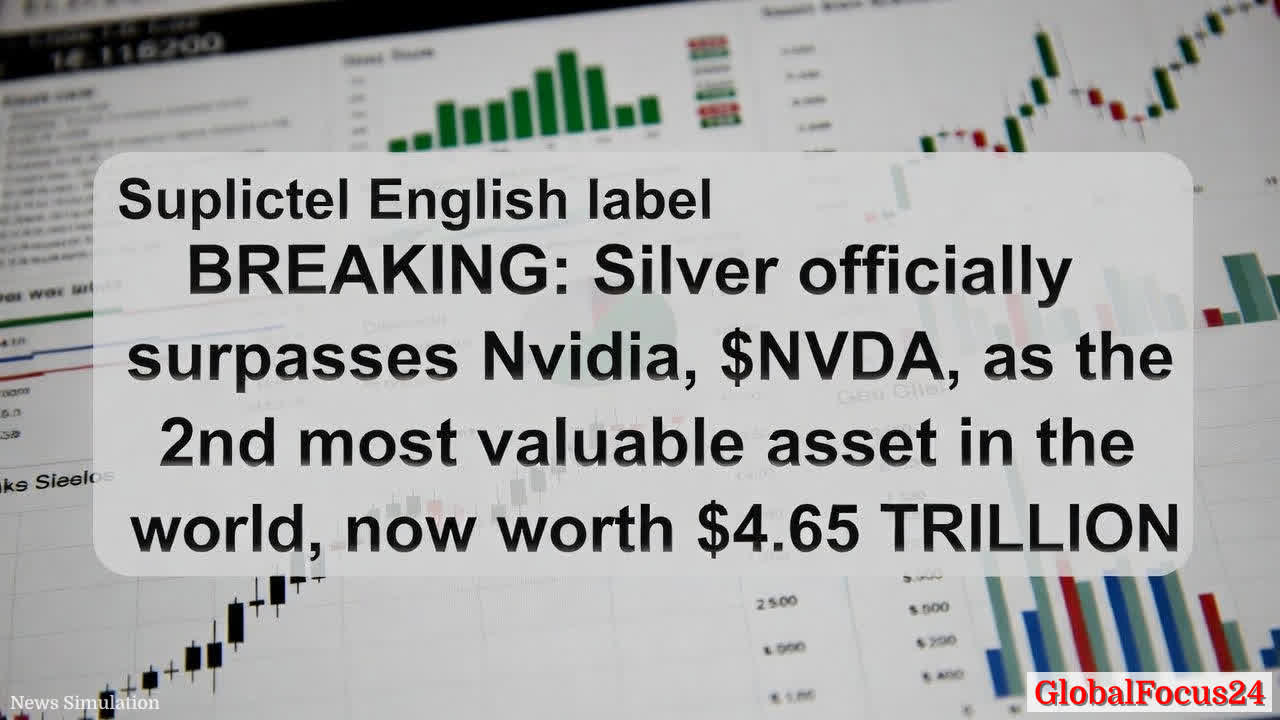
Silver Surpasses Nvidia as the World’s Second-Valued Asset: A Global Market Milestone
In a striking turn of financial markets, silver has overtaken Nvidia to claim the position of the world’s second-most valuable asset, reaching a valuation of approximately $4.65 trillion. The milestone, if sustained, signals a dramatic reassessment of precious metals’ role in a modern, tech-driven economy. It also raises questions about the trajectory of semiconductor equities, supply chain resilience, and the evolving demand dynamics that blend traditional monetary functions with urgent industrial applications.
Historical context: silver’s enduring role in finance and industry
To understand the significance of silver’s ascent, it helps to recall silver’s long-standing dual identity as both money and material. For centuries, the metal has served as a reliable store of value and a unit of account, underpinning coinage, reserves, and international settlements. Its monetary properties—scarcity, durability, divisibility, and fungibility—have kept silver in circulation across continents, even as the global financial system shifted toward fiat currencies and digital assets.
At the same time, silver’s industrial utility has never waned. Reflecting its status as an excellent conductor of electricity and a versatile material in electronics, solar energy, medical devices, and chemical catalysts, silver commands sustained demand from manufacturers and engineers. The past decade has seen a renewed emphasis on green energy and advanced manufacturing, further elevating silver’s industrial use. This dual demand profile—monetary appeal during times of uncertainty and practical everyday utility—continues to shape investors’ views of silver as both a hedge and an essential input for modern supply chains.
The current surge and its drivers
Several forces appear to be converging to lift silver’s valuation to record territory. First, inflationary pressures and currency volatility have historically supported precious metals as a portfolio hedge. When investors worry about the erosion of purchasing power, safe-haven assets like silver often attract capital as a relatively accessible alternative to gold.
Second, the industrial demand narrative has become more pronounced with the continued expansion of solar photovoltaic technology and electronics manufacturing. Silver’s role in solar panels as a high-efficiency electrical conductor, together with its applications in electronics, medical devices, and water purification systems, provides a recurring backbone of demand even as other commodities fluctuate.
Third, the supply side presents a nuanced picture. Silver production is distributed across several mining regions, and disruptions—whether geopolitical, weather-related, or labor-related—can influence price dynamics. The balancing act between supply constraints and rising demand creates a backdrop where investors re-evaluate silver’s risk and return profile, potentially anchoring prices at higher levels than in prior cycles.
Compared to Nvidia’s market narrative
Nvidia has been a standout in the technology sector, driven by leadership in graphics processing units, artificial intelligence acceleration, and a diversified product ecosystem spanning data centers, gaming, and automotive applications. The company’s market capitalization has reflected expectations of sustained growth, prolific demand for AI workloads, and a resilient product roadmap that aligns with hyperscale computing needs.
However, in this moment, silver’s move past Nvidia highlights how financial markets assign value not only to growth potential but also to the perceived stability and strategic role of a resource with broad industrial and monetary relevance. Nvidia’s position, while formidable in its own right, now sits within a broader context of asset reallocation and risk reassessment across asset classes, currencies, and regional markets.
Regional comparisons and implications
- United States and Europe: In mature markets, investors often balance equities with precious metals and fixed income to diversify risk. Silver’s ascent could influence portfolio allocations, particularly for institutions seeking to blend liquidity, inflation hedging, and exposure to green-energy supply chains. The cross-border flow of capital into silver can reflect a global search for strategic assets that resist rapid valuation swings.
- Asia-Pacific: The region remains a pivotal manufacturing hub for electronics and solar technology. Demand for silver in photovoltaic cells and electronic components aligns with regional policy priorities, particularly green transition initiatives and semiconductor supply chain resilience. A sustained demand channel from Asia could reinforce silver’s price trajectory and market depth.
- Emerging markets: In economies with higher inflation or currency volatility, silver often serves as a portable form of wealth. A shift in asset valuations could influence central banking discussions, reserve diversification, and retail investor behavior as households seek to protect purchasing power.
Economic impact and policy considerations
- Inflation hedging and monetary policy: If silver emerges as a more pronounced hedge, central banks and financial institutions may monitor price movements alongside traditional indicators of inflation. The performance of silver during inflationary periods could influence hedging strategies, reserve management, and macroprudential considerations.
- Industrial supply chains and pricing: For manufacturers relying on silver for electronics and solar technology, higher precious-metals prices can affect input costs, project budgeting, and long-term procurement planning. Companies may respond with supply diversification, efficiency improvements, and alternative materials where feasible.
- Investment flows and market structure: A shift in asset leadership often triggers rebalancing, risk parity strategies, and changes in futures and spot-market activity. Liquidity in silver markets, funding costs for mining operations, and the accessibility of bullion for individual investors can all influence the velocity of price movements.
Sustainability and long-term outlook
The broader context for silver includes environmental and social governance considerations. Mining operations carry environmental footprints, and the industry faces ongoing pressures to improve sustainability, reduce water usage, and mitigate tailings risk. Advances in mining technology, recycling rates, and substitution research can modulate the long-term supply-demand balance and influence price stability over multiple business cycles.
From a technological vantage point, Silver’s role in sustainable energy devices—like solar modules and energy storage systems—places it squarely at the intersection of climate policy and industrial productivity. As nations advance decarbonization goals, the durable demand for silver in critical technologies may provide a steady underpinning for its value, even as other asset classes experience volatility.
Public reaction and market sentiment
Investor sentiment often moves in tandem withdrivers, but it can also diverge from fundamental data. A narrative of “silver as the new global reserve asset” may capture media attention, fueling speculative activity in the near term. Yet, seasoned market participants typically emphasize the need to assess supply constraints, monetary policy signals, and real-economy demand to gauge whether the current leadership position is sustainable.
Regional markets are reacting with a mix of enthusiasm and caution. Retail investors may view silver as both a store of wealth and a practical investment in infrastructure-related industries. Professional asset managers emphasize portfolio diversification, risk management, and scenario analysis to navigate volatility and maintain discipline across investment horizons.
Technological segmentation and future pathways
- Electronics and conductors: Silver’s unparalleled conductivity ensures continued relevance in high-performance electronics. Innovations in flexible electronics, wearable devices, and advanced sensors could sustain demand for silver as a core material.
- Solar energy: In photovoltaic cells, silver remains a key component for efficient electricity conversion. As solar deployment accelerates globally, silver demand is likely to exhibit a stable, long-run growth pattern, even if short-term price fluctuations occur.
- Medical and water technology: Silver’s antimicrobial properties and chemical stability support applications in medical devices and water treatment systems, contributing to resilient demand across sectors.
- Recycling and circular economy: Enhanced recycling of silver-containing products can bolster supply resilience. Circular economy initiatives may help moderate price volatility by returning silver to the market from used electronics and industrial waste streams.
Conclusion: navigating a dynamic asset landscape
The moment in which silver surpasses Nvidia as the world’s second-most valuable asset signals more than a. It underscores the evolving interplay between traditional precious metals, high-growth technology equities, and the industrial demand that underpins critical infrastructure. For policymakers, investors, and industry leaders, the implications extend across inflation dynamics, supply-chain resilience, and regional economic performance.
As markets digest this development, observers will watch for sustainability in the price path, the durability of demand drivers, and the capacity of silver markets to absorb shifts in global risk sentiment. The coming quarters will reveal whether this milestone reflects a temporary reallocation of capital or a sustained re-prioritization of assets in a world where every basis point of price, supply, and productivity matters.