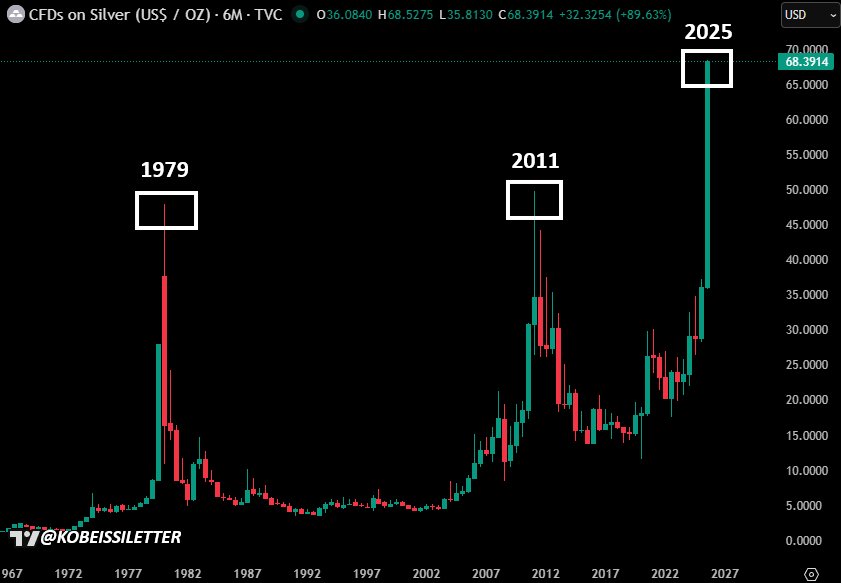
Silver Surges to New Highs as 2025 Sparks Third Supercycle
Silver prices have entered uncharted territory in 2025, rising to daily record highs and delivering a remarkable 140% year-to-date increase. The precious metal's eight-month streak of gains reflects a confluence of demand drivers, macroeconomic pressures, and shifting investor sentiment that together push silver beyond prior peaks. In recent trading, prices have convincingly surpassed the $68 per ounce level, a threshold that would have seemed improbable even a few years ago. The move marks a dramatic departure from established patterns, prompting both market participants and policymakers to reassess the metal’s role in portfolios and global supply chains.
A historical arc unfolds as silver eclipses notable past peaks
To understand the significance of the current rally, it helps to place it within a long-running historical context. Silver has long lived in the shadow of gold, trading as both a monetary metal and an industrial commodity. The late 1970s and early 1980s saw silver prices spike during inflationary pressures and financial market turmoil, culminating in dramatic highs that many investors still reference as benchmarks. A later surge in the early 2010s, driven in part by renewed concerns about monetary policy and safe-haven demand, resulted in another set of elevated price levels. The 2025 run, however, has surpassed those prior peaks, positioning silver within what market participants are calling the third silver supercycle in its modern history.
Analysts describe the current phase as different from prior rallies in both pace and breadth. While earlier spikes often rested on specific triggers—such as inflation spikes or particular supply shocks—the 2025 ascent appears to derive from a broader, multi-faceted set of factors: sustained low-interest-rate environments in many regions, persistent geopolitical tensions that heighten demand for safe assets, and a structural shift toward industrial applications that increasingly rely on silver’s unique electrical, thermal, and antimicrobial properties. The result is a price path marked by rapid gains, high volatility, and sustained participation across a wide range of market segments.
Economic impact spreads across sectors and regions
The ramifications of silver’s ascent extend far beyond speculative traders. As one of the most widely used metals globally, silver underpins sectors ranging from solar energy and electronics to medical devices and automotive technology. A price backdrop at or above the current levels reshapes cost structures for manufacturers, potentially altering procurement strategies and investment plans. In the solar industry, for instance, silver continues to play a crucial role in photovoltaic cells. While technological advances and efficiency gains help control overall material intensity, higher silver prices can influence the economics of solar projects, particularly in markets where margins are already tight.
In the electronics and electrical equipment sectors, silver’s unparalleled conductivity supports a broad array of components—from high-performance semiconductors to critical contact materials. Elevated prices may incentivize manufacturers to seek alternatives or to implement more efficient usage strategies, including recycling and design optimization. These responses can, in turn, drive changes in supply-chain practices, affecting not only end-product pricing but also procurement cycles, inventory management, and research and development priorities.
From an economic perspective, the sustained rally in silver intersects with broader macroeconomic forces. Inflation dynamics, currency movements, and central-bank policies collectively shape investor behavior and asset allocation. In markets where inflationary expectations remain elevated, investors often seek tangible assets that preserve value, and silver serves as a versatile instrument in this context. Additionally, the metal’s sensitivity to currency fluctuations—often priced in U.S. dollars—can amplify or dampen price movements for buyers and producers in different regions, depending on exchange-rate trajectories.
Regional comparisons highlight varying exposure and resilience
Different regions experience the silver surge with distinct characteristics. In large, import-dependent economies, rising metal prices can contribute to higher input costs for manufacturing, potentially fueling inflationary pressures if pass-through occurs. Conversely, producers and exporters that hold significant silver inventories may see improved balance sheets as prices rise, though this comes with higher hedging considerations and market risk.
Emerging markets with advanced industrial sectors—such as those expanding solar installations, electronics manufacturing, or medical device production—may encounter amplified effects from silver price movements. For these economies, the metal’s price trajectory interacts with their own currency strength, trade relationships, and domestic policy choices, creating a mosaic of outcomes. In regions with diversified manufacturing bases and robust energy transition initiatives, silver price trends can also influence investment incentives and project pipelines, especially in sectors where silver’s role is integral to performance and efficiency.
On the investor front, hedge funds, commodity funds, and retail investors alike are recalibrating their strategies. Portfolio managers weigh the benefits of exposure to precious metals against volatility and correlation with other assets. The current rally’s breadth—spanning physical holdings, futures markets, and exchange-traded products—reflects a broad-based interest that could sustain or accelerate price discovery in the near term.
Supply considerations and market dynamics
Beyond demand, supply fundamentals remain a critical lens through which to view the silver market. Global silver production has historically magnetic ties to mine output, jewelry demand, electrical fabrication, and industrial demand. In 2025, supply dynamics are influenced by factors such as mining costs, geopolitical risk in major producing regions, and the cadence of mine development projects. While silver is more abundant than gold, its production is often subject to higher extraction costs in certain jurisdictions, making the market more sensitive to price movements and exploration success.
Recycling activity also shapes the supply-demand balance. Silver is highly recyclable, and the reuse of scrap from electronics and industrial processes provides a significant, albeit variable, stream of supply. As metal prices rise, recycling economics become more favorable, potentially offsetting some of the pressure from rising primary production costs. Industry participants closely monitor recycling rates, collection infrastructure, and policy frameworks that encourage or impede material recovery.
Market participants and sentiment indicators
In this cycle, traditional technical indicators appear to be losing some relevance as the rally continues. Patterns that previously signaled turning points—such as momentum divergences or overbought readings—have not reliably forecast a pullback, prompting analysts to consider broader macro drivers and supply-demand signals. This shift underscores the evolving nature of commodity markets, where computerized trading, algorithmic strategies, and cross-asset correlations can blur conventional signals.
Investors are watching financial benchmarks that often correlate with precious metals, including real yields, inflation expectations, and currency strength. When real interest rates remain low or negative in real terms, non-yielding assets like silver may attract greater interest as stores of value. Conversely, if inflation expectations ease or if central banks pivot toward tighter policy, the dynamic can shift rapidly, feeding volatility and repositioning risk-reward calculations.
Public reaction and the broader narrative
Public sentiment around silver has grown increasingly pronounced as prices push higher. Retail investors, long wary of speculative episodes, are joined by professional traders and institutional participants who view the metal as a cornerstone of diversified exposure. Media attention, social discussions, and the attention of market commentators contribute to a feedback loop, reinforcing demand from a broad audience while fueling caution about the risks inherent in fast-moving markets.
Within communities that rely on silver for cultural or practical reasons, the price surge has sparked conversations about affordability, investment literacy, and the implications for households. As with other volatile assets, the public discourse often emphasizes preparedness, risk management, and the importance of understanding the fundamentals behind price movements rather than chasings.
Pathways forward: potential scenarios and considerations
Looking ahead, several scenarios could shape the trajectory of silver prices in the near to medium term. If the current drivers remain intact—strong industrial demand, durable safe-haven appeal, and supportive macro conditions—silver could sustain elevated levels or push toward new milestones. However, the market could also face retracements if inflation expectations cool, if alternative assets attract greater attention, or if supply responses become increasingly effective at dampening price spikes.
For participants across sectors, prudent risk management remains essential. Companies that use silver in manufacturing may review hedging strategies, supplier diversification, and inventory policies to mitigate exposure. Investors may consider a balanced approach that accounts for both potential upside and the inherent volatility of a rapid rally. Regulators and industry bodies might scrutinize market activity to ensure transparency, orderly trading, and robust reporting in a market experiencing rapid shifts.
Global context and historical parallels
The silver market does not operate in a vacuum. Its movements intersect with global trade dynamics, energy prices, and the broader landscape of commodities that fuel industrial activity and financial markets. While each cycle has its own character, historical parallels provide a framework for interpretation. The 1970s and 2010s rallies demonstrated how a combination of inflation pressures, currency fluctuations, and investor demand for tangible assets can propel metals to elevated levels. The 2025 cycle, by contrast, reflects a more integrated set of factors, including accelerating energy transition efforts and the resilience of manufacturing demand in a digitally driven economy.
In regional terms, advanced economies that implement policies encouraging clean energy adoption and technological advancement may find silver a strategic input in multiple value chains. At the same time, developing economies pursuing diversification and modernization may experience heightened costs of inputs in the near term, which could influence competitiveness and investment priorities. The net effect is a global mosaic of outcomes, where silver’s role as both commodity and asset class becomes increasingly nuanced.
Conclusion: silver’s ascent and its lasting implications
The ascent of silver in 2025 signals more than a price move; it reflects evolving market perceptions about value, risk, and the interplay between financial markets and real economic activity. With prices at levels that surpass historical peaks, the metal sits at a crossroads—potentially reinforcing its place as a versatile industrial input and a strategic store of value for investors. The coming months will reveal how the balance of demand, supply, and macro policy shapes the path forward, and how regional markets adapt to a landscape where silver’s role continues to expand in unexpected directions.
In a world where asset prices continually test new thresholds, silver’s current cycle stands out for its breadth of participation and its endurance. For manufacturers seeking continuity in supply chains, investors seeking diversification, and policymakers aiming to ensure orderly markets, the key remains careful analysis of fundamentals, transparent market mechanics, and flexible risk management. As the metal carves a new chapter in its long-running history, observers will watch closely not only the next price tick but the evolving economic ecosystems that sustain demand for this uniquely versatile metal.