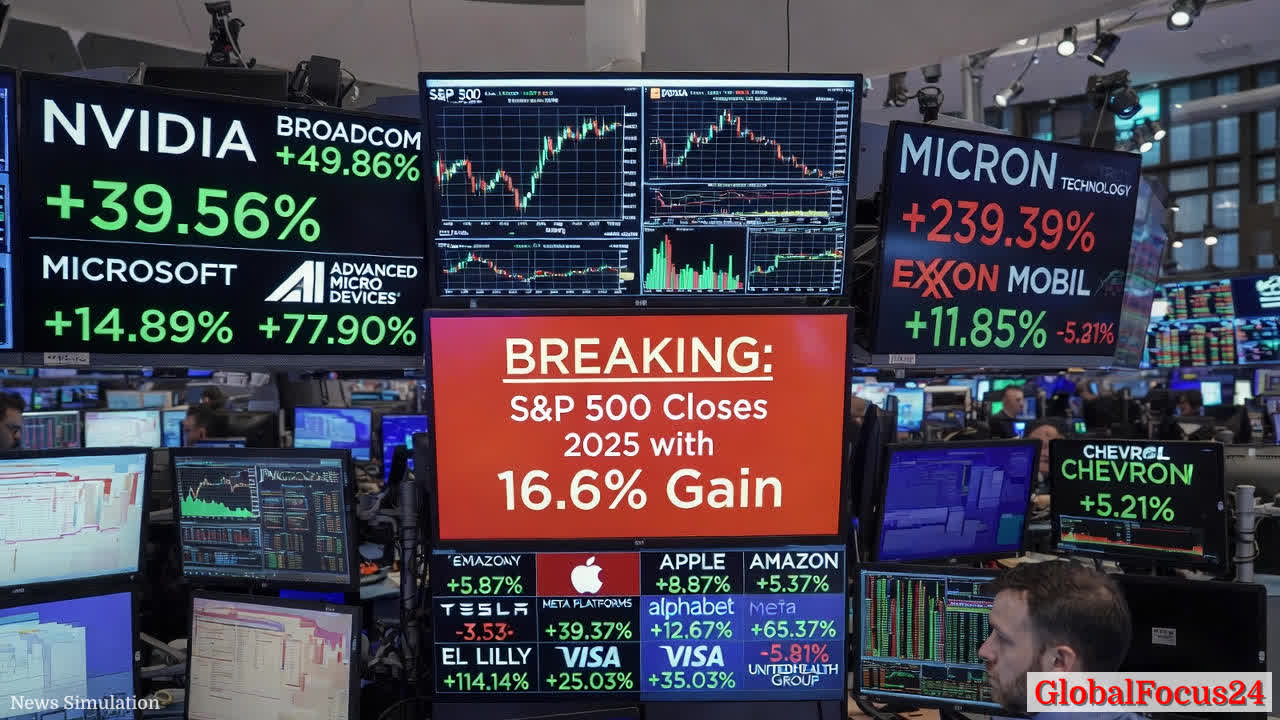
S&P 500 Closes 2025 with 16.6% Gain, Marking Third Consecutive Double-Digit Year
The stock market closed 2025 on a strong note, with the S&P 500 posting a 16.6% gain for the year. The double-digit advance extends a three-year streak of robust returns, underscoring a period of resilience as investors navigated shifting macro conditions, evolving technology trends, and sectoral rotations. The year’s performance reflects a broad-based rally tempered by selective weakness, with leadership concentrated in technology and select consumer, financial, and energy names.
Historical context and macro backdrop To understand 2025’s market trajectory, it helps to view the year against a backdrop of recovering inflation dynamics, monetary policy calibration, and a rapidly changing technology landscape. Inflation cooled from its prior peaks, allowing central banks to maintain a cautious but accommodative stance while gradually normalizing policy. The global growth environment remained uneven, characterized by pockets of strength in developed and emerging markets alike, but with ongoing sensitivity to supply chain realignments, labor market resilience, and geopolitically driven energy demand.
From 2019 through 2025, the S&P 500 has experienced periods of volatility driven by technological breakthroughs, geopolitical shifts, and the cyclical nature of enterprise investment. The 2025 close fits into a longer arc of growth tied to productivity gains from digital transformation, cloud adoption, and the commercialization of artificial intelligence across industries. Corporate earnings expanded in multiple sectors, supported by persistent demand for software, semiconductors, and innovative consumer products, even as some traditional groups faced margin pressures or competitive disruption.
Sector and stock highlights Technology stocks led the year, as innovation and capital expenditure in AI and cloud computing fueled investor interest. Nvidia and Broadcom delivered outsized performances, signaling continued demand for high-performance chips and semiconductors essential to advanced computing and AI inference. Microsoft posted a solid gain, reflecting ongoing strength in its cloud-based platforms and productivity software. Advanced Micro Devices posted a marked advance, underscoring the ongoing secular demand for processor capacity and accelerating product cycles.
In the semiconductor segment, Micron Technology achieved standout growth, illustrating the tilt of the market toward memory and data-center-related applications. The momentum in semis mirrored a broader technology cycle that emphasized efficiency, data processing capability, and the strategic importance of domestic supply chains for critical components.
Consumer cyclicals showed a more nuanced year. Tesla delivered a remarkable rally, driven by product cadence, demand in key markets, and investor enthusiasm for electric-vehicle scale and autonomy, contributing to its standout performance. Apple, while delivering a respectable gain, faced a mixed set of headwinds including ongoing supply chain normalization, regulatory considerations, and competition. Amazon also rose, reflecting resilient e-commerce demand, cloud integration, and marketplace dynamics that continued to adapt to evolving consumer behaviors.
Alphabet and Meta Platforms contributed to the communication services bloc, with Alphabet registering a sizable gain that reflected continued strength in digital advertising, cloud-related initiatives, and other growth vectors. Meta Platforms rose modestly, highlighting ongoing strategic pivots and user engagement trends in a challenging but evolving social-media landscape.
Healthcare provided a mix of winners and laggards. Eli Lilly and Company posted a strong gain on late-stage product momentum and broader healthcare trends, while UnitedHealth Group moved lower, illustrating the sensitivity of healthcare-related equities to shifting policy expectations and cost dynamics within managed care and pharmaceutical segments.
Financials, a cornerstone of many investment portfolios, posted solid results. JPMorgan Chase and Visa led the sector with notable gains tied to improved profitability, balance-sheet strength, and the continued expansion of digital payments and financial services innovation. The energy complex showed resilience as well, with Exxon Mobil and Chevron posting gains that reflected ongoing demand dynamics, global energy supply considerations, and the broader transition in energy markets.
Economic impact and investment implications The year’s performance across sectors translates into several practical implications for investors, businesses, and policymakers. First, the leadership bestowed by technology and AI-enabled growth reinforces the importance of research and development, capital expenditure on scalable platforms, and the strategic deployment of cloud-native infrastructure. For corporations, this points to continued prioritization of efficiency, automation, and data-driven decision-making as levers for margin expansion and competitive differentiation.
Second, the breadth of the rally—spanning technology, financial services, and select energy names—suggests that diversified exposure remains a prudent strategy. While some traditionally resilient sectors faced headwinds, others benefited from secular growth trends, a reminder that market leadership can shift with evolving macro and industry-specific catalysts. Investors may have balanced pain points, such as valuation discipline and risk management, with strategies that emphasize quality earnings, healthy balance sheets, and sustainable cash flow generation.
Third, the energy and financials performances highlight the interdependence of macroeconomic conditions and sector performance. Energy stocks benefited from steady demand and price dynamics, illustrating how real-time energy consumption patterns influence corporate profitability. Financials’ strength reflected improving loan demand, credit quality, and capital markets activity, signaling continued resilience in the financial ecosystem as higher interest rates gradually stabilized.
Regional comparisons and global context Regional performance across major markets provides additional nuance. In large, technology-driven economies, equity markets benefited from domestic innovation ecosystems and supportive commercial infrastructure. Regions with robust manufacturing and supply chains for semiconductor components demonstrated notable gains, while areas with exposure to cyclical industries or consumer demand faced more varied results. Comparisons across continents indicate that countries with advanced digital economies and strong corporate investment in AI and cloud computing tended to outperform, even as currency movements and trade dynamics influenced relative returns.
Beyond the United States, several markets experienced parallel themes: heightened demand for AI-enabled products and services, resilient corporate earnings, and strategic adjustments in supply chains to reduce dependence on single-source regions. The global market environment in 2025 reinforced the importance of diversification, currency risk management, and the ability to navigate policy shifts that influence investment flows and corporate profitability.
Innovation, policy, and public reaction Public sentiment around the stock market’s strength in 2025 was shaped by investor confidence in continued innovation and the durability of earnings growth. News about breakthrough technologies, corporate partnerships, and strategic acquisitions contributed to a sense of momentum, even as market participants remained mindful of potential risks, including regulatory scrutiny, competition, and macroeconomic volatility.
From a policy perspective, the year highlighted the ongoing balance policymakers seek between fostering innovation and ensuring market stability. Regulatory developments in technology, healthcare, and financial services continued to influence corporate strategy and investor behavior. Companies that focused on transparent governance, robust risk controls, and accountable deployment of new technologies tended to attract investor interest and maintain credibility with stakeholders.
Public and corporate reaction to earnings and guidance Corporate earnings announcements during 2025 offered a mixed but generally constructive picture. Investors paid close attention to forward-looking guidance, free cash flow generation, and the ability to sustain margins amid price pressures and evolving input costs. Positive earnings momentum in AI-enabled software, cloud services, and select hardware segments reinforced expectations for sustained growth in technology-adjacent industries. In consumer discretionary sectors, performance often hinged on product innovation timelines, pricing strategies, and consumer demand dynamics, shaping short- to medium-term stock trajectories.
This dynamic translated into a year where the market rewarded companies that demonstrated scalable growth, efficient cost management, and clear pathways to profitability. While some stalwart names faced volatility due to valuation concerns or regulatory developments, the overall tone remained accommodative to companies executing strategic plans with credible take-rates and durable competitive advantages.
Looking ahead As investors reflect on 2025, the market’s three-year run of double-digit gains suggests a degree of resilience that could persist if economic fundamentals remain favorable. Key factors to monitor include the pace of technology investment, the trajectory of inflation and interest rates, and the health of global trade and supply chains. Additionally, corporate governance practices and capital allocation decisions will continue to influence market sentiment and investor confidence.
For businesses, the year-end performance offers a reminder of the importance of innovation, disciplined capital expenditure, and strategic resilience. Firms that align product development with real-world needs, cultivate scalable platforms, and maintain strong balance sheets are well-positioned to capitalize on ongoing digital transformation trends.
In healthcare, continued emphasis on innovation in therapeutics and patient-centric models is likely to drive steady growth, even as pricing and regulatory considerations evolve. Financial institutions may benefit from sustained demand for digital payment solutions, risk management services, and the monetization of data-driven insights, while energy companies will continue to navigate the transition to cleaner energy sources alongside the persistence of traditional demand drivers.
Regional winners and losers will depend on how economies balance growth with inflation control, policy support for innovation, and global trade dynamics. Investors should remain vigilant for shocks that could alter the trajectory of the market, including geopolitical developments, commodity price swings, and shifts in consumer sentiment.
In sum, the 2025 close of the S&P 500 reflects a period of sustained growth driven by technological advancement and strategic corporate execution. The triple-digit momentum across a diverse set of sectors underscores a broader narrative: economies and markets that invest in innovation while maintaining financial discipline tend to demonstrate resilience in the face of uncertainty. As 2026 unfolds, market participants will watch for continued progress in AI-enabled productivity, the evolution of cloud-based ecosystems, and the ongoing balance between growth opportunities and risk management.