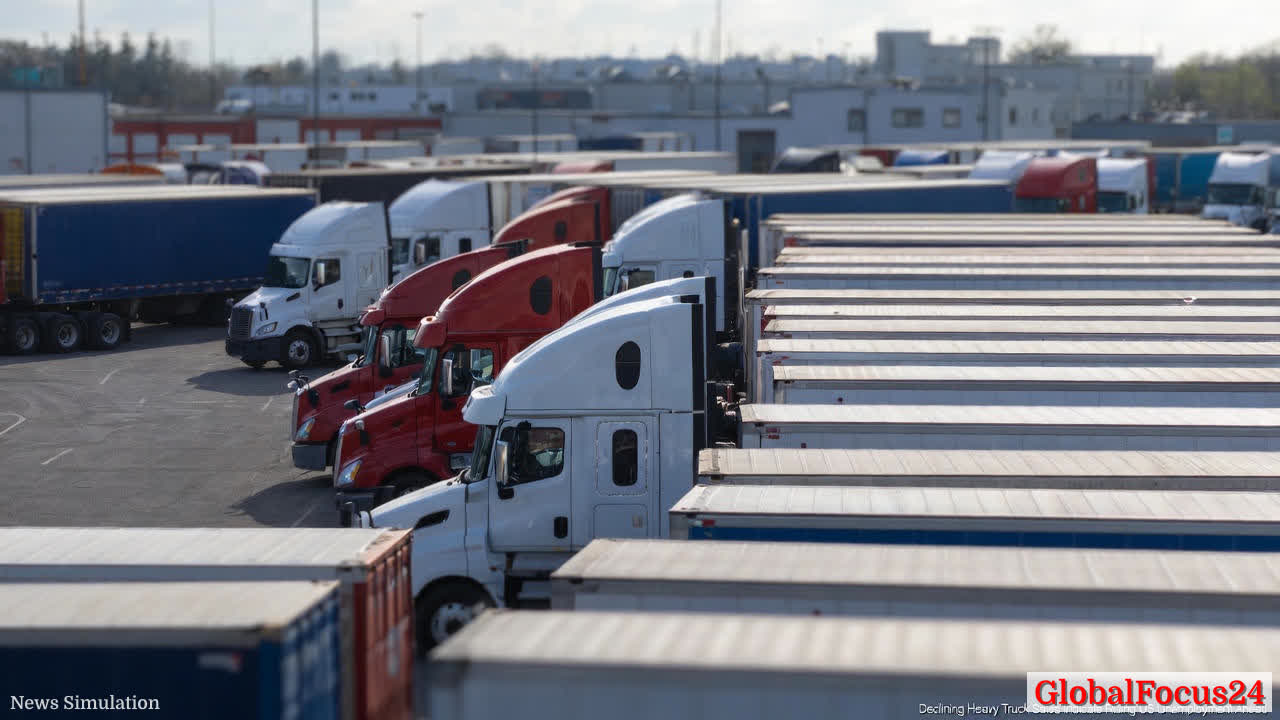
Declining Heavy Truck Sales Signal Rising Unemployment Risk in the U.S.
In a development that broadens the lens on the U.S. economy, heavy truck sales have fallen to levels not seen since the early days of the pandemic, underscoring potential weakness in demand across manufacturing, logistics, and construction sectors. Over the past 12 months, U.S. heavy-duty truck sales have totaled roughly 5.1 million units, a figure that marks the weakest performance outside of the most abrupt pandemic disruptions and the lowest since 2020. The slide translates to an approximate 1.1 million-unit drop in annual sales over the last 18 months, a trajectory that has officials and analysts poring over the data for signals about labor market resilience and broader macroeconomic health.
Historical context and the production cycle Heavy truck sales have historically served as a barometer for the American economy. The trucking industry is deeply tied to industrial activity, consumer demand, and global supply chains. When manufacturing output, energy exploration, and freight volumes contract, fleets scale back orders for tractors, trailers, and related equipment. Conversely, a rebound in freight volumes typically foreshadows broader labor market improvements as shippers restock fleets and logistics networks respond to rising demand.
The current downturn arrives after a multi-year period of robust fleet investment spurred by strong consumer spending, infrastructure projects, and a recovery from the pandemic-era downturn. The stretch of elevated demand contributed to a high watermark for heavy truck registrations in several recent years. The latest pullback, however, aligns with patterns seen in prior cycles where tightening financial conditions, elevated input costs, and slower growth expectations temper investment in rolling stock and capital equipment.
Economic significance and sectors most affected A sustained drop in heavy truck sales reverberates across multiple layers of the economy. For manufacturers, lower orders can signal a transfer of pricing power and tighter margins, compounding the challenges of already strained supply chains. In fleet management, businesses must balance the need for modernization with the reality of cash-flow constraints, sometimes delaying replacements or upgrades in order to preserve liquidity.
Logistics and transportation are the pulse of commerce. When fleets contract, shipping capacity tightens relative to demand — a dynamic that can press freight rates higher or lower depending on regional conditions and seasonality. The latest figures suggest softening equipment purchases, which can reflect cautious capital spending by trucking companies, shippers, and consumer-facing retailers anticipating slower demand growth or higher financing costs.
Regional comparisons help illuminate the scope and texture of the trend. In regions with heavy manufacturing concentration, such as parts of the Midwest, buyers may pull forward or delay orders in response to plant maintenance cycles and regional demand fluctuations. Energy-producing regions, where trucking activity is closely tied to commodity markets, may experience different rhythms, with volatility in oil and gas that influences fleet utilization and decision-making. The West Coast, a hub for intermodal traffic and cross-border supply chains, often exhibits sensitivity to global trade dynamics, labor availability, and port-related backlogs, which can shape recent sales patterns in nuanced ways.
Interpreting the unemployment signal Economists monitor heavy truck sales alongside a suite of labor and production indicators. In some historical episodes, pronounced declines in new trucking equipment orders have predated upticks in unemployment, offering a forward-looking read on the labor market. The current trajectory has analysts pointing to a potential rise in unemployment by a meaningful margin within a six-month horizon. The precise magnitude remains a topic of debate, given the interplay of financing costs, inventory cycles, and the pace of economic reacceleration.
The labor market has shown resilience in recent quarters, with strong job creation in many sectors and robust wage growth in certain industries. Yet the weight of recent data suggests risks are shifting. A slower expansion in freight activity can translate into softer demand for labor in sectors tied to transportation, warehousing, and manufacturing support services. Employers may respond to uncertainty by adjusting hiring plans, freezing positions, or reallocating roles — moves that can collectively nudge unemployment higher if confidence deteriorates.
Policy and market implications From a policy perspective, the persistence of softer truck demand could influence decisions about financing conditions, industrial policy, and energy transition investments. Financing for fleet acquisitions is sensitive to broader interest rate trends and credit availability. If lenders perceive increased risk, credit terms may tighten, further dampening orders for heavy equipment. Conversely, signs of stabilization in freight volumes could support a more favorable financing environment and encourage fleet renewal, which would feed back into economic activity.
On the macroeconomic stage, the trucking sector’s health intersects with inflation trajectories, supply chain normalization, and consumer spending patterns. A gradual rebalancing of demand across goods and services might reduce volatility in freight markets, while persistent headwinds could prolong slower growth phases. The dynamic underscores the importance of close, nuanced monitoring of regional freight flows, port activity, and intermodal capacity to gauge the speed and breadth of any reacceleration.
Public reaction and practical consequences Public sentiment around trucking and employment tends to reflect both direct employment conditions and broader economic expectations. Truck drivers, fleet managers, and logistics workers often sense shifts in demand through workload fluctuations, route patterns, and the pace of equipment upgrades. Communities anchored by warehousing and distribution hubs may feel the impact through shifts in hiring activity, wage trends, and local investment. The social dimension of a slowing freight cycle includes considerations of retraining opportunities, regional development strategies, and the resilience of supply chains that households rely on for everyday goods and services.
Looking ahead: scenarios and uncertainties Experts present multiple scenarios depending on the evolution of consumer demand, industrial activity, and financing costs. In an optimistic path, freight volumes regain momentum as supply chains normalize and manufacturing sectors accelerate, prompting renewed fleet investments and a stabilizing job market. In a more cautious scenario, persistent softness in freight demand and tighter credit conditions could extend the decline in heavy truck sales, with unemployment potentially rising further if businesses scale back hiring to match lower utilization.
Regional resilience will be a critical differentiator. Areas with diversified economic bases, strong export-oriented manufacturing, or dynamic logistics ecosystems may weather a downturn more effectively than regions reliant on a narrow mix of industries. Policymakers and business leaders are likely to emphasize workforce development, retraining programs, and infrastructure investments that bolster long-term productivity and mitigate cyclical vulnerabilities in the trucking and logistics sectors.
Historical benchmarks provide useful context for interpreting the latest data. Previous cycles have shown that declines in heavy-duty equipment orders can precede shifts in labor markets, but the timing and magnitude vary with the pace of demand recovery, credit conditions, and global trade dynamics. Investors and industry participants will be watching closely for corroborating signals from freight volumes, fleet utilization rates, and capacity utilization across key transportation hubs.
Conclusion: a pivotal moment for freight-led growth The drop in heavy truck sales underscores a pivotal moment in the consolidation of demand and supply forces shaping the U.S. economy. While a single data point rarely dictates the trajectory of unemployment, it contributes to a broader mosaic of indicators that economists, analysts, and policymakers use to forecast labor market health and inflation pressures. As freight activity stabilizes or contracts further, the labor market will respond in tandem, and communities dependent on logistics networks may feel the ripple effects more acutely.
In the near term, stakeholders across manufacturing, shipping, and policy circles are likely to prioritize careful budgeting, strategic fleet management, and targeted investments in automation and efficiency improvements. By blending rigorous data analysis with on-the-ground insights from trucking and logistics professionals, analysts aim to discern the true pace of recovery and the potential path for employment, wages, and overall economic vitality in the months ahead.