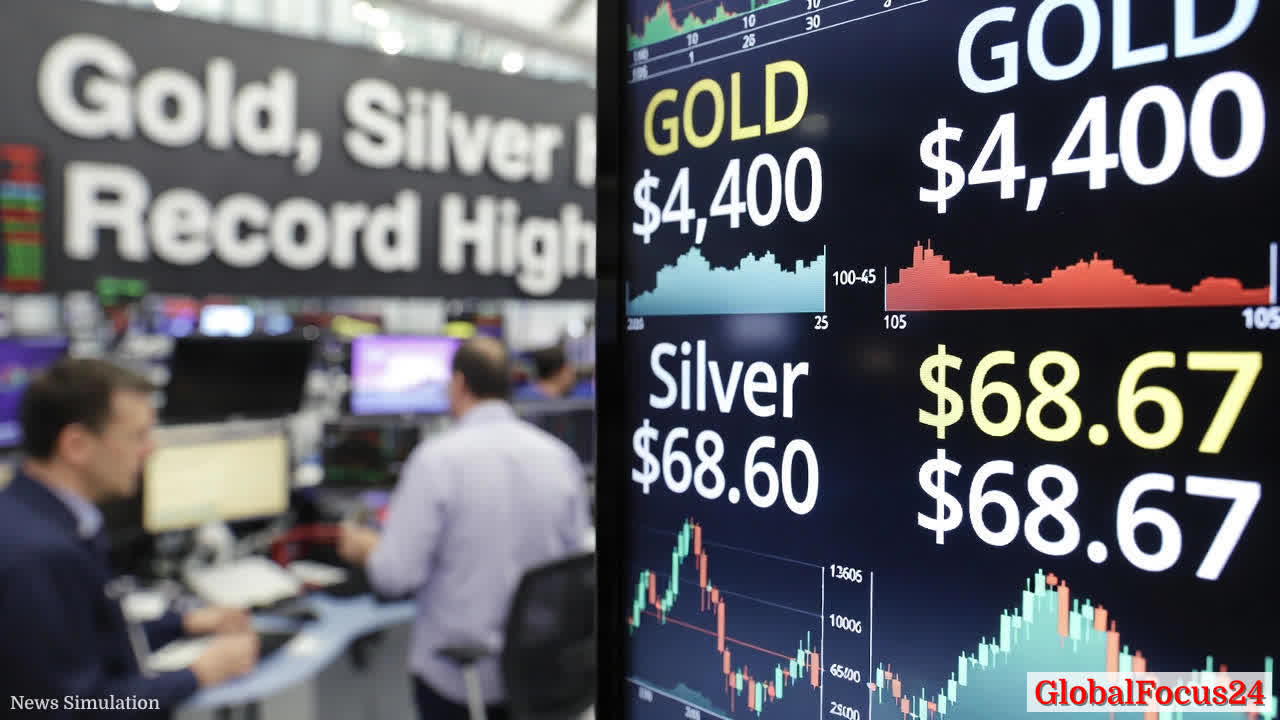
Gold and Silver Prices Surge to Record Highs Amid Rate-Cut Expectations and Geopolitical Tensions
In a dramatic turn for global markets, gold prices surged to all-time highs, crossing the $4,400 per ounce mark as traders priced in a more accommodative U.S. monetary policy backdrop for 2026 and grew wary of geopolitical flashpoints. Futures contracts climbed to roughly $4,445.70 per ounce, while spot gold traded around $4,388.77. Silver followed with a robust advance, rallying about 1.8% to $68.67 per ounce after briefly touching the $69.50 level, with platinum not far behind, up nearly 3% to over $2,013 per ounce. The vigor across precious metals signals a broad-based shift in investor posture toward non-yielding assets in an environment marked by policy ambiguity and regional tensions.
Historical context underscores the extraordinary nature of the current move. Gold has long served as a hedge against monetary and political uncertainty, and its relationship with the U.S. dollar, inflation expectations, and real interest rates has been a persistent driver of cycles of enthusiasm and caution. The latest leg higher echoes a pattern seen during late-stage easing cycles when investors seek ballast in precious metals as traditional asset classes face headwinds from improving risk appetite or inflation dynamics stabilizing unexpectedly. This year’s performance places gold on a trajectory that many analysts say could rival or exceed some of the strongest multi-year advances of the modern era, reflecting both macroeconomic anxieties and a persistent demand for safe-haven assets.
Economic impact is widening beyond the metal markets themselves. The surge in prices for gold and silver has ripple effects across related sectors, including mining equities, jewelry demand, and central-bank reserve allocations. Mining stocks have moved in tandem with bullion prices, though the relationship is nuanced and contingent on production costs, hedging strategies, and country-specific supply dynamics. Companies with diversified portfolios and strong balance sheets have benefited from higher bullion prices, while those with substantial debt or exposure to energy and transport costs face more mixed outcomes. The broader equity market has watched these developments closely, as precious metals activity can serve as both a signal and a stabilizing force during episodes of heightened risk.
From a regional perspective, the surge in precious metals finds resonance in markets across North America, Europe, and Asia, each with distinct macro drivers. In North America, expectations of deeper U.S. rate cuts in 2026 have reinforced the appeal of gold as a nonyielding asset, especially when real interest rates remain elusive or negative. In Europe, central banks have maintained a cautious stance, balancing inflation dynamics against growth concerns, which sustains demand for hedges that preserve purchasing power. Across Asia, a constellation of factors—from domestic inflation pressures to resilient manufacturing and diversified investment flows—has kept gold and silver in the spotlight as strategic reserves and investment vehicles. The regional comparison reveals how, despite differing fiscal trajectories, the common thread is a search for stability in asset prices when political or economic indicators diverge.
Geopolitical tensions have also played a decisive role in fueling safe-haven demand. Recently, heightened geopolitical frictions have intensified concerns around regional stability and global supply chains. While specific policy moves vary by country, the overarching theme is clear: investors are prioritizing assets with intrinsic value and limited exposure to sovereign credit risk. The interplay between geopolitical risk and monetary policy attitudes creates a feedback loop, where expectations of looser policy bolster bullion appeal, and perennially elevated demand for bullion reinforces currency and macroeconomic narratives around resilience and security in uncertain times.
Central-bank activity remains a critical underpinning of current pricing dynamics. Sustained purchases and robust inflows into gold-backed exchange-traded funds (ETFs) have provided ongoing support for bullion markets. This pattern suggests that institutional investors, pension funds, and sovereign wealth entities view gold as a strategic hedge with long-term value, particularly when price volatility in other asset classes remains elevated or when inflation expectations are shifting. While ETF flows have varied across months, the net direction over the year has generally reinforced bullion’s supply-demand balance in favorable ways for holders.
Market participants are closely watching the path of U.S. monetary policy, inflation data, and labor market signals as they assess the sustainability of this price ascent. The prevailing scenario features a market consensus that anticipates looser monetary policy by 2026, even as data recently published has shown mixed signals on job growth and inflation. In such an environment, nonyielding assets like gold and silver tend to attract broader interest, as investors seek to preserve capital and diversify risk without surrendering the potential for capital appreciation that can accompany periods of geopolitical tension or currency weakness.
Industry analysis highlights a number of structural factors shaping the current landscape. First, mining economics remain sensitive to energy costs, labor availability, and regulatory environments, all of which can influence the cost curve for precious metals production. Second, jewelry and industrial demand—particularly for silver, given its extensive use in electronics and solar technologies—continue to provide a floor for metal prices even as investment demand waxes and wanes. Third, technological developments in gold and silver mining, processing, and refining contribute to efficiency gains that can help sustain revenue growth for miners when bullion prices move decisively higher. Taken together, these components suggest that the current surge is not merely a speculative spike but part of a broader structural dynamic in precious metals markets.
Beyond the immediate price action, the stability of gold and silver markets will likely hinge on the evolution of macroeconomic indicators and policy guidance. If subsequent economic data reinforces expectations of slower inflation and accommodative monetary policy, the appeal of safe-haven assets could endure or strengthen. Conversely, if inflation proves more persistent or if central banks signal a quicker pivot toward tightening, bullion markets could experience a pause or retracement, albeit within a wider context of cautious investor sentiment.
Public reaction to the price developments has been pronounced in both consumer and business circles. Retail investors have noted the opportunity to diversify portfolios with precious metals as a potential hedge against currency depreciation and market volatility, while institutional investors have emphasized the role of gold and silver as strategic components of risk parity and capital preservation. Market commentary has also highlighted the potential for price volatility to persist in the near term as new information about inflation trends, labor market resilience, and geopolitical developments emerges.
From a policy perspective, the current environment underscores the importance of clear communication from central authorities and coordinated signaling across financial markets. The expectation of rate cuts in 2026, if realized, would provide a predictable framework for investors seeking to balance growth with risk management. However, uncertainty around job markets, inflation trajectories, and global geopolitical developments means that market participants will likely continue to hedge with precious metals as part of a diversified strategy.
Looking ahead, analysts expect gold and silver to maintain upward momentum if global risk perception remains elevated and if monetary policy remains accommodative. However, any shift in risk sentiment, stronger-than-anticipated inflation data, or unexpected economic resilience could alter the trajectory. Investors will be watching for key indicators, including domestic inflation prints, labor force participation rates, and policy guidance from major central banks, to determine whether the current price level signifies a temporary surge or the start of a longer-term trend.
Historical benchmarks provide a useful frame of reference for interpreting the present movement. The current rally in gold, silver, and related mining equities resonates with the enduring narrative of precious metals as a store of value during periods of monetary policy adjustment and geopolitical uncertainty. While past performance is not a guarantee of future results, the alignment of price behavior with macroeconomic and geopolitical cues suggests that this cycle could extend beyond short-term fluctuations, particularly if real rates remain suppressed and demand remains robust.
In sum, the surge in gold and silver prices reflects a convergence of macroeconomic expectations, geopolitical risk, and sustained central-bank engagement. As investors navigate a landscape characterized by uncertain data and evolving policy signals, precious metals are likely to remain a focal point of asset allocation discussions. The balance of risks and opportunities will continue to shape market trajectories in the months ahead, with gold and silver serving as barometers of global risk sentiment and currency stability in an increasingly interconnected economy.