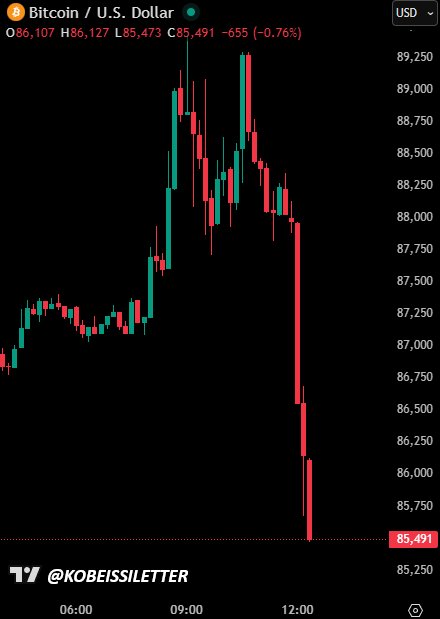
Bitcoin Plunges $3,000 in 30 Minutes as Leveraged Long Liquidations Hit $140 Million
Bitcoin surged into the early morning hours of the trading day, but by mid-morning it had reversed course dramatically. The flagship cryptocurrency fell from its recent intraday highs to a low around $85,491, a retreat of about 0.76% from the preceding level. The rapid drop coincided with a wave of liquidations on highly leveraged long positions, totaling roughly $140 million, signaling a shift in sentiment and prompting traders to reassess risk exposure across crypto markets.
Market snapshot and immediate aftermath In a span of less than half an hour, Bitcoin's price declined sharply after trading above the reference level for much of the session. Analysts noted that the drop was accompanied by a surge in selling volume as investors reevaluated volatility expectations and margin requirements. The move punctured a short-term uptrend that had formed in previous sessions, and market watchers warned that the price could press further if support levels around the mid-$80,000s were breached or if broader risk-off trading conditions intensified.
The liquidation wave underscores the fragility of highly leveraged bets in a market characterized by thin liquidity during certain hours and persistent macro caution. Cross-asset correlation, particularly with high-beta tech equities and other risk-sensitive assets, amplified the impact of the move as traders migrated to safer assets or hedges.
Historical context: volatility cycles and past drawdowns Bitcoin has demonstrated a pattern of pronounced, rapid moves followed by periods of stabilization. Historically, the cryptocurrency has experienced both sharp upswings driven by speculative fervor and swift retrenchments triggered by profit-taking, regulatorys, or macro shifts. Analysts point to previous episodes where liquidations in futures markets served as an accelerant for price corrections, especially when leverage levels were elevated. The latest development fits within that continuum: a sudden price retreat accompanied by a wave of liquidations that can trigger cascading effects across exchanges and related platforms.
Over the past several years, Bitcoin’s price has navigated multiple cycles marked by episodic breakouts above key psychological thresholds. These cycles have often been driven by a combination of retail enthusiasm, institutional investment maneuvers, and global macro news. While price swings remain a defining characteristic, the ability of the market to absorb distress through robust liquidity provisioning and diversified participants has also evolved, even as episodes of extreme movement persist.
Economic implications and market structure The immediate economic impact of Bitcoin’s decline is most acutely felt by traders who operate with high leverage. Liquidations not only unwind positions but can trigger cascading effects across futures markets, funding rates on perpetual swaps, and margin requirements for exchange-traded products that track or hold crypto exposure. For risk management professionals, such episodes emphasize the importance of prudent leverage usage, robust stop-loss strategies, and diversification across crypto assets and related financial instruments.
Beyond individual portfolios, the broader crypto ecosystem watches liquidity dynamics across major bitcoin hubs and centralized and decentralized exchanges. During periods of heightened volatility, trading infrastructure must withstand sudden bursts in order flow, while risk controls across platforms aim to minimize systemic spillovers. The notable $140 million liquidation tally serves as a reminder of the interconnected nature of modern crypto markets, where futures markets, options, and spot trading can reinforce price movements in ways that amplify risk and potential rewards.
Regional comparisons and regional market activity Liquidity and price behavior in Bitcoin have shown regional variations influenced by time-zone differences, exchange liquidity pools, and local regulatory environments. In North American markets, traders have traditionally demonstrated robust participation, though liquidity can tighten during certain hours when futures funding rates move rapidly. Europe and Asia-Pacific regions contribute to a continuous global trading cycle, with shifts in sentiment often rippling across time zones as market participants react to overnight developments.
Comparatively, regions with more mature derivatives ecosystems tend to experience pronounced price dynamics during brief windows of high activity, whereas markets with primarily spot trading activity may see more gradual price adjustments. The current episode highlights how global participants, regardless of geographic location, remain connected through arbitrage activity, cross-exchange price discovery, and the interconnected web of wallets and liquidity providers.
Investor sentiment and public reaction Public reaction to Bitcoin’s decline has been mixed, with long-term BTC holders generally viewing pullbacks as part of a broader volatility tapestry. Traders focused on near-term price action may interpret the move as a test of support levels and a potential setup for a rebound if technical indicators align and macro conditions stabilize. Media and financial commentators often weigh in on the implications for broader crypto adoption, institutional risk appetite, and the evolving regulatory backdrop.
In social and mainstream discourse, debates frequently center on whether pullbacks represent healthy corrections or indicators of deeper systemic fragility. While this episode does not signal an imminent collapse, it reinforces the need for ongoing risk assessment, transparent disclosure by exchanges, and continued education for investors about the mechanics of leverage and margin calls.
Technical analysis: key levels and indicators From a technical perspective, the price action suggests a shift in momentum, with traders watching critical support and resistance bands. The near-term level near the mid-$80,000s could act as a pivot for the next moves. If buyers re-enter and push back through an upper resistance threshold, it may herald a short-term recovery. Conversely, a continuation of selling pressure could push prices toward lower baselines, potentially inviting additional liquidations and testing of risk controls across platforms.
Volume patterns during the session also warrant close attention. A spike in trading activity around the peak of volatility typically indicates a battle between bulls and bears, with order flow dynamics likely to influence liquidity and price discovery in the hours ahead. Market participants may monitor funding rates on perpetual futures as an indicator of sentiment and can use open interest data to gauge whether new positions are accumulating or being unwound.
Regulatory and macro backdrop Regulatory developments continue to shape crypto markets, influencing participant behavior and institutional engagement. While no single regulatory action can fully explain short-term price movements, policy signals—whether related to custody, market integrity, or taxation—contribute to the overall risk-reward calculus for investors. In parallel, macroeconomic indicators, including inflation data, interest rate expectations, and geopolitical tensions, can affect appetite for risk assets, including Bitcoin, as investors weigh opportunity costs and hedging needs.
Outlook: what comes next for Bitcoin Looking ahead, market observers expectBitcoin to test nearby support levels while monitoring liquidity conditions and macro signals. If volatility persists, traders may adopt hedging strategies or reduce leverage to mitigate potential downside risk. However, a renewed uptick in demand from institutional players or a shift in macro fundamentals could catalyze a rebound, potentially restoring some balance to a market that remains sensitive to both sentiment-driven moves and technical breakouts.
In the longer view, Bitcoin’s trajectory continues to be shaped by its growing ecosystem: on-chain activity, mining dynamics, institutional product offerings, and the maturation of decentralized finance interfaces that interact with BTC as a base layer and store of value. As adoption accelerates in certain regions and use cases expand—from cross-border settlement to programmable money pilots—the crypto market will likely continue to experience episodic volatility within an overarching trend of increasing recognition and integration into mainstream financial narratives.
Bottom line for investors and observers The day’s price action illustrates the ongoing, dynamic nature of Bitcoin markets. A $3,000 intraday drop and the liquidation of leveraged long positions reflect both the fragility and resilience of the ecosystem—a reminder of the importance of risk management, diversification, and informed participation in a global, rapidly evolving financial landscape. As markets digest the latest move, traders will watch key technical levels, liquidity metrics, and macro cues to determine the next phase of Bitcoin’s journey.