Trump Extends U.S. Ceasefire With Iran Indefinitely Amid Regional Pressure and Strategic Uncertainty
Ceasefire Extension Signals Shift in U.S. Military Posture
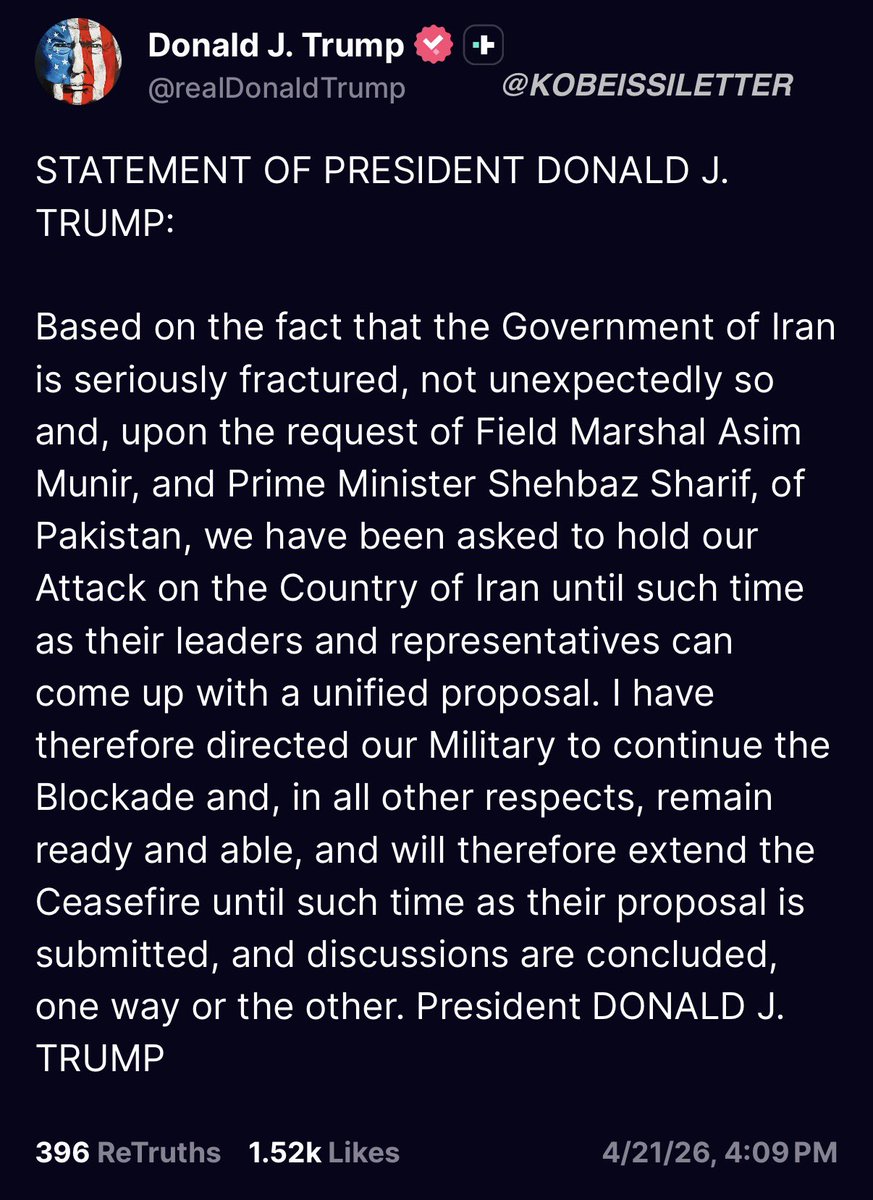
President Donald J. Trump announced Tuesday that the United States will extend its ceasefire with Iran indefinitely, marking a significant pause in a period of escalating tensions that had raised concerns across global markets and diplomatic circles. The decision comes as U.S. forces continue to maintain a naval and economic blockade in the region, while remaining on high alert for any change in conditions.
According to the statement, the extension was influenced in part by the “seriously fractured” condition of Iran’s government, which has reportedly struggled to present a unified negotiating position. Trump also cited direct appeals from Pakistan’s Field Marshal Asim Munir and Prime Minister Shehbaz Sharif, who urged restraint to allow diplomatic channels time to develop.
The ceasefire will remain in place until Iranian leadership submits a cohesive proposal and negotiations reach a clear outcome.
Regional Diplomacy Shapes Immediate Outcome
Pakistan’s involvement highlights the increasingly complex regional dynamics surrounding the U.S.-Iran standoff. As a nuclear-armed nation with longstanding ties to both Western and regional powers, Pakistan has positioned itself as a stabilizing intermediary during moments of heightened tension.
Analysts note that Islamabad’s request reflects broader concerns across South Asia and the Middle East about the risks of prolonged conflict. Energy routes, trade corridors, and security alliances intersect heavily in the region, meaning even limited military engagements can produce widespread ripple effects.
Neighboring countries, including Gulf states, have also shown signs of cautious support for de-escalation, prioritizing stability in oil markets and maritime trade routes over immediate confrontation.
Historical Context of U.S.-Iran Tensions
The relationship between the United States and Iran has been defined by decades of volatility, dating back to the 1979 Iranian Revolution and subsequent hostage crisis. Over the years, tensions have fluctuated between diplomatic negotiations and periods of economic sanctions, proxy conflicts, and direct military incidents.
Recent years have seen a resurgence in hostilities, driven by disputes over nuclear development, regional influence, and maritime security in the Persian Gulf. The current ceasefire follows a series of confrontations that included targeted strikes, cyber operations, and naval incidents.
Historically, ceasefires between the two nations have often been temporary and fragile, serving as pauses rather than permanent resolutions. This latest extension, however, stands out for its indefinite nature, suggesting a strategic recalibration rather than a short-term tactical decision.
Economic Implications and Global Market Reactions
The extension of the ceasefire has already begun to influence global financial markets, particularly in the energy sector. Oil prices, which had experienced volatility amid fears of supply disruptions, showed signs of stabilization following the announcement.
Key economic factors include:
- Continued flow of oil through the Strait of Hormuz, a critical chokepoint for global energy supply.
- Reduced risk premiums in shipping and insurance costs for vessels operating in the region.
- Stabilization of commodity markets that had reacted sharply to earlier military escalations.
For the United States, maintaining a blockade while avoiding active conflict allows for sustained economic pressure on Iran without incurring the immediate costs associated with military engagement. Defense expenditures, logistics, and operational risks are significantly lower under a ceasefire scenario, though readiness levels remain high.
In Iran, internal economic pressures have intensified, with currency fluctuations, inflation, and restricted trade contributing to domestic instability. The fractured political landscape referenced in the U.S. statement may be exacerbated by these economic challenges.
Military Readiness and Strategic Positioning
Despite the ceasefire, U.S. military forces in the region remain fully deployed and operational. Naval assets continue to enforce the blockade, while air and ground units are positioned to respond quickly if hostilities resume.
Defense officials emphasize that the pause in active engagement does not signal a reduction in capability or intent. Instead, it reflects a strategic approach aimed at balancing deterrence with diplomatic opportunity.
This approach mirrors previous U.S. military strategies in high-tension regions, where maintaining pressure without immediate escalation can create leverage in negotiations. The indefinite timeline allows flexibility, enabling rapid shifts in response to developments on the ground.
Iran’s Internal Challenges and Negotiation Prospects
The reference to Iran’s “fractured” government underscores a key obstacle in resolving the current standoff. Reports indicate divisions among political factions, military leadership, and economic authorities, complicating efforts to present a unified negotiating stance.
Such internal fragmentation can delay diplomatic progress, as competing priorities and strategies emerge within the leadership structure. It also raises questions about the durability of any potential agreement, should one be reached.
Historically, internal political dynamics in Iran have played a significant role in shaping its foreign policy decisions. Periods of internal consolidation have often coincided with more decisive international engagement, while fragmentation tends to produce delays and uncertainty.
Comparisons With Previous Ceasefire Scenarios
The indefinite extension distinguishes this ceasefire from earlier agreements in both the Middle East and other global conflict zones. In many cases, ceasefires are time-bound, with clear deadlines intended to force negotiation outcomes.
Examples from recent history illustrate differing approaches:
- In Syria, multiple ceasefires were limited in duration and frequently collapsed due to violations or lack of enforcement mechanisms.
- The Korean Peninsula has operated under a long-term armistice rather than a formal peace treaty, creating a persistent but controlled state of tension.
- In Ukraine, ceasefire agreements have often been linked to specific conditions and timelines, with mixed results.
The current U.S.-Iran ceasefire combines elements of these models, offering open-ended duration while maintaining active military positioning and economic pressure.
Public and International Reactions
Public reaction to the announcement has varied across regions, reflecting differing priorities and perspectives. In the United States, the decision has been viewed through the lens of national security and economic stability, with attention focused on avoiding prolonged military conflict.
In the Middle East, responses have been more closely tied to regional security concerns and economic implications. Countries reliant on stable energy markets have generally welcomed the pause, while others remain cautious about the long-term outlook.
International organizations and global powers have largely supported the continuation of the ceasefire, emphasizing the importance of diplomatic resolution and the risks associated with escalation.
Strategic Uncertainty Moving Forward
The indefinite nature of the ceasefire introduces a degree of uncertainty that could shape future developments. Without a fixed timeline, both sides have flexibility but also face pressure to demonstrate progress.
Key factors that will influence the next phase include:
- The ability of Iran’s leadership to consolidate and present a unified proposal.
- The effectiveness of regional mediation efforts, particularly those led by Pakistan.
- The stability of global economic conditions, especially in energy markets.
- The readiness of U.S. forces to respond to any changes in the situation.
While the ceasefire reduces immediate risks, it does not resolve the underlying issues that led to the conflict. As a result, the situation remains dynamic, with potential for both diplomatic breakthroughs and renewed tensions.
Broader Implications for Global Security
The extension of the U.S.-Iran ceasefire carries implications beyond the immediate region. It reflects broader trends in how modern conflicts are managed, combining military readiness with economic measures and diplomatic engagement.
This hybrid approach is increasingly common in international relations, where direct confrontation is often balanced by efforts to maintain stability and avoid widespread disruption.
For global security, the outcome of this ceasefire could influence future strategies in other high-risk regions, shaping how nations respond to complex and evolving threats.
As negotiations unfold and regional actors continue to play active roles, the situation will remain a focal point for policymakers, markets, and observers worldwide.