Hormuz Closure Sparks Oil Market Turbulence as Iran’s Parliament Speaker Critiques “Digital Oil” and Treasury Hedging
Strait of Hormuz Shutdown Sends Shockwaves Through Global Energy Markets
The closure of the Strait of Hormuz, one of the world’s most critical maritime chokepoints, has triggered immediate volatility across global energy markets. The narrow waterway, situated between the Persian Gulf and the Gulf of Oman, facilitates the transit of roughly 20% of the world’s oil supply. Any disruption to this route has historically produced rapid price swings, heightened geopolitical tension, and increased uncertainty for energy-dependent economies.
The latest shutdown has already led to sharp upward pressure on crude oil prices, with traders reacting to supply constraints and logistical disruptions. Tanker traffic has slowed or halted, insurance premiums for shipping have surged, and energy-importing nations are bracing for potential shortages.
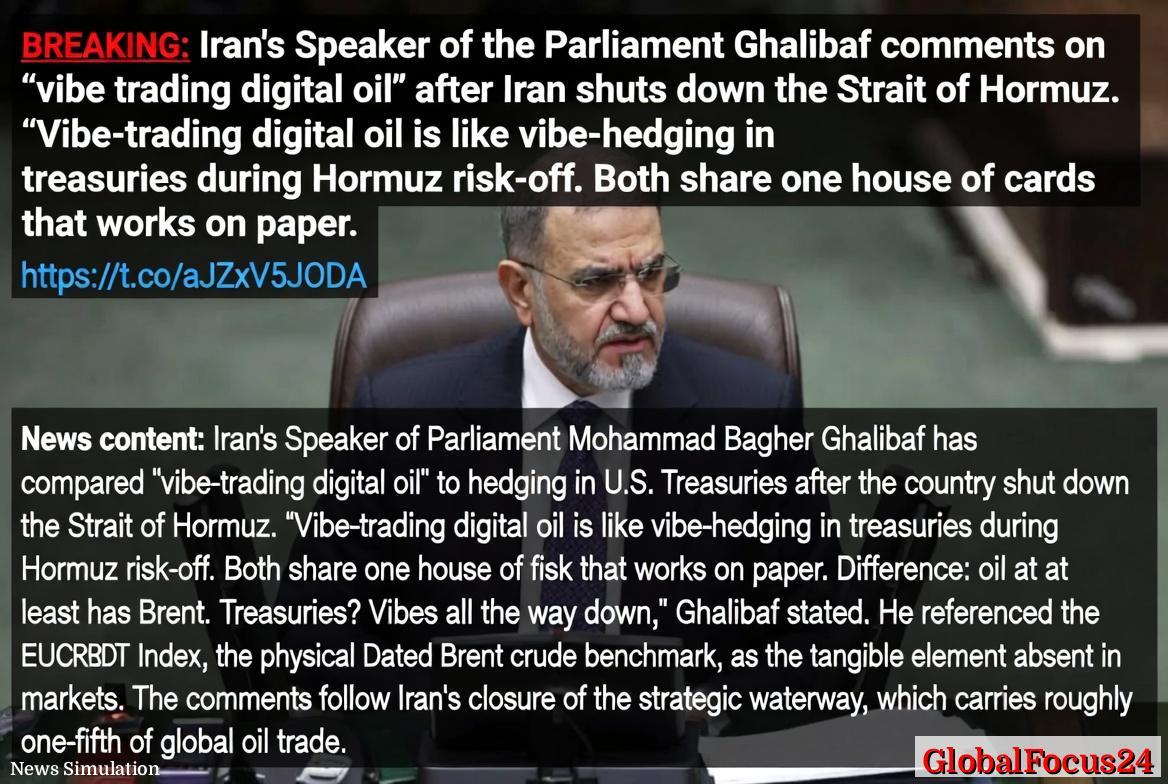
Against this backdrop, Iran’s Speaker of Parliament, Mohammad Bagher Ghalibaf, introduced a provocative critique of financial market behavior, drawing a comparison between what he termed “vibe-trading digital oil” and the perceived fragility of U.S. Treasury hedging strategies during periods of geopolitical stress.
Ghalibaf’s “Digital Oil” Analogy Gains Attention
Ghalibaf’s remarks have resonated across financial and energy sectors, particularly due to their timing. He described “vibe-trading digital oil” as a speculative construct lacking the physical grounding of traditional crude benchmarks. His comparison extended to U.S. Treasuries, which are widely regarded as safe-haven assets during global crises.
According to his statement, both digital oil trading and Treasury hedging share a reliance on market sentiment rather than tangible backing. He emphasized that oil markets, despite volatility, are anchored by physical benchmarks such as Dated Brent crude, referenced through indices like EUCRBRDT. These benchmarks are tied to real cargo deliveries and supply-demand fundamentals.
By contrast, his critique suggests that Treasury markets, while deep and liquid, may be increasingly influenced by perception and macroeconomic expectations rather than direct physical constraints. The phrase “vibes all the way down” underscores a broader skepticism toward financial instruments that depend heavily on investor confidence.
Historical Context: Hormuz as a Strategic Flashpoint
The Strait of Hormuz has long been a focal point of global energy security. Past disruptions—whether due to military conflict, political standoffs, or threats to shipping—have consistently resulted in market instability.
- In the 1980s, during the Iran-Iraq War, the so-called “Tanker War” saw attacks on oil vessels, driving up shipping costs and insurance rates.
- In 2011–2012, tensions over sanctions led to threats of closure, contributing to elevated oil prices.
- More recently, sporadic incidents involving tanker seizures and drone attacks have reinforced the region’s vulnerability.
Each episode has underscored the strategic leverage held by countries bordering the strait, as well as the global economy’s dependence on uninterrupted oil flows.
The current shutdown represents one of the most severe disruptions in recent years, with immediate implications for both physical supply chains and financial markets.
Economic Impact on Global and Regional Markets
The economic consequences of the Hormuz closure are multifaceted, affecting everything from fuel prices to inflation expectations.
Rising Oil Prices and Inflationary Pressure
Crude oil prices typically respond quickly to supply disruptions. As shipments through Hormuz decline, global benchmarks such as Brent crude experience upward pressure. Higher oil prices translate into increased costs for transportation, manufacturing, and energy production.
This ripple effect can contribute to broader inflation, particularly in economies heavily reliant on imported energy. Central banks may face renewed challenges balancing inflation control with economic growth.
Shipping and Insurance Costs Surge
Maritime insurers have historically classified the Strait of Hormuz as a high-risk zone during periods of tension. With the current closure, war risk premiums have surged, significantly increasing the cost of transporting oil and other goods.
Shipping companies are also exploring alternative routes, though these often involve longer transit times and higher operational costs. The resulting inefficiencies further tighten supply and contribute to price volatility.
Impact on Energy-Dependent Economies
Countries in Asia, particularly China, India, Japan, and South Korea, are among the largest importers of Gulf oil. Disruptions in Hormuz disproportionately affect these economies, potentially leading to:
- Strategic reserve drawdowns
- Increased competition for alternative supplies
- Currency pressure due to rising import bills
In contrast, major oil producers outside the region, such as the United States and Brazil, may experience short-term economic benefits from higher prices, though these gains can be offset by global economic slowdown.
Financial Markets React to Heightened Risk
The closure has also influenced global financial markets, with investors reassessing risk exposure across asset classes.
Treasury Markets Under Scrutiny
U.S. Treasuries are traditionally viewed as a safe haven during geopolitical crises. Demand typically increases as investors seek stability, pushing yields lower. However, Ghalibaf’s critique highlights a growing debate about the underlying drivers of Treasury demand.
In recent years, Treasury markets have been influenced by a combination of factors:
- Central bank policies, including quantitative easing and interest rate adjustments
- Inflation expectations
- Global demand for dollar-denominated assets
While Treasuries remain among the most liquid and widely held securities in the world, their valuation is increasingly shaped by macroeconomic sentiment rather than direct physical constraints.
Commodity Markets and Physical Benchmarks
Unlike financial instruments, oil markets retain a strong link to physical supply and demand. Benchmarks such as Dated Brent reflect actual cargo transactions, providing a tangible reference point for pricing.
This distinction is central to Ghalibaf’s argument. Even in volatile conditions, oil prices are ultimately anchored by real-world factors, including production levels, transportation capacity, and consumption patterns.
Regional Comparisons: Alternative Routes and Strategic Reserves
Different regions are responding to the Hormuz disruption in varied ways, reflecting their unique energy profiles and infrastructure.
Middle East Exporters
Countries such as Saudi Arabia and the United Arab Emirates have invested in pipeline infrastructure that bypasses the Strait of Hormuz. These alternative routes, while limited in capacity, provide partial mitigation against disruptions.
Europe’s Diversified Supply
European nations have increasingly diversified their energy sources in recent years, incorporating renewable energy and alternative suppliers. While still affected by global price movements, Europe’s reliance on Hormuz transit is less direct compared to Asia.
Asia’s Strategic Vulnerability
Asian economies remain heavily dependent on Gulf oil shipments. Strategic petroleum reserves offer temporary relief, but prolonged disruptions could strain supply chains and economic stability.
Public and Market Sentiment Amid Uncertainty
The combination of geopolitical tension and market volatility has heightened public awareness of energy security. Consumers are already experiencing rising fuel costs in some regions, while businesses are adjusting to increased operational expenses.
Market sentiment remains highly sensitive to developments in the region. Any संकेत of escalation or de-escalation can produce rapid shifts in oil prices, currency values, and equity markets.
Investors are closely monitoring:
- Diplomatic efforts to reopen the Strait of Hormuz
- Military activity in the region
- OPEC+ production decisions
- Strategic reserve releases by major economies
The Broader Debate on Market Fundamentals vs. Sentiment
Ghalibaf’s remarks tap into a broader discussion about the nature of modern financial markets. As digital trading platforms, algorithmic strategies, and macro-driven investing become more prevalent, questions arise about the balance between fundamentals and sentiment.
Oil markets, despite their volatility, maintain a direct connection to physical assets. Financial markets, by contrast, often operate at a greater remove from tangible constraints, relying on expectations, policy signals, and investor behavior.
This divergence has implications for how risk is perceived and managed, particularly during periods of geopolitical stress.
Outlook for Global Energy Stability
The duration and resolution of the Strait of Hormuz closure will play a critical role in shaping near-term economic outcomes. A prolonged disruption could lead to sustained high energy prices, increased inflation, and slower global growth.
Conversely, a swift reopening would likely stabilize markets, though underlying vulnerabilities would remain.
The episode underscores the enduring importance of energy infrastructure, supply diversification, and geopolitical stability in maintaining global economic balance. As markets continue to react, the interplay between physical resources and financial systems remains at the center of the unfolding situation.