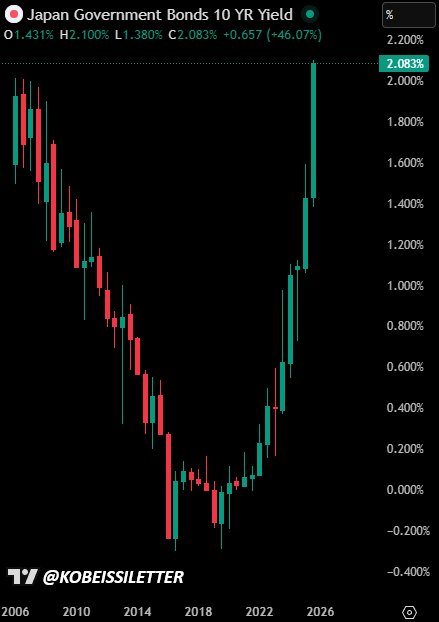
Japan's 10-Year Bond Yield Surges to 2.10% as BOJ Rate Hike Reverberates Across Markets
A wave of market movement swept through Japan's government debt market Monday, with the benchmark 10-year Japanese government bond (JGB) yield climbing to 2.10%, its highest level since 1999. By the close, the yield settled at 2.086%, marking a daily increase of 0.068 percentage points and a 3.37% gain from the prior session. The session’s trading range stretched from 2.055% to 2.100%, flirting with the year’s peak and underscoring the growing sensitivity of fixed-income investors to shifting monetary policy signals. The bond carries a coupon of 1.70% and matures on December 20, 2033, reinforcing the long end of the curve as investors reassess risk and duration in a climate of higher policy rates.
Historical context anchors today’s move in a broader arc of Japan’s post-bubble era debt management and policy normalization efforts. For more than two decades, Japan’s bond yields remained anchored by ultra-low rates, a consequence of the Bank of Japan’s (BoJ) aggressive easing and a deflationary environment that constrained inflation and growth. In this context, a move toward the 2% mark on the 10-year yield signals a fundamental recalibration within the country’s monetary framework. The BoJ’s decision to raise its policy rate to 0.75% on December 19, 2025, marked a watershed moment in the central bank’s pivot away from near-zero, long-standing accommodative settings. The yield’s ascent thus reflects the market’s response to a policy regime shift that aims to balance inflation dynamics with the need to sustain financial stability.
The immediate driver behind Monday’s yield rise was the BoJ’s rate increase, which tightened financial conditions and prompted price adjustments across the government bond complex. Higher short-term policy rates tend to lift long-term yields as investors recalibrate expected future inflation, growth, and the path of monetary tightening. In Japan, where public debt has grown to exceed 250% of gross domestic product in many estimates, even modest changes in the yield curve can have outsized implications for debt service costs and fiscal planning. The 10-year note, a reference point for corporate financing and municipal borrowing, is a barometer of these broader dynamics.
Economic impact reverberates beyond the debt market. A higher yield on 10-year JGBs translates into higher borrowing costs for issuers and could influence consumer and business credit conditions. While the transmission to consumer rates is not always direct in Japan due to the complex overlay of policy tools, there is a clear channel through which rising yields can affect corporate finance, project viability, and state-backed investment plans. Public infrastructure initiatives, energy projects, and technology investments—segments often financed through long-term bonds—may face higher hurdle rates as yield expectations move higher. In addition, pension funds, insurers, and other long-duration investors are reassessing duration risk, liquidity needs, and asset-liability matching in a higher-rate environment.
Regional comparisons illuminate how Japan’s trajectory fits within a global context of shifting monetary policy landscapes. Across Asia, several economies have navigated divergent paths, balancing inflation pressures with growth challenges. In contrast to Japan’s gradual normalization, some regional peers have pursued more aggressive tightening amid resilient domestic demand or commodity price swings, while others have underscored structural reforms to sustain growth. The interplay between currency movements, capital flows, and trade balances remains a central theme as regional markets adjust to a landscape of gradually higher interest rates and evolving risk sentiment.
From a policy perspective, the BoJ’s decision to elevate rates signals a clear commitment to reestablishing price stability and controlling inflation pressures that had persisted despite decades of deflationary trends. Analysts note that a successful normalization requires careful calibration to avoid sudden disruption to debt markets, financial institutions, and the real economy. The central bank’s communication strategy, including forward guidance and its assessment of inflation trajectories, will be crucial in shaping market expectations going forward. Observers will watch for the durability of the inflation uptick, the trajectory of wage growth, and the response of consumer spending as indicators of the sustainability of higher rates.
Market participants, including banks, asset managers, and international investors, are adjusting portfolios in response to the new rate environment. A steeper yield curve, in which long-term yields rise faster than short-term ones, can affect bank profitability, potentially widening net interest margins for lenders if funding costs and loan rates align favorably. However, banks also face heightened credit risk concerns if borrowing costs impede business investment or consumer demand. The behavior of foreign investors will also influence the depth and liquidity of the JGB market, with currency movements and risk appetite playing supporting roles in price discovery.
The broader macroeconomic landscape in Japan remains characterized by a delicate balance: inflation has shown signs of persistence, yet growth remains uneven across sectors. The BoJ’s rate hike reflects a belief that inflationary pressures are not transitory and that price discipline should be reinforced to anchor expectations. Yet policymakers must mitigate any unintended consequences for growth-oriented programs and public finances, particularly in a country where demographic trends and an aging population add layers of complexity to fiscal sustainability and social welfare costs.
Investors will be watching key data releases and policy communications in the coming weeks. Economic indicators such as domestic consumption, manufacturing activity, and wage dynamics will help illuminate whether the higher-yield environment accelerates or dampens economic momentum. Analysts will also monitor international developments, including supply-chain resilience, global demand, and cross-border capital flows, which can influence risk sentiment and the appetite for JGBs.
The market’s historical memory of late-1990s high yields provides a backdrop that frames today’s movement with a lens of caution and anticipation. In the late 1990s, Japan navigated balancing acts between debt sustainability and financial stability amid the broader global context of low growth and shifting currency dynamics. Today, the recalibration occurs within a different inflationary regime and a more interconnected global financial system. Yet the core objective remains consistent: calibrate risk, maintain financial resilience, and ensure that debt service obligations remain sustainable as the economy evolves.
Regional benchmarks for fixed-income performance offer a comparative lens for assessing Japan’s trajectory. For instance, government bond markets in neighboring economies have responded to their own domestic inflation and policy developments in ways that can influence capital allocation decisions for international investors. Yet the sensitivity of long-duration bonds to policy shifts is a common thread across markets, underscoring the universal challenge of navigating an era of gradual monetary normalization after a prolonged period of accommodation.
Public reaction to the yield move has been mixed, reflecting a blend of concern and pragmatism. Some observers emphasize the importance of policy credibility and the role of the BoJ in steering inflation expectations toward a stable target. Others highlight the potential for higher borrowing costs to influence business investment decisions and household financial planning. Traders and analysts alike stress the importance of a transparent, data-driven approach from the central bank to minimize market volatility and provide clearer guidance on the path ahead.
In conclusion, Japan’s 10-year government bond yield reaching 2.10% marks a significant moment in the ongoing transition from ultra-accommodative policy to a more normalized interest-rate regime. The move underscores the market’s anticipation of sustained inflation and the BoJ’s resolve to combat it through gradual policy tightening. As debt management considerations intersect with real economy dynamics, the coming months will reveal how the bond market, financial institutions, and policymakers collectively navigate higher yields, rising borrowing costs, and the quest for durable growth in a complex global economy. The path ahead will require careful monitoring of inflation signals, fiscal plans, and the evolving balance between risk and resilience across Japan’s financial landscape.