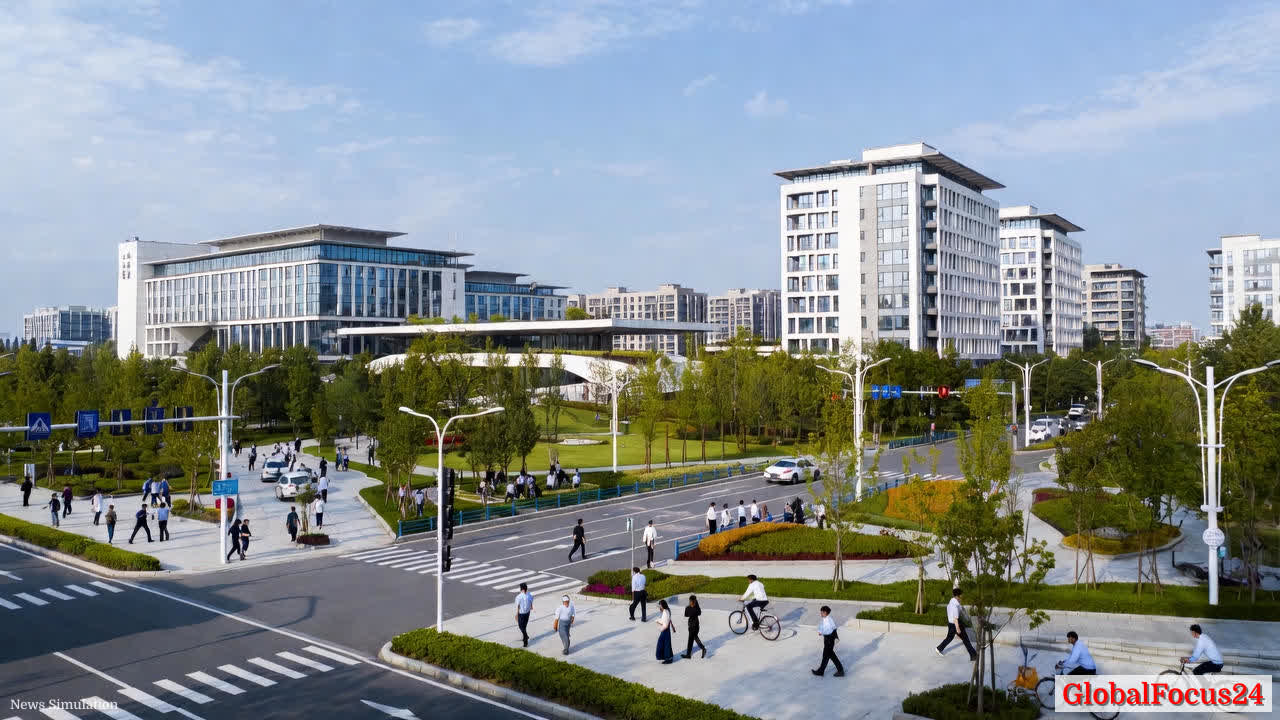
Xiongan New Area Attracts Residents with Incentives Amid Growth as Privileged Enclave
In the shadow of Beijing, the Xiongan New Area has evolved from a bold architectural concept into a living, breathing urban district that aims to redefine regional development in northern China. Since its formal launch in 2017, the project envisioned by national leadership as a model for modern, low-carbon urbanization has steadily drawn new residents and a growing concentration of state-owned enterprises, government offices, and high-skilled workers. The city’s trajectory reflects a nuanced approach to economic planning, social policy, and regional balance that many observers see as a barometer for China’s broader urbanization strategy.
Historical context and genesis of a modern prototype Xiongan New Area emerged as a centerpiece of China’s urban strategy in the late 2010s, designed to alleviate pressure on Beijing and to pilot a new form of city development that emphasizes efficiency, sustainability, and integration with surrounding rural areas. The rationale was twofold: to distribute economic activity more evenly across the region and to establish a domestically led, technologically advanced urban hub that could attract investment while reducing congestion in the capital. The project drew immediate attention for its ambitious scope—an entire zone crafted with futuristic infrastructure, integrated transportation networks, and high-tech industrial parks.
Over the years, planners have framed Xiongan as a living laboratory for urban governance. The area has pursued a development model that prioritizes green spaces, smart utilities, and digital services, with an emphasis on creating a recognizable, globally competitive brand for northern China. This historical backdrop helps explain the early and ongoing emphasis on incentives designed to draw residents and enterprises to the new urban center.
Economic impact and the mechanics of growth The economic narrative around Xiongan reflects a measured attempt to create momentum through targeted incentives and strategic investments. State-backed initiatives have accelerated the establishment of core facilities, from telecommunications hubs to space for research and development. Large-scale infrastructure projects—roads, rail connections, and urban utilities—are being developed not only to serve the resident population but also to attract national and international business interests seeking a foothold in a northern corridor that connects Beijing, Tianjin, and surrounding provinces.
A key feature of Xiongan’s growth model is the concentration of public-sector and state-owned enterprise presence. The relocation of certain functions away from central Beijing carries potential benefits for labor markets, including job stability, predictable career pathways, and access to specialized training programs. For residents, this can translate into a stable, long-term economic environment in which skills development and advancement opportunities are aligned with both governmental and industrial priorities. For the broader region, the incentives tied to these moves can stimulate ancillary industries, local services, housing markets, and educational ecosystems.
Regional comparisons and contextual insights Xiongan’s development presents a contrast with other ambitious urban projects worldwide. In many global examples, large-scale urban redevelopments are driven by private capital and market-driven demand. In Xiongan, the state plays a central coordinating role, shaping a more deliberate and policy-led growth path. This distinction influences timelines, risk profiles, and the pace at which private sector participation expands. Yet the incentives offered to newcomers—housing subsidies, educational advantages, and access to premium services—are not unique to Xiongan. Similar models have appeared in other equity-focused urban development programs where governments seek to attract talent and anchor investment through targeted support.
From an economic perspective, Xiongan’s trajectory is influenced by macroeconomic trends, regional labor dynamics, and the evolving needs of a Chinese economy that continues to pivot toward advanced manufacturing, high-tech services, and sustainable urban living. The region’s performance will hinge on how effectively it balances incentives with productive employment opportunities, how infrastructure investments translate into durable productivity, and how education and healthcare ecosystems scale to meet growing demand. In this sense, Xiongan serves as a test bed for measuring the broader feasibility of state-led urban expansion in the Chinese economic model.
A look at infrastructure and livability Infrastructure in Xiongan is being designed to support a dense, mixed-use urban core. Modern business districts, scientific research facilities, and residential neighborhoods are being integrated with transit corridors, utility networks, and digital governance tools that promise enhanced public services. These elements are essential for fostering a livable environment that can attract families, professionals, and students who seek a balance between career opportunities and quality of life.
Public reception has been mixed in some quarters, reflecting a blend of cautious optimism and scrutiny. Communities weighing the trade-offs of relocation consider factors such as commuting times, school quality, housing affordability, and access to cultural amenities. Officials contend that the long-term benefits will accrue as the city matures, with continued investment in education, healthcare, and public safety contributing to a resilient, inclusive urban fabric.
Housing, education, and social policy implications Housing remains a central pillar of Xiongan’s resident attraction strategy. Subsidies, affordable housing options, and favorable financing terms are intended to ease transitions for newcomers and to stabilize local housing markets over time. Education is another critical component, with programs designed to leverage partnerships with universities, research institutions, and international exchanges to cultivate a skilled workforce capable of driving advanced industries within the new area.
Social policy in Xiongan seeks to create a sense of community among residents who may come from diverse provincial backgrounds or governmental postings. This involves not only physical infrastructure but also services that ease daily life: healthcare facilities, public safety resources, and inclusive community programs. As the city evolves, policymakers aim to foster social cohesion while preserving the flexibility necessary for ongoing development.
Public perception and the sense of urgency Public sentiment around Xiongan’s growth is shaped by a combination of local experiences and broader national narratives about modernization and opportunity. For many residents, the incentives provide a pathway to greater career stability, educational advantages for children, and a chance to participate in a new urban ecosystem. At the same time, observers frequently highlight the need for transparent governance, consistent quality of life standards, and equitable access to the benefits of relocation. The sense of urgency accompanying Xiongan’s expansion reflects both the momentum of the project and the long runway required for a city to realize its full potential.
Long-term outlook and regional integration Looking ahead, Xiongan’s long-term success will depend on its ability to harmonize growth with sustainable urban design. Key milestones include the consolidation of administrative functions, ongoing enhancement of transit connectivity, and the continuous refinement of housing and education programs. As the region deepens its integration with Beijing and the broader North China Belt, Xiongan could become a central node in a multi-city economic corridor, attracting talent and investment from across the country and potentially serving as a blueprint for similar efforts in other parts of the world.
Regional comparisons within China highlight how provincial strategies for talent attraction, infrastructure investment, and social policy can shape outcomes. Provinces that balance incentives with high-quality public services and reliable regulatory environments tend to outperform those that overemphasize incentives without corresponding infrastructure or governance capacity. In this sense, Xiongan’s experience provides a case study for policymakers seeking to translate ambitious visions into tangible, sustainable growth.
Conclusion Xiongan New Area represents a deliberate, state-guided approach to urban development that emphasizes future-oriented infrastructure, strategic population growth, and a diversified economic base. By offering housing support, educational advantages, and other incentives, the project has created a magnet for newcomers, including a growing cadre of government and state-sector personnel. As infrastructure deepens and the community evolves, Xiongan’s trajectory will continue to be watched closely by analysts, investors, and regional planners who are assessing the viability of this model as a blueprint for modern urbanization in a rapidly changing global economy. The city’s ongoing evolution will reveal how effectively it can balance aspirational design with practical, lived realities for its residents, while contributing meaningfully to the broader regional and national economic landscape.