U.S. Trade Deficit Narrows Slightly in 2025 as Services Surplus Hits New High
U.S. Trade Gap Edges Lower Despite Record Goods Deficit
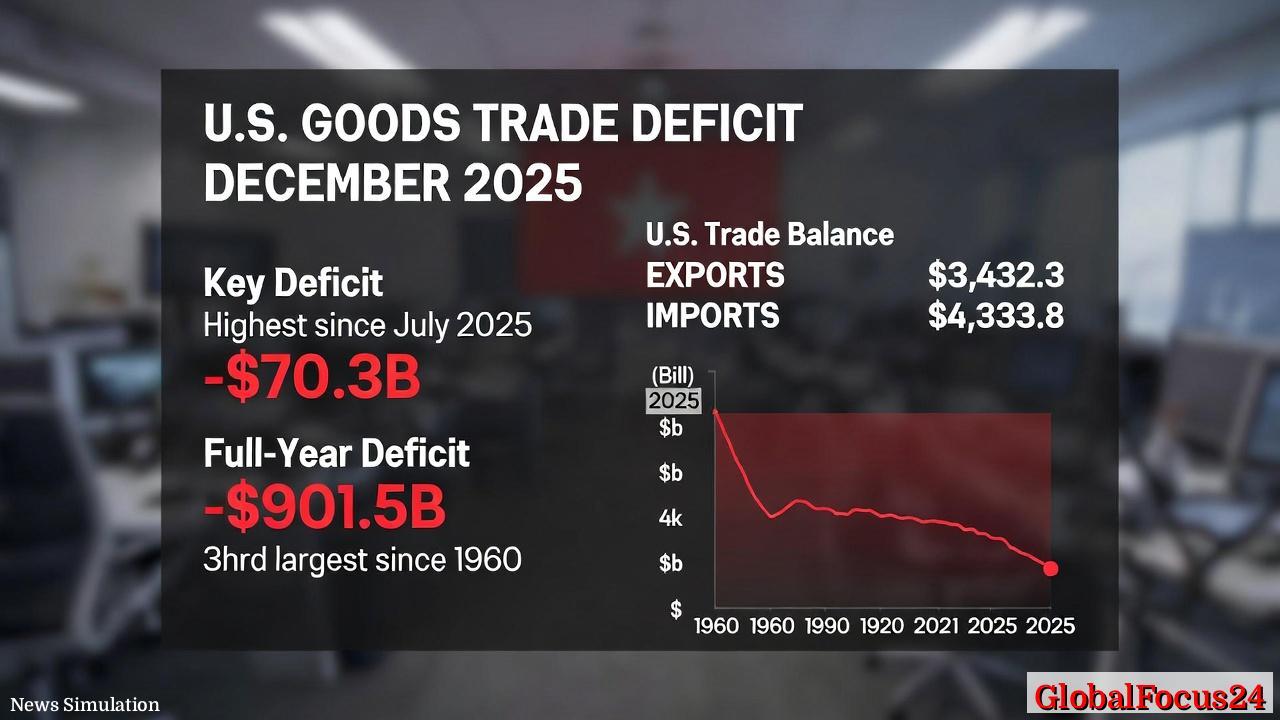
The United States ended 2025 with a goods and services trade deficit of 901.5 billion dollars, a slight improvement from the 903.5 billion dollar gap recorded in 2024. The modest 2.1 billion dollar narrowing came despite a record goods deficit and reflects the growing role of U.S. services exports in cushioning the overall trade position. At the same time, a sharp widening of the monthly trade gap in December underlined that trade remains a significant drag on overall economic performance and a barometer of global demand for American products.
Exports rose solidly in 2025, reaching 3,432.3 billion dollars, up 199.8 billion dollars or 6.2 percent from the previous year. Imports also climbed, hitting 4,333.8 billion dollars, an increase of 197.8 billion dollars or 4.8 percent. The faster growth in exports than imports, in percentage terms, was enough to slightly trim the annual deficit, even as underlying patterns showed continuing structural weaknesses in U.S. goods trade and renewed strength in services such as travel, financial services, and intellectual property.
Record Goods Deficit Highlights Structural Imbalances
Theimprovement in the overall trade balance masks a troubling development on the goods side of the ledger. The U.S. goods deficit widened by 25.5 billion dollars, or 2.1 percent, to 1,240.9 billion dollars in 2025, a record high. This expansion underscores longstanding structural imbalances in the nation’s trade profile, particularly its reliance on imported manufactured products, consumer electronics, machinery, and a wide array of intermediate inputs used by American factories.
Over the past several decades, the United States has shifted toward a more services-oriented economy, while many trading partners have built large manufacturing bases that supply global markets. As production of goods such as apparel, electronics, and many industrial components moved offshore, the U.S. became increasingly dependent on imports to meet domestic demand. The result has been a persistent goods deficit that widened sharply in the early 2000s, narrowed briefly after the global financial crisis, and then re-accelerated in the 2010s and early 2020s during periods of strong consumer spending.
The 2025 record goods deficit fits into this broader historical pattern. When domestic demand is robust and labor markets are tight, American consumers and companies typically draw on a wide global supply network, importing everything from household goods to advanced capital equipment. The latest figures indicate that, even as some manufacturing activity has been reshored or diversified away from single-country dependence, the overall import bill for physical goods continues to outpace the gains in goods exports. That dynamic keeps the goods deficit near historic highs, even when the total trade gap shows modest improvement.
Services Surplus Grows as Global Travel and Digital Trade Rebound
In contrast to the goods side, services trade provided a key offset in 2025. The U.S. services surplus grew by 27.6 billion dollars, or 8.9 percent, to 339.5 billion dollars. This expansion reflects renewed momentum in cross-border services, including tourism, business travel, higher education, financial and insurance services, consulting, and the licensing of intellectual property in areas such as software, entertainment, and pharmaceuticals.
Historically, the United States has maintained a strong comparative advantage in services, a trend that became more pronounced with the rise of the digital economy. American firms in technology, media, professional services, and finance have built global customer bases, generating substantial export revenues without shipping physical goods. After pandemic-era disruptions severely curtailed travel and certain in-person services, the rebound in international mobility and the normalization of global business operations have boosted services exports.
The 2025 data suggest that this recovery is now firmly underway. Increased inbound tourism and student flows contribute foreign spending in U.S. cities and college towns, while continued demand for American entertainment content, cloud services, and business solutions fuels growth in royalties and fees. The larger services surplus, therefore, plays a critical role in narrowing the overall trade deficit and underscores how services exports help offset the deepening gap in goods trade.
December 2025: Trade Deficit Widens Sharply
Despite the modest improvement for the year as a whole, the monthly numbers at the end of 2025 point to renewed volatility. In December, the U.S. trade deficit widened to 70.3 billion dollars, up from a revised 53.0 billion dollars in November. This 17.3 billion dollar monthly increase is significant, suggesting a surge in imports, a pullback in exports, or a combination of both as the year closed.
Monthly trade balances can swing with seasonal factors, including holiday-related shipping, fluctuations in energy prices, and the timing of large capital goods orders. However, a jump of this magnitude often signals a shift in economic conditions. Strong consumer spending during the holiday season can drive imports of consumer electronics, apparel, and household goods higher. At the same time, global headwinds or currency movements can temporarily weaken demand for U.S. exports, particularly in cyclical sectors like industrial machinery and chemicals.
Economists will watch subsequent months closely to determine whether December marks the start of a new widening trend or a one-off distortion caused by timing and seasonal adjustments. For policymakers, the monthly spike serves as a reminder that the trade deficit remains sensitive to changes in domestic demand, supply-chain conditions, and global growth.
Long-Term Trend: A Deepening Trade Gap Since 1960
Placed in a long-run perspective, the 2025 trade deficit ranks among the largest on record since the early 1960s, when systematic data on the U.S. trade balance began. The historical series shows a relatively modest trade position in the 1960s and 1970s, when the United States was still the dominant industrial power and benefited from postwar reconstruction elsewhere. As Europe and Asia rebuilt their industrial bases and export capacity, the U.S. began to run more persistent deficits, a trend that intensified in the 1980s.
From the early 2000s onward, the charted trade balance shows a sharp downward trend, with the deficit deepening as global supply chains expanded and offshoring accelerated. The lowest point in recent years was around 923.7 billion dollars in 2022, reflecting robust domestic demand and elevated import volumes during the post-pandemic rebound. The 2025 figure of negative 901.5 billion dollars, while slightly better than that trough, still sits in a zone that would have been unprecedented in earlier decades.
This long historical arc reflects several underlying forces. The U.S. dollar’s longstanding role as the world’s primary reserve currency supports persistent deficits by making it easier for the country to finance external imbalances. At the same time, global investors’ appetite for U.S. assets—ranging from Treasury securities to corporate bonds and equities—channels foreign savings into American financial markets, enabling the United States to consume and invest more than it produces in tradable goods. The trade balance thus becomes a mirror of wider capital flows, exchange-rate dynamics, and structural shifts in production and consumption.
Economic Impact on Growth, Jobs, and Prices
The 2025 trade figures carry important implications for the broader U.S. economy. A large trade deficit subtracts from gross domestic product through net exports, meaning that strong domestic demand and government or private investment must compensate to sustain overall growth. When the trade gap narrows, even slightly, it can provide a modest boost to GDP, as occurred with the 2.1 billion dollar improvement in 2025. Yet the continued record goods deficit shows that trade remains a net drag rather than a driver of output.
On the labor market front, a high goods deficit is often associated with competitive pressures on manufacturing industries. Sectors that compete directly with imports—for example, consumer electronics assembly, certain types of machinery, and some segments of the auto industry—can face headwinds, affecting employment and wage growth in specific regions. At the same time, the growing services surplus helps support jobs in fields such as software development, finance, engineering, tourism, and higher education, many of which are concentrated in metropolitan and coastal areas. This uneven geography of trade benefits and losses can shape local economic fortunes, even when national aggregates appear stable.
The trade balance also interacts with inflation and consumer prices. Large imports of goods can help keep prices in check by giving consumers access to lower-cost products produced abroad. Over time, this has contributed to more affordable consumer goods, from clothing to electronics. However, reliance on global supply chains can make the U.S. vulnerable to disruptions, as seen during recent years of shipping bottlenecks and geopolitical tensions. The 2025 figures, with rising imports and strong demand for foreign goods, suggest that global supply chains were functioning more smoothly, helping moderate price pressures in key categories.
Regional Comparisons: How the U.S. Trade Position Stacks Up
When viewed against other major economies, the U.S. reversal between goods and services is particularly striking. Many export-oriented countries in East Asia and parts of Europe run large surpluses in goods trade, built on manufacturing strength in automobiles, machinery, electronics, and consumer products. These economies often rely on external demand to support factory employment and growth, while domestic consumption plays a comparatively smaller role.
By contrast, the United States combines a large, consumption-driven domestic market with a strong competitive edge in high-value services. The result is a persistent goods deficit offset in part by a sizable services surplus. Some advanced economies, including the United Kingdom and several smaller service hubs, exhibit similar patterns, though on a smaller scale. Others, such as Germany and several northern European countries, maintain substantial overall trade surpluses, reflecting their manufacturing focus and longstanding trade frameworks.
The U.S. position therefore stands out in scale as much as in structure. A goods deficit exceeding 1.2 trillion dollars would be unsustainable for many countries, but the depth and liquidity of U.S. financial markets and the dollar’s central role allow the United States to sustain large external gaps over extended periods. The 2025 numbers reaffirm this distinctive model—high reliance on foreign goods, strong export performance in services, and a capacity to attract foreign capital that finances the overall deficit.
Policy and Business Implications
The latest trade data arrive at a time when trade policy, supply-chain resilience, and industrial strategy remain core concerns for businesses and policymakers. The record goods deficit in 2025 may reinforce efforts to diversify supply chains, encourage domestic production of strategic goods, and deepen trade ties with a broader set of partners. For companies, the figures underscore the importance of managing currency risk, shipping costs, and regulatory differences across markets.
At the same time, the rising services surplus highlights the continued importance of maintaining open digital trade, protecting intellectual property, and ensuring that professional and financial services can operate across borders. Measures that facilitate travel, streamline visa processes for students and business visitors, and safeguard data flows can help sustain the momentum in services exports. For regions that depend heavily on tourism, higher education, or technology services, the 2025 performance offers a measure of reassurance that global demand is stabilizing after a period of profound disruption.
Looking ahead, the balance between goods and services will remain central to the trajectory of the U.S. trade deficit. If goods imports continue to grow faster than goods exports, the record deficit in merchandise trade could deepen further. Conversely, continued strength in services, combined with targeted efforts to expand exports in advanced manufacturing and clean technologies, could help gradually narrow the overall gap. The 2025 figures, with their mixture of a slightly smaller overall deficit, a record goods shortfall, and a robust services surplus, capture a moment in which the long-standing contours of U.S. trade are under scrutiny but remain firmly in place.