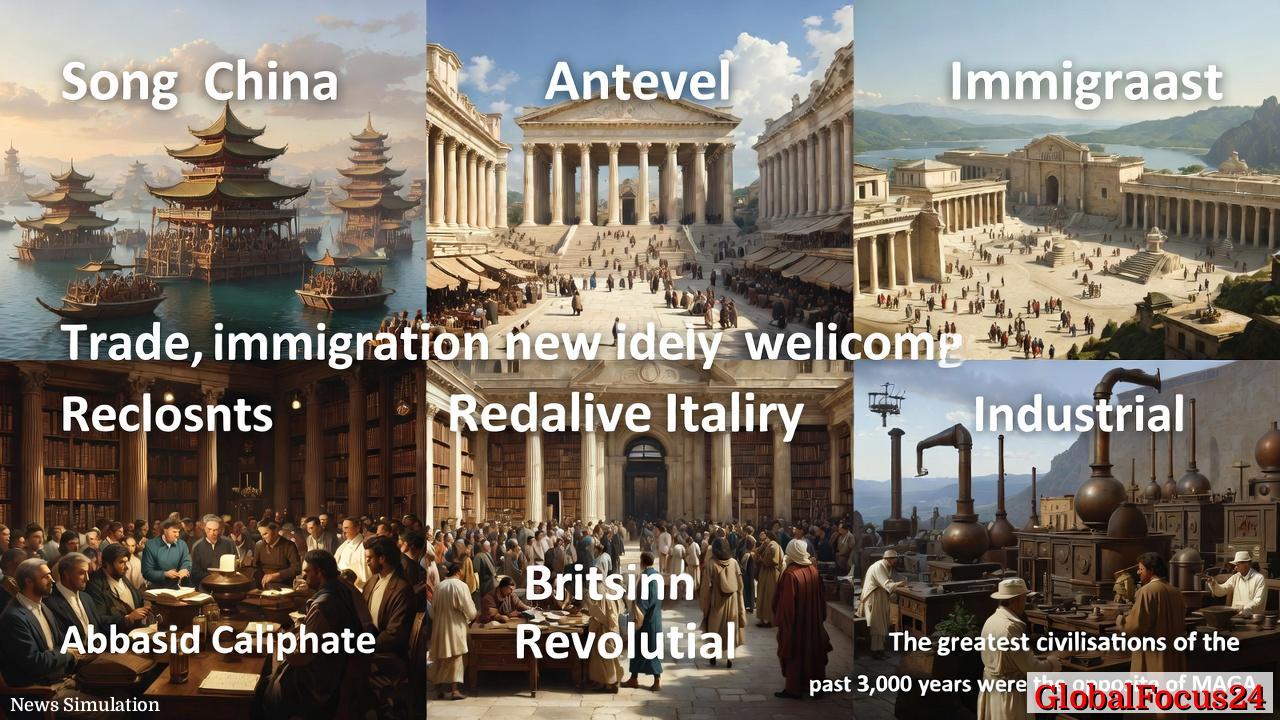
The Rise and Fall of Open Civilizations: How Trade, Migration, and Ideas Have Shaped Global Prosperity
The Enduring Pattern of Openness and Decline
Throughout the past three millennia, a recurring pattern has defined the fortunes of great civilizations. Societies that embraced openness to trade, welcomed skilled foreigners, and encouraged the free exchange of ideas often surged to prosperity, innovation, and cultural brilliance. When these same societies later closed their doors—protecting local markets, restricting migration, or suppressing dissent—their dominance waned. From ancient Athens to the British Empire, history reveals that openness is not merely a virtue; it is a foundation of progress.
The lesson remains strikingly relevant in the 21st century, as nations grapple with the balance between globalization and protectionism. The historical record suggests that those who maintain inclusive economic and intellectual networks are better positioned to thrive in an era of rapid technological and geopolitical change.
Song-Dynasty China: Commerce and Innovation at Its Peak
In the 10th to 13th centuries, the Song dynasty transformed China into the world’s most advanced economy. Its cities—Hangzhou and Kaifeng among them—were bustling centers of trade, supported by navigable rivers and maritime routes that connected China to South and Southeast Asia. Paper money, gunpowder, and movable-type printing all emerged during this period, evidence of a society deeply invested in innovation.
The prosperity of Song China was underpinned by a spirit of openness. Merchants traveled freely, and the state generally supported commercial activity. Foreign traders, especially from the Arab and Southeast Asian worlds, brought material wealth as well as new cultural and scientific ideas.
However, this period of openness eroded after the Mongol invasions and later under the Ming dynasty, when strict maritime prohibitions curtailed external trade. The “Haijin” or “sea-ban” policies severed vital links with the outside world, contributing to economic stagnation and technological inertia over time.
Classical Athens: The Birthplace of Open Inquiry
Athens in the 5th century BCE offers another classic example of openness driving prosperity. Its democratic governance, maritime trade networks, and patronage of free thought fostered extraordinary creativity in philosophy, science, and the arts. Thinkers like Socrates, Plato, and Aristotle shaped Western intellectual tradition, while architects and artists transformed the city’s skyline.
Trade and immigration were central to Athenian vitality. The port of Piraeus welcomed merchants and foreigners known as “metics,” many of whom were skilled artisans and entrepreneurs. Their contributions helped sustain the city’s economic dynamism.
When Athens turned inward after the Peloponnesian War, favoring rigid citizenship laws and protectionist policies, its commercial power and cultural influence declined. The contrast between its vibrant openness and later exclusivity illustrates how quickly isolation can erode competitive advantage.
Rome’s Cosmopolitan Empire
Imperial Rome flourished by uniting a vast array of peoples under a single economic and political umbrella. Its strength lay in integrating conquered territories through trade, infrastructure, and citizenship. From Britain to Egypt, merchants and migrants moved freely across an empire connected by roads and maritime routes.
The Roman economy benefited enormously from the circulation of goods and ideas—olive oil from Hispania, grain from Egypt, glassware from Syria, philosophy from Greece. Latin absorbed words from dozens of languages, a linguistic reflection of Rome’s cosmopolitan nature.
Yet the empire’s later centuries saw growing restrictions on movement and trade, driven by fear of invasions, plague, and political instability. Protectionist measures and heavy taxation squeezed commerce, while the suppression of intellectual exchange within a rigid bureaucratic system stifled innovation. The world’s once-great melting pot became brittle and insular.
The Abbasid Caliphate: A Golden Age of Knowledge
In the 8th to 13th centuries, the Abbasid Caliphate made Baghdad the intellectual crossroads of the world. Scholars there translated Greek, Persian, and Indian scientific works into Arabic, laying the foundation for advances in mathematics, astronomy, and medicine. The “House of Wisdom” symbolized an era of tolerance and inquiry, where scholars from diverse faiths collaborated.
Trade routes stretching across the Indian Ocean and the Silk Road enriched the caliphate’s cities. Goods such as spices, textiles, and precious metals flowed in, while ideas flowed out to Europe and beyond. The Islamic world’s openness to foreign knowledge directly influenced the later European Renaissance.
When Mongol invasions and internal strife disrupted this openness, many centers of learning declined. Rigid orthodoxy replaced intellectual pluralism. The collapse of Baghdad’s cosmopolitan networks marked the end of a golden age that had illuminated the medieval world.
Renaissance Italy: Creativity Through Connection
The Italian city-states of the 14th to 16th centuries, particularly Florence and Venice, became hubs of commerce and creativity through openness to foreign trade and culture. Banking innovations by families like the Medicis fueled continental commerce, while artists and architects found patronage from both local and foreign sponsors.
Venice’s success was inseparable from its openness to the Mediterranean world. Its arsenals, staffed by a diverse workforce, produced ships that carried goods from North Africa, the Middle East, and Northern Europe. Cultural and technological exchanges through trade inspired breakthroughs in navigation, art, and science.
This interconnected prosperity declined as Italian states lost control of sea routes to rising Atlantic powers like Portugal and Spain. When external trade diminished and internal conflicts grew, the Renaissance’s golden momentum could not be sustained.
Britain and the Industrial Revolution: Global Exchange Redefined
By the 18th and 19th centuries, Britain embodied the global spirit of openness. The exchange of goods, ideas, and labor across continents powered the Industrial Revolution. Raw materials from colonies fueled production, while immigrants and innovators contributed to scientific and technical breakthroughs.
Britain’s universities, printing presses, and scientific societies thrived on free inquiry. Its cities attracted skilled workers from Europe seeking opportunity in expanding industries. The resulting explosion in productivity transformed both the British economy and global trade.
However, the late 19th and early 20th centuries saw mounting pressures toward protectionism. Tariffs, restrictive immigration laws, and the moral certainty of empire planted seeds of rigidity. While Britain maintained economic prominence, the rise of new competitors demonstrated that openness must continually be renewed to preserve vitality.
Economic Lessons for the Modern Era
Across these examples, a pattern emerges: openness breeds growth, while closure invites stagnation. Economists have long noted that trade liberalization and immigration correlate with innovation, productivity, and rising incomes. Today, regions that maintain international linkages—through universities, trade agreements, and technology networks—continue to lead in economic resilience.
Contrast this with periods of retreat from globalization. The 1930s Great Depression, deepened by tariff wars and immigration restrictions, illustrates how isolation can magnify economic crisis. In contrast, the postwar decades of open trade and migration fueled one of the most sustained global booms in history.
Regions like Silicon Valley demonstrate how openness to talent and ideas still drives cutting-edge innovation. The same pattern that elevated Athens and Renaissance Florence persists: where cultures welcome thinkers, they grow; where they exclude, they decline.
The Cost of Isolation
Turning inward has consistently reduced not only economic output but also cultural vitality. Isolation limits competition and suppresses creativity, leaving nations ill-prepared for rapid change. From the Ming dynasty’s maritime bans to Rome’s protectionist decrees, societies that reject exchange often do so in the name of security—only to find that their defenses hasten decline.
Modern parallels are not difficult to find. The tension between global collaboration and nationalist protection remains one of the defining forces of the 21st century. Technological innovation, climate challenges, and migration pressures test every society’s willingness to stay open.
A Future Defined by Openness
The history of the past 3,000 years suggests that prosperity depends not merely on power or resources but on connection. Civilizations that welcome trade, migration, and the circulation of knowledge repeatedly outpace those that guard their borders and suppress dissent.
As the world stands on the cusp of another technological revolution driven by artificial intelligence, clean energy, and digital trade, the same principle holds true. The most successful societies will be those that remain open to new people, new ideas, and new possibilities—continuing the ancient tradition of progress through exchange.