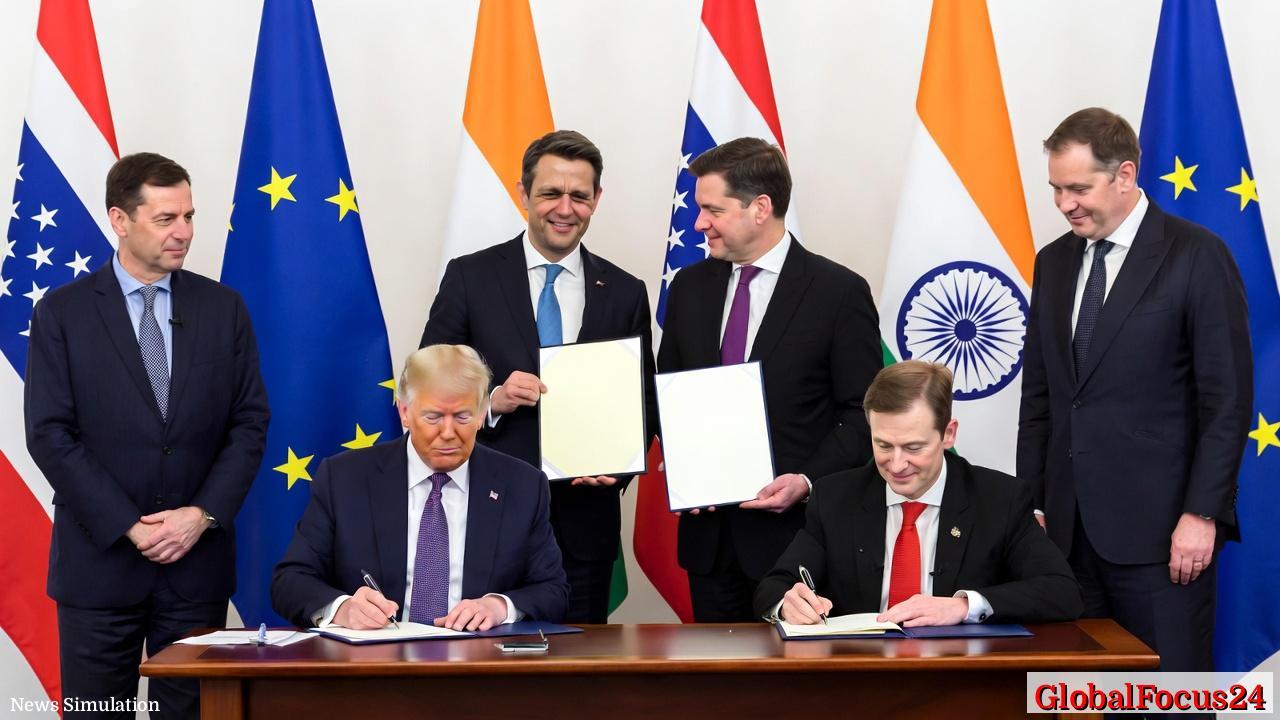
EU-India Free-Trade Pact: A Historic Boost for Global Trade, Jobs, and Regional Competitiveness
In a landmark move signaling a new era of global commerce, Europe eyes a long-delayed free-trade agreement with India, aiming to unlock vast potential across both regions. Negotiators have pursued a deal for years, balancing sensitive sectors—from agriculture and automobiles to digital services and intellectual property—against political considerations and domestic industrial goals. With structural shifts in global supply chains, high inflationary pressures, and a strategic imperative to diversify partners, the prospective accord stands to recalibrate economic trajectories across Europe and South Asia while echoing broader trends in a multipolar world economy.
Historical backdrop: decades of evolving ties
The push for closer trade ties between Europe and India has deep historical roots. Since the early post-Cold War era, both regions have pursued closer economic cooperation, recognizing mutual gains from expanded markets and investment. India’s liberalization journey accelerated in the 1990s, transforming from a relatively closed economy to a hub of services and manufacturing, while the European Union broadened its own base of trade agreements and regional clusters. The desire for a comprehensive trade pact grew in parallel with India’s modernization drive and Europe’s own strategic interest in diversifying supply chains away from over-reliance on a limited set of partners.
Over the past two decades, the trade relationship expanded in tandem with regulatory harmonization efforts and regional market integration. Yet several sensitive sectors remained sticking points, including agriculture, automotive standards, pharmaceuticals, and digital data rules. Negotiations intensified in fits and starts, reflecting the balancing act each side faces: India’s need to protect rural livelihoods and infant industries, and Europe’s push to ensure level playing fields, high labor standards, and robust data governance. The current momentum suggests negotiators have found common ground enough to move toward a formal agreement, signaling a potential milestone in multilateral trade architecture at a moment when global trade rules are under reform.
Economic impact: what a deal could mean for growth, jobs, and innovation
- Growth accelerants: A comprehensive EU-India free-trade agreement would likely lift real GDP for both sides by enhancing market access, reducing average tariff barriers, and expanding opportunities for services, manufacturing, and digital trade. Economists project that a well-structured pact could generate significant output gains over a decade, with cumulative productivity improvements and spillovers from intensified competition, more efficient supply chains, and greater specialization.
- Industry-by-industry implications:
- Services and digital sectors: India’s booming IT, software services, and business-process outsourcing industries could see reinforced demand from European clients, while European financial services, engineering, and professional services firms could access new markets with fewer frictions. The digital economy stands to benefit from harmonized standards, stronger intellectual property protections, and clearer data-transfer rules that balance innovation with privacy.
- Manufacturing and automotive: Europe could gain improved access to India’s vast manufacturing base, including automotive components and machinery. In return, Indian manufacturers could capitalize on Europe’s advanced technology ecosystems, automotive supply chains, and modern infrastructure to scale production and export capacity.
- Agriculture and agro-processing: While politically sensitive, phasing in market access for high-value agricultural products, coupled with quality standards and sanitary measures, could lift farm incomes in India and provide European consumers with greater product variety. Careful sequencing would help mitigate disruption to farmers on both sides.
- Investment and innovation: A stable, rules-based framework often spurs investment. Investors on both sides could benefit from clearer guidelines on dispute resolution, investment protection, and predictable regulatory environments. Cross-border mergers, joint ventures, and technology transfer arrangements could accelerate, driving innovation ecosystems in sectors like renewable energy, battery technology, and pharmaceutical manufacturing.
- Trade balance considerations: As with any large free-trade agreement, effects on the trade balance will vary across industries and over time. Regions with comparative advantages—in this case, Europe’s advanced manufacturing and India’s services and cost-competitive production—could see rebalanced trade patterns that emphasize efficiency and specialization, rather than protectionist reflexes.
Regional comparisons: how Europe-India cooperation stacks up
- Europe versus other major partnerships: The EU has several ongoing or completed trade agreements with major economies, including some with Asia in aggregate. The India deal would add a large, fast-growing economy to Europe’s portfolio, diversifying trade flows away from several traditional partners and offering new channels for growth in the technology, healthcare, and consumer goods sectors. Compared with deals with East Asian supply chains, a robust India pact could strengthen Europe’s strategic autonomy by expanding manufacturing options and service delivery capabilities within a broader, rules-based system.
- India’s regional ties: India’s own regional footprint includes growing ties with Southeast Asia, the Gulf, and Africa through a mix of free-trade agreements and preferential arrangements. A EU-India pact would complement regional integration efforts by embedding a high-standard framework that could serve as a model for future arrangements with other partners, particularly in areas like digital trade, data security, and sustainable development.
- Global supply chains and resilience: The pact would contribute to supply-chain diversification by strengthening ties across high-growth markets. For Europe, it offers a way to rebalance exposure to any single region and to participate more deeply in India’s rapidly expanding consumer market, capital-intensive manufacturing, and green-energy ambitions. For India, the agreement could help attract European technology, capital, and know-how to accelerate modernization and export-led growth.
Geopolitical context: signaling strategic intent and resilience
Beyond pure economics, the EU-India trade initiative has strategic resonance. As geopolitical tensions and protectionist sentiment shape global trade policies, a comprehensive, rules-based agreement demonstrates a commitment to open markets, inclusive growth, and collaborative problem-solving. For both sides, the pact would reinforce their stakes in a stable, multilateral trading order at a time when global norms around data, intellectual property, and environmental standards are increasingly important.
Public reaction and social considerations
Public sentiment toward trade liberalization is nuanced. On one hand, businesses and workers in export-oriented industries often welcome greater access to markets and the potential for job creation. On the other hand, communities concentrated in sectors exposed to competition may worry about disruptions and the need for retraining and social safety nets. A successful agreement would require robust accompanying measures, including targeted support for affected workers, investment in reskilling programs, and transparent, timely communication about transition plans.
Regulatory alignment and standards: what would change in practice
- Tariffs and market access: Reducing or eliminating tariffs on a broad set of goods and services would be central to unlocking value in both directions. While phased preferences help manage transition risks, the long-term effect would be more price-competitive inputs for manufacturers and more affordable consumer goods for households.
- Services liberalization: The agreement would likely include commitments to cross-border service trade, including professional services, engineering, financial services, and digital offerings. Streamlined licensing, mutual recognition of qualifications, and easier data movement across borders would enable firms to deploy talent and capabilities more efficiently.
- Intellectual property and innovation: Stronger IP protections and clearer enforcement mechanisms would help European innovators monetize new ideas while encouraging Indian developers and startups to invest in R&D, knowing their creations have a predictable legal framework.
- Standards and regulatory cooperation: Harmonization of technical standards, conformity assessment, and product-safety rules would reduce compliance costs and shorten time-to-market for goods. Cooperation on regulatory convergence in areas like chemicals, pharmaceuticals, and electronics could accelerate innovation cycles.
- Digital privacy and data flows: A high-quality framework for data protection, cross-border data transfers, and cybersecurity would be essential. Ensuring that data can move freely while maintaining privacy and security safeguards would unlock the digital economy’s potential in both regions.
Implementation roadmap: timelines, milestones, and risk controls
Negotiators are typically guided by a phased approach. Initial milestones might include a broad framework agreement, followed by sector-specific schedules and tariff commitments. Verification mechanisms, dispute resolution procedures, and contingency plans for deviations would be integrated from the outset to build trust and reduce friction during implementation. Risk factors include domestic political changes, currency volatility, and evolving regulatory standards—factors that require robust governance and continuous dialogue.
Public policy alignment: ensuring sustainable and inclusive growth
To maximize benefits, the pact should be complemented by domestic policies that promote inclusive growth. In Europe, this means supporting industrial modernization, regional development, and workforce training that aligns with the opportunities created by greater trade. In India, a parallel emphasis on infrastructure investments, ease of doing business, and targeted sectors like manufacturing and services would help translate market access into real job creation and productivity gains.
Environmental and social standards: a forward-looking framework
Sustainability is increasingly central to trade deals. An EU-India agreement could incorporate commitments on environmental protection, clean energy, and responsible supply chains. By promoting green technologies, energy efficiency, and sustainable manufacturing practices, the pact would help align economic growth with climate objectives, while ensuring social safeguards for workers and communities impacted by shifting trade patterns.
Regional implications: broader effects across adjacent markets
- South Asia: A deeper EU-India relationship could influence neighboring economies, encouraging higher standards and greater competition within the region. Spillover effects might include more robust regional value chains and shared best practices in governance, sustainability, and innovation.
- Europe’s internal markets: Businesses across EU member states could benefit from expanded opportunities, particularly in sectors such as automotive, machinery, pharmaceuticals, information technology, and consumer goods. The cumulative effect would be a more dynamic, diversified European economy with enhanced global competitiveness.
- Global trade architecture: The deal could serve as a catalyst for a broader reform of trade rules, encouraging other large economies to pursue high-standard agreements that reinforce a rules-based order. In parallel, it would push global standard-setting in digital trade, data governance, and sustainability.
Economic indicators to watch
- Trade flows: Monitor shifts in bilateral trade volumes across goods and services, noting any acceleration in exports of European machinery and Indian IT services, as well as changes in agricultural and consumer-goods trade.
- Investment patterns: Track private sector commitments, joint ventures, and technology transfers that indicate confidence in the pact’s long-term predictability.
- Labor market impact: Assess job creation in export-oriented sectors and track retraining initiatives designed to offset displacement in industries facing greater competition.
- Price dynamics: Observe changes in consumer prices, input costs, and inflationary trends resulting from tariff reductions and supply-chain efficiencies.
Conclusion: a turning point with careful stewardship
The proposed EU-India free-trade agreement represents more than a commerce deal; it signals a concerted effort to redefine economic relationships in a rapidly changing global landscape. By weaving together Europe’s manufacturing backbone with India’s services strength and growth potential, the pact could unlock broad-based opportunities, drive innovation, and reinforce resilience in both regions. Preserving social safeguards, ensuring a fair transition for workers, and maintaining high standards on environmental and digital governance will be essential to translating potential into durable, inclusive prosperity. As negotiators move from framework discussions toward concrete sectoral commitments, markets, businesses, and communities will be watching closely for signs that this historic partnership can deliver on its promise.
Would you like this article tailored to a specific audience, such as policymakers, business leaders, or the general public, with a focus on particular sectors or regions within Europe or India?