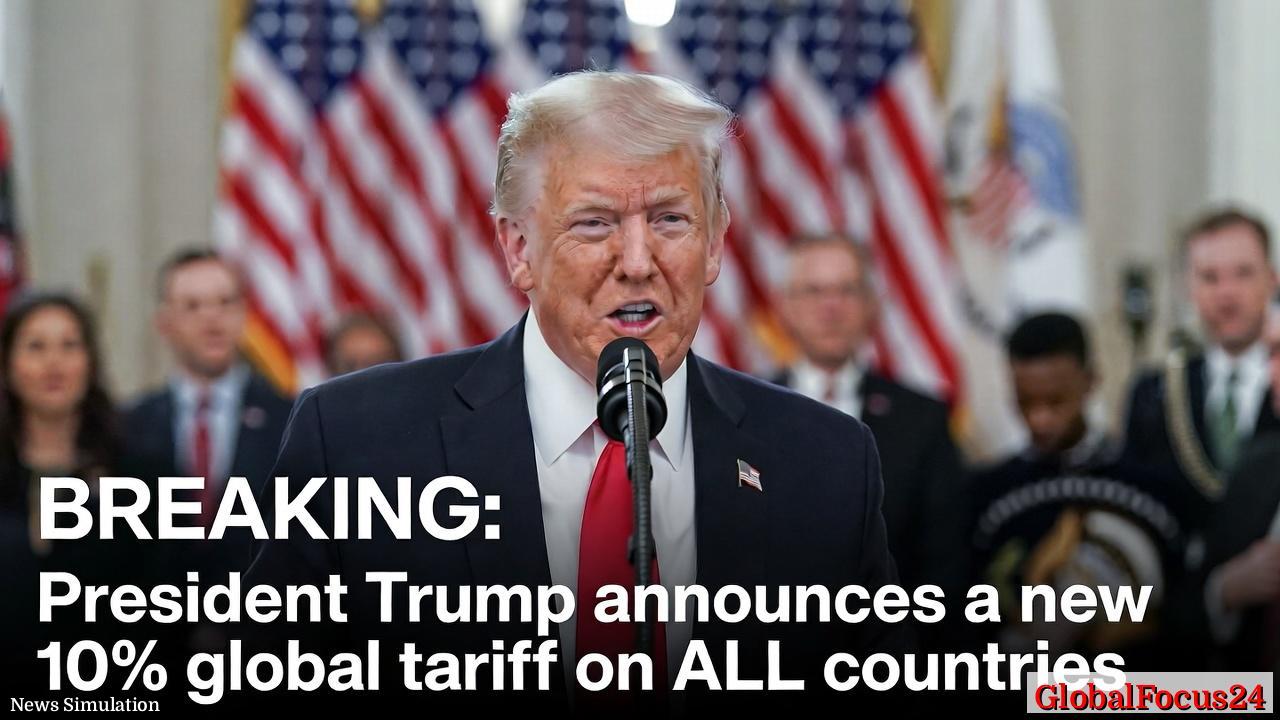
President Trump Announces 10% Global Tariff After Supreme Court Strikes Down Previous Duties
A Sudden Turn in U.S. Trade Policy
WASHINGTON — President Donald Trump announced on Friday that the United States will impose a 10% global tariff on imports under Section 122 of the Trade Act of 1974, invoking a rarely used presidential authority that allows temporary import surcharges without congressional approval. The announcement came just hours after the Supreme Court struck down the administration’s prior tariff package, ruling 6–3 that Trump’s earlier actions under emergency powers had exceeded constitutional limits.
The new measure, framed as a “temporary import surcharge,” is set to take effect in three days. It applies to goods from all trading partners, including countries with existing trade deals such as the United Kingdom, India, and the European Union. The White House said the tariff aims to narrow a “large and serious balance-of-payments deficit” and prevent what officials describe as “significant depreciation of the U.S. dollar” in global currency markets.
“This is about protecting the American worker and defending the American dollar,” Trump declared during a press briefing. Calling the Supreme Court’s ruling “deeply disappointing,” he condemned certain justices as “unpatriotic and disloyal” to the Constitution but vowed his administration would “not be stopped from defending our economy.”
Legal Foundation Under Section 122
While the court rejected Trump’s previous tariffs—many of which were implemented under the International Emergency Economic Powers Act (IEEPA)—the new order leans on a distinct legal foundation. Section 122 of the Trade Act of 1974 grants the president authority to impose tariffs of up to 15% for no more than 150 days when the country faces a balance-of-payments crisis or currency instability.
Trade law experts note that such a provision has not been used on a global basis since President Richard Nixon’s 1971 action, when the U.S. imposed a 10% import surcharge to protect the dollar and end the Bretton Woods gold standard system. That move shocked global markets, leading to a realignment of exchange rates and, eventually, the modern floating currency system.
In today’s case, analysts say the policy is different in scope but similar in reasoning. “The Section 122 announcement is legally more defensible than the emergency powers tariffs,” said Dana Wilcox, a trade law professor at Georgetown University. “However, it is strictly temporary and may face intense political and economic backlash, especially if allies retaliate.”
Immediate Market and Global Reaction
Financial markets reacted sharply to the announcement. The Dow Jones Industrial Average fell more than 800 points within an hour of the news, while the U.S. dollar index strengthened briefly before retreating amid uncertainty about potential countermeasures. Major industrial and retail stocks, including automakers and electronics producers reliant on imported components, saw their shares drop between 5% and 12%.
In Europe and Asia, officials expressed alarm. The European Commission said it was assessing the legality of the new tariff and “reserves all rights for appropriate countermeasures.” Japan’s finance ministry called for an emergency consultation under WTO rules, and India’s commerce minister suggested the measure would “strain trade partnership discussions that were beginning to normalize.”
The global backlash echoes that of earlier trade confrontations during Trump’s presidency, particularly the 2018–2019 tariffs targeting steel, aluminum, and Chinese goods. Despite some domestic manufacturing gains at the time, those measures triggered widespread retaliation and slowed global trade volumes. Economists warn that similar ripple effects could follow this latest initiative.
Economic Rationale and Risks
The administration argues that the tariff is necessary to reduce the U.S. trade deficit, which widened again in late 2025 to more than $1.1 trillion, and to stabilize the dollar after months of weakness against Asian and European currencies. Trump officials claim that foreign currency manipulation and “unfair trade practices” have created long-term imbalances detrimental to American competitiveness.
However, independent economists suggest that the move could have mixed outcomes. While short-term exports may stabilize if the dollar’s value strengthens, the broad-based tariff is likely to raise import costs across industries, feeding into higher consumer prices and potentially worsening inflation.
“Tariffs of this magnitude act like a tax on U.S. consumers,” said Miguel Rivas, chief economist at a San Francisco investment firm. “Even if temporary, a 10% blanket duty affects everything from electronics and cars to clothing and food packaging. The impact would be broad and felt almost immediately.”
Retail trade associations echoed these concerns. The National Retail Federation warned that the policy could erase the modest inflation progress seen in late 2025, with price pressures returning in the second quarter of 2026. “Consumers have just begun to recover from pandemic-era inflation,” the organization said in a statement. “A new global tariff will reverse those gains.”
Historical Context and Global Comparisons
The use of broad-based tariffs as an economic lever has deep roots in U.S. history. From the Smoot-Hawley Tariff Act of 1930—infamously linked to worsening the Great Depression—to Nixon’s temporary surcharge five decades ago, such measures have tended to reshape international trade patterns and test America’s diplomatic relationships.
Unlike those historical precedents, today’s global economy is far more interconnected. The United States imports over $3.5 trillion annually, with high dependency on complex supply chains spanning East Asia, North America, and Europe. Many U.S. manufacturers rely on imported intermediate goods, meaning the new tariff could raise production costs and reduce competitiveness abroad.
Other nations have experimented with similar import surcharges. India imposed temporary tariffs during currency crises in the 1990s, while Argentina has used selective import duties to defend its peso. In both cases, economists observed only short-lived benefits, with domestic inflation and reduced investment confidence outweighing the initial currency support.
“The U.S. has far greater global exposure,” said Rivas. “Even a 10% surcharge worldwide reverberates through energy markets, shipping rates, and manufacturing inputs. This is not happening in isolation—it’s effectively a global tax on trade flows.”
A Balancing Act Between Law and Policy
Friday’s Supreme Court decision that struck down Trump’s earlier tariffs centered on constitutional limits to executive power, ruling that the president could not indefinitely expand trade restrictions by citing ongoing emergencies. The justices reaffirmed Congress’s primary authority over tariffs and trade law, while leaving intact temporary provisions such as Section 122.
By turning to this older statute, Trump is walking a legal tightrope. The provision’s 150-day limit means that without congressional approval, the tariff must expire by summer unless reauthorized under different legal grounds. Political observers expect a fierce debate on Capitol Hill as lawmakers weigh the economic costs against domestic political appeal.
“This may ultimately force a broader conversation about America’s trade strategy,” said Wilcox. “The Supreme Court has clarified the limits, but the president is testing those boundaries again. It’s a showdown between trade law structure and executive improvisation.”
Business Community Weighs Response
Corporate leaders responded cautiously, with many calling for urgent consultations to mitigate supply chain disruption. U.S. automakers, technology firms, and manufacturers that rely heavily on imported semiconductors said they were compiling lists of essential inputs that might require tariff exemptions.
In Silicon Valley, analysts predicted that the technology sector—already grappling with chip shortages and geopolitical constraints—could face an immediate 5–8% cost increase in imported components. “Every additional cost trickles down,” said one executive from a leading semiconductor firm. “Our concern is not just about the tariff itself but about what it signals to trading partners moving forward.”
Agricultural groups also warned of swift retaliation. China, Mexico, and Canada, among the largest importers of U.S. farm products, could reimpose duties on American soybeans, corn, and pork, reversing recent export gains. “Farmers remember 2018,” said the president of the American Soybean Association. “Any hint of another tariff war sends ripple effects through our prices overnight.”
Policy Outlook and Uncertain Future
The new 10% global tariff marks a pivotal moment in U.S. trade relations, reopening debates over protectionism, monetary stability, and international law. While the administration insists the measure is temporary and essential for financial stability, critics warn that it risks destabilizing global supply chains precisely when inflation pressures remain fragile.
Markets and policymakers now await details on implementation and enforcement, including whether exemptions or phased adjustments will be granted. The Treasury Department is expected to clarify in coming days how the surcharge will be collected and whether it applies equally across all product categories.
For now, global markets brace for turbulence as the world’s largest economy once again tests the limits of unilateral trade action. The outcome—economic resilience or renewed volatility—may determine not only the trajectory of U.S. growth in 2026 but also the tone of its trade diplomacy for years to come.