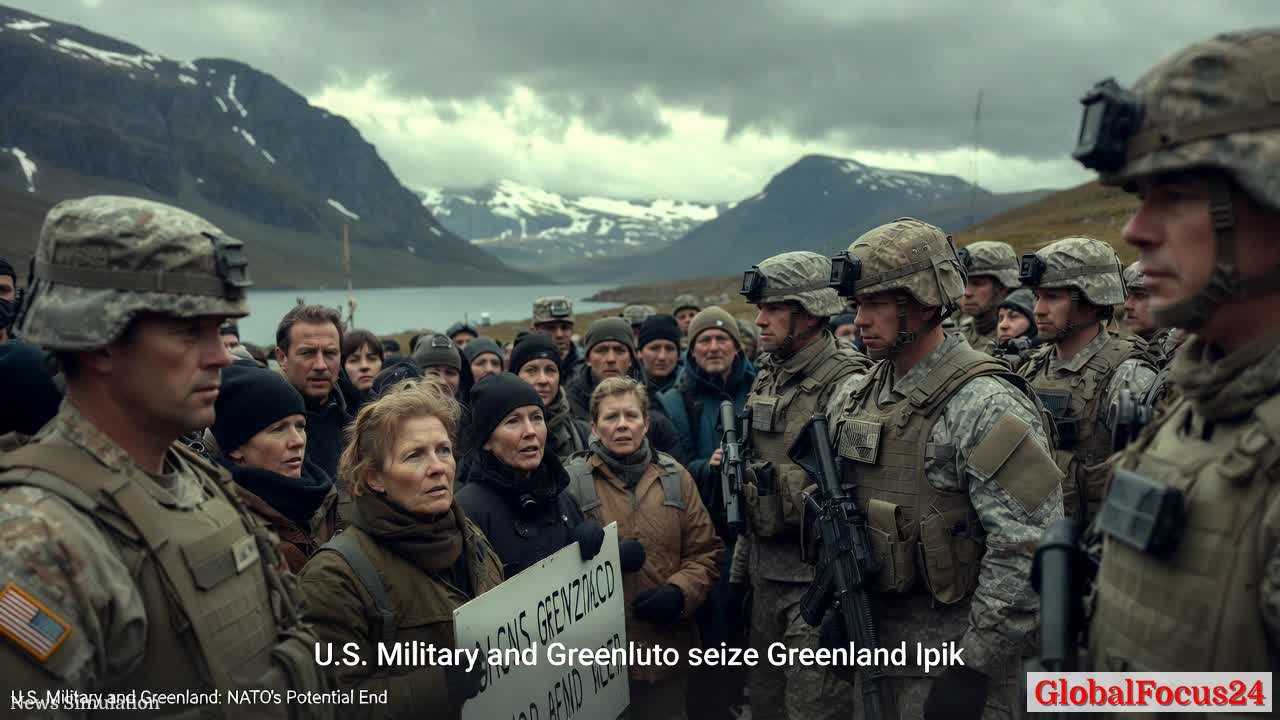
If the U.S. Seized Greenland, NATO Could Collapse: Analyzing the Strategic and Global Consequences
The Strategic Shock of Seizing Greenland
A provocative analysis has ignited debate in diplomatic and defense circles: if the United States were to use military force to take control of Greenland, it would not only shatter the North Atlantic Treaty Organization (NATO) but also redefine how the world perceives American power. The idea, controversial and implausible to some, serves as a litmus test for assessing the limits of alliance trust and the endurance of Western unity.
Greenland, an autonomous territory within the Kingdom of Denmark, holds immense strategic value. Its location between North America and Europe places it at the crossroads of Arctic geopolitics, offering access to new trade routes as polar ice recedes. Beneath its surface lie significant untapped reserves of rare earth minerals, vital for global technologies ranging from wind turbines to smartphones. But despite its growing global importance, any military attempt to “claim” Greenland would, experts warn, push Washington far beyond the acceptable bounds of international law and alliance cooperation.
A History of Interest and Tension
American interest in Greenland is not new. In 1946, President Harry Truman offered Denmark $100 million to purchase the island outright — a proposal that Copenhagen rejected. The U.S., however, established a lasting presence through the Thule Air Base, a critical Cold War outpost monitoring Soviet activity across the Arctic. Today, Thule remains one of the most strategically positioned military facilities in the world, hosting missile warning systems and space surveillance operations.
That past fascination resurfaced in 2019 when then-President Donald Trump suggested buying Greenland again, calling it “strategically interesting.” Danish Prime Minister Mette Frederiksen dismissed the idea, labeling the proposal “absurd.” While that episode ended diplomatically, it revealed the island's enduring significance in U.S. strategic thought — and how easily the topic can strain long-standing alliances.
The Alliance Risk: NATO’s Foundation Under Threat
NATO was built on mutual defense, trust, and respect for sovereignty. Article 5 of the treaty famously guarantees that an attack on one member is an attack on all. If the United States were to unilaterally seize Greenland — a territory linked to Denmark, a founding NATO member — it would effectively nullify the very principle that binds the alliance together.
A military occupation would pit the United States not only against Denmark but against its closest allies, including the United Kingdom, Canada, and Germany. These nations would be forced to confront an existential dilemma: how to respond when the guarantor of Europe’s security becomes a violator of its own rules.
Defense analysts suggest that such a move would dismantle NATO from within, eroding trust irreparably. The alliance’s cohesion depends as much on shared values as on military capability. An act of aggression by the United States against another member’s territory would undermine every future security pledge — from Baltic defense plans to Arctic cooperation initiatives.
Imperial Ambitions or Security Necessity?
Critics of the hypothetical scenario describe it as an imperial turn — a deliberate rejection of cooperative diplomacy in favor of nationalist expansion. Were Washington to commit to such an act, it would signal to allies and rivals alike that America's global strategy had shifted from partnership to dominance. The move would evoke comparisons to 19th-century imperialism, when powerful nations seized territories for their resources and strategic advantage.
Supporters of greater U.S. control in the Arctic might argue that securing Greenland would serve vital national interests: strengthening missile defense systems, protecting supply routes, and countering Russian and Chinese influence. Both Moscow and Beijing have expanded their presence in the Arctic in recent years, making the region a stage for renewed great-power competition.
However, even proponents of U.S. strategic assertiveness acknowledge that such a unilateral seizure would be catastrophic diplomatically. It would fracture Western unity at the very moment global security threats demand cooperation — from cyber warfare to energy resilience.
Economic and Geopolitical Fallout
The economic consequences of an American takeover of Greenland would be severe, not just for Denmark but for global trade stability. Denmark’s control over Greenland’s vast exclusive economic zone grants it rights to critical shipping routes and maritime resources. Losing this territory by force would upend international energy markets, mineral supply chains, and Arctic environmental agreements.
Greenland’s mineral wealth, particularly its deposits of rare earth elements, has drawn increasing interest from multinational companies. The U.S. has worked diplomatically in recent years to secure supply chains independent of China. Yet an armed seizure would destroy those cooperation efforts, prompting retaliatory measures and sanctions from the European Union, Canada, and other key economic partners.
Global markets, already sensitive to geopolitical risks, would likely react with volatility. The dollar might initially strengthen on perceptions of U.S. assertiveness but would soon face instability amid widespread condemnation and trade backlash. European defense spending would surge as nations prepared for uncertainty in a post-NATO world.
Regional Comparisons: Lessons from Other Powers
The hypothetical U.S. action in Greenland can be compared to other recent territorial assertations — most notably Russia’s annexation of Crimea in 2014. That event set off a wave of sanctions, global condemnation, and long-term isolation for Moscow. If Washington mirrored such behavior, it would forfeit its moral high ground and weaken its argument for defending the sovereignty of Ukraine, Taiwan, or any other threatened region.
China’s artificial island projects in the South China Sea offer another point of comparison. Like Greenland for the U.S., those islands represent a strategic expansion of control and surveillance capacity. Yet they also demonstrate how militarized territorial claims destabilize maritime law and fuel regional suspicion.
Unlike those examples, however, a U.S. move against Greenland would target a democratic ally. The psychological and diplomatic shock would be unprecedented — allies who once looked to Washington for security would begin to hedge against American unpredictability, potentially seeking independent defense arrangements or closer ties with non-Western powers.
The Arctic: The Next Frontier of Conflict
Greenland’s importance is magnified by the Arctic’s growing role in global strategy. Melting ice is opening new shipping lanes, cutting transit times between Asia, Europe, and North America. Russia, with its Northern Fleet, controls roughly half of the Arctic coastline and has invested heavily in new bases and nuclear-capable weapons in the region. China, though not an Arctic power geographically, calls itself a “near-Arctic state” and has launched investment and research initiatives to secure influence.
In this tense environment, even symbolic U.S. aggression would provoke an immediate response. Russia would likely interpret the move as evidence that NATO cohesion had collapsed, encouraging greater military adventurism in Eastern Europe. China, meanwhile, could exploit the diplomatic chaos to strengthen its global economic ties and portray itself as a defender of international stability.
The End of NATO: A Foreseeable Outcome
If the United States were to militarily control Greenland, the NATO alliance would cease to function in practice. European members, feeling betrayed, could suspend participation in collective defense missions or withdraw entirely. France and Germany might accelerate efforts to form a separate European defense structure, independent of Washington’s command. The United Kingdom, historically aligned with American interests, would face a domestic and diplomatic crisis over whether to side with allies or its transatlantic partner.
Such a breakdown would mark the end of Western military unity as it has existed since 1949. For Russia and China, this would represent the greatest geopolitical opportunity in decades — the dismantling of the world’s most powerful defensive alliance without firing a shot.
Global Public Reaction and Moral Consequences
The public and political backlash would be immediate and fierce. Demonstrations across Europe and North America would call for an end to militarism and a return to international norms. The United Nations would likely convene emergency sessions, while humanitarian groups would decry the violation of sovereignty. Even within the United States, public opinion could turn sharply against such a decision, as Americans confront the moral and financial burden of occupying a democratic territory against its will.
Generational trust in alliances — built over decades since World War II — would erode. Europe’s younger political movements, already prone to skepticism toward U.S. foreign policy, would accelerate campaigns for military independence. The United States, once seen as a defender of democracy, could find itself isolated alongside nations it has long criticized for territorial aggression.
A Turning Point in Global Order
In the end, the hypothetical military takeover of Greenland would not just terminate NATO — it would redefine global power relationships. It would signal the emergence of a world no longer organized by cooperative defense or shared democratic principles, but by unilateral ambition and tactical opportunism. The very foundations of postwar diplomacy — sovereignty, alliance fidelity, and collective security — would crumble, leaving a vacuum that rivals would eagerly fill.
The analysis concludes that prompting such a confrontation would be not only self-defeating but historically transformative. The United States could possess Greenland, but it would lose the world that its leadership helped shape.