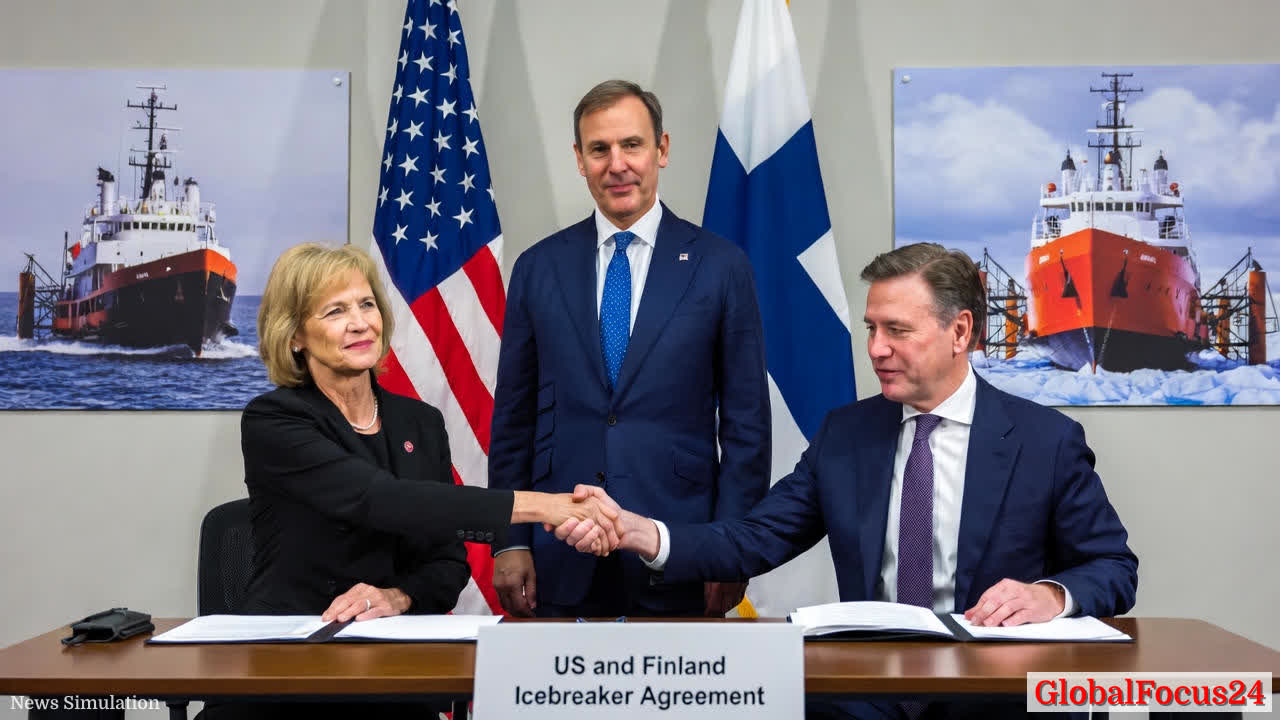
US and Finland Forge Arctic Icebreaker Partnership to Expand Fleet and Presence
A new pact between the United States and Finland marks a pivotal shift in Arctic maritime capability, with Finland to build the initial batch of medium-sized icebreakers and the United States to host additional construction at domestic shipyards. The agreement, modeled as a memorandum of understanding, paves the way for up to four Finnish-built vessels and as many as seven more constructed in the United States, expanding the U.S. Coast Guard’s polar fleet from its current three icebreakers to a robust lineup designed for the high north. The program envisions eleven vessels in total with a projected cost of approximately $6.1 billion, and delivery milestones beginning as early as 2028.
Strategic drivers and historical context
The Arctic has long represented a theater where geography, technology, and strategy intersect. Historically, icebreakers have served not only as utility ships enabling year-round access to critical ports and research stations but also as symbols of national will and sovereignty in polar waters. In the modern era, melting sea ice has altered the geography of the region, revealing new shipping lanes and resource opportunities while simultaneously increasing strategic competition. Russia maintains a sizable and technologically sophisticated icebreaking fleet, including nuclear-powered units, and has used its northern routes to project influence and protect economic interests. China, meanwhile, has been expanding polar operations through joint ventures, scientific missions, and a series of strategic icebreaker-related initiatives. Against this backdrop, the United States has prioritized strengthening its own Arctic presence and partnership-based capacity-building with like-minded allies.
The ICE Pact and trilateral dimensions
The Arctic collaboration builds on an existing framework designed to accelerate vessel production and knowledge sharing across allied networks. The Icebreaker Collaboration Effort, or ICE Pact, brings together the United States, Finland, and Canada to streamline procurement, share technical expertise, and align standards for polar operations. By coordinating design choices, propulsion technologies, ice-breaking capabilities, and hull-form optimization, the ICE Pact aims to reduce duplication, shorten construction timelines, and enhance interoperability among allied fleets when operating in high-lidelity, challenging environments.
Economic implications and workforce impact
The announced program is expected to generate thousands of jobs in the U.S. shipbuilding sector, including positions in design, construction, and winemaking of supporting systems for the new cutters. The initiative also envisions a domestic industry ecosystem—spanning suppliers, sub-contractors, and defense-related services—that could yield broader economic spillovers beyond the immediate project. While the precise distribution of contracts between Finnish shipyards and U.S. facilities will unfold through subsequent procurement cycles, the arrangement reinforces a domestic industrial base aligned with national security and strategic-research priorities.
Regional comparisons and capability differentials
- United States: The United States currently operates a limited number of polar-capable vessels. Expanding to eleven cutters would markedly augment patrol and research support in Arctic waters, enabling more continuous presence, expanded surveillance, and enhanced search-and-rescue and scientific mission capacity. The program also signals a deliberate push to align U.S. capabilities with allied partners, improving joint operations and information-sharing in high-latitude theaters.
- Finland and Nordic partners: Finland has built a reputation as a respected shipbuilder with expertise in icegoing hulls, propulsion systems, and winterized platforms. The collaboration leverages Finnish engineering strengths while fostering closer security and economic ties with North American partners. The broader Nordic approach to Arctic resilience emphasizes cooperative defense, civilian-mederal integration, and robust research ecosystems.
- Russia and China: Observers closely monitor how the expanded U.S. and allied icebreaker capacity might influence Arctic dynamics, including shipping lane governance, resource access, and security clout in contested routes. The presence of more capable icebreaking assets could affect pacing in regional activities and stimulate responses in adjacent fleets and port infrastructures.
- Global maritime commerce: As Arctic routes become more navigable for longer periods each year, nations and commercial shippers reassess the balance of risk, cost, and speed. Icebreakers support reliable transit through otherwise icebound waters, ensuring year-round access to key ports and facilitating scientific and supply-chain missions in northern regions.
Operational and strategic implications
With the Finnish-built vessels and U.S.-constructed units, the Coast Guard expects improvements in several key areas:
- Persistent Arctic presence: A larger, more capable fleet allows for more frequent patrols, environmental monitoring, and quick-response capabilities in remote, icy waters.
- Scientific collaboration: The icebreakers will support research missions, enabling scientists to collect data on sea-ice dynamics, oceanography, and climate indicators from a mobile platform that can reach diverse polar environments.
- Resource security and sovereignty: Enhanced navigation monitoring and patrol capabilities contribute to safeguarding sovereign claims and ensuring safe corridors for legitimate commerce and scientific activity.
- Alliance interoperability: Shared design principles, common systems, and standardized procedures bolster joint operations with Canada, Nordic partners, and other allied nations operating in polar regions.
Delivery timeline and next steps
Initial deliveries are anticipated to begin around 2028, with the Finnish-built icebreakers forming the foundation of the expanded fleet. Subsequent vessels constructed at U.S. shipyards—including a new facility in Galveston, Texas, and existing yards in Louisiana—will step in to complete the eleven-ship program over the following years. The project schedule will be influenced by procurement cycles, construction ramp-up, labor availability, and the integration of advanced polar-capable technologies.
Public reaction and regional sentiment
Public interest in Arctic security and icebreaker capability spans policymakers, industry stakeholders, researchers, and coastal communities reliant on Arctic routes for trade and scientific programs. As capacity grows, regional observers emphasize the importance of transparent implementation, responsible environmental stewardship, and clear governance around Arctic access and resource management. While national security considerations often dominate public discourse around such investments, the broader narrative includes optimism about job creation, technological innovation, and strengthened international collaboration in the high north.
Technological considerations and environmental stewardship
The new icebreakers are expected to incorporate modern propulsion systems, enhanced hull designs for efficient propulsion through ice, and advanced rescue, communications, and weather-monitoring suites. As with any heavy-ship program, environmental and operational safeguards will be central to design reviews, with attention paid to fuel efficiency, emissions controls, and mitigate potential impacts on fragile polar ecosystems. The collaboration with Finnish partners also provides an opportunity to leverage Finland’s experience in sustainable shipbuilding practices and cold-weather engineering.
Geopolitical context and policy alignment
The Arctic strategic landscape hinges on a balance between freedom of navigation, legitimate resource exploration, and national security obligations. The United States’ approach emphasizes alliance-based capacity-building, rules-based order in polar waters, and cooperative defense arrangements with partner nations. By integrating Finnish expertise with American shipbuilding capacity, policymakers aim to reinforce deterrence, encourage responsible behavior among regional actors, and support scientific inquiry in a domain where climate change and economic activity intersect.
Conclusion
The U.S.-Finland icebreaker collaboration represents a notable advancement in Arctic resilience and alliance-based security architecture. Through a combination of Finnish-built vessels and U.S.-constructed cutters, the program seeks to close a strategic capability gap, accelerate industrial development in allied shipyards, and strengthen the capacity to monitor, protect, and navigate northern seas amid evolving climatic and geopolitical conditions. As the first vessels roll off the lines in the coming years, observers will assess how this expanded Arctic footprint translates into safer lanes for commerce, more robust scientific missions, and a more integrated, cooperative approach to polar stewardship among Arctic and near-Arctic nations.