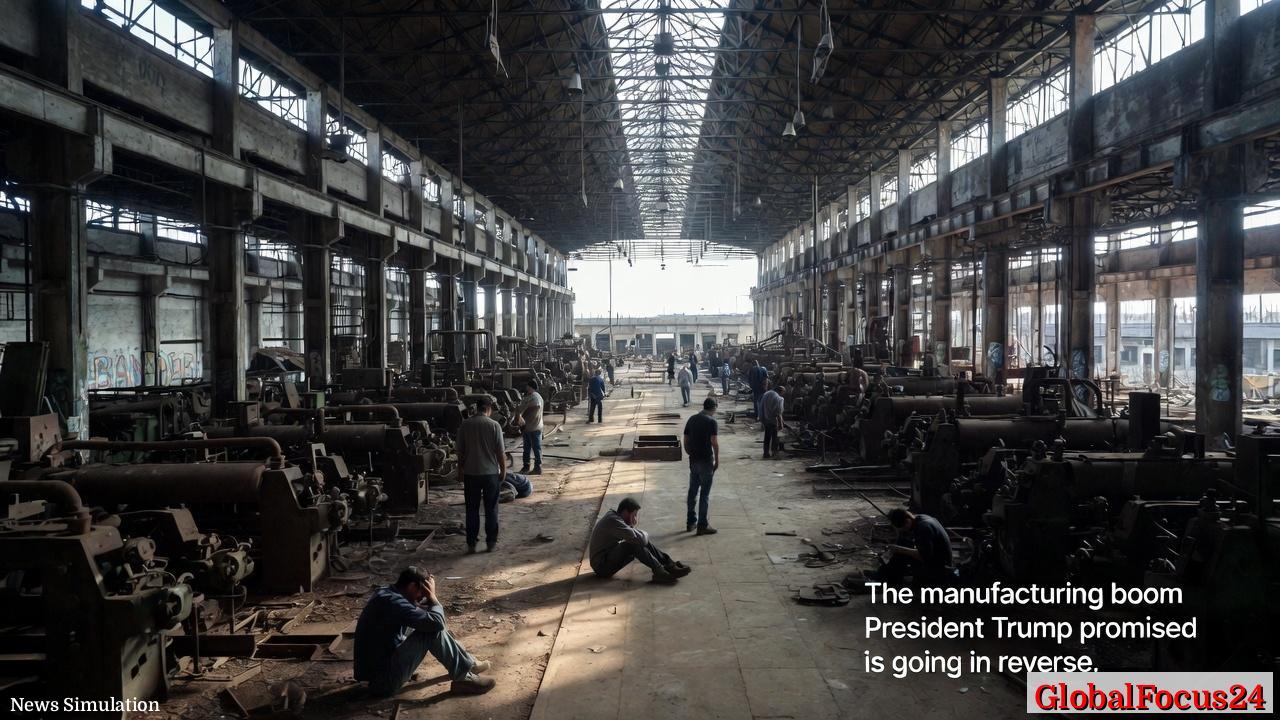
U.S. Manufacturing Sector Contracts Despite Tariff Measures
The U.S. manufacturing industry is navigating a period of pronounced downturn even as policymakers have leaned on tariff measures intended to revive domestic production. After a sequence of elevated import taxes implemented in recent years, the sector has not only failed to regain momentum but has registered sustained job losses and output softness. The latest indicators point to a manufacturing ecosystem in flux, with consequences reverberating from factory floors to regional economies and supply chains across the country.
Historical context: tariff policy and the manufacturing cycle Over the past decade, U.S. policymakers have repeatedly invoked tariffs as a tool to bolster domestic production, protect core industries, and narrow trade deficits. In theory, higher import costs should make locally produced goods comparatively more attractive, encouraging investment, hiring, and resilience within American factories. In practice, the relationship between tariff policy and manufacturing performance has proven intricate. Global supply chains—long organized around efficiency gains, cost differentials, and just-in-time logistics—face disruption when tariffs shift the relative calculus of where goods are made and assembled. The current environment features a complicated mosaic of tariff layers, exemptions, and counter-tariffs that have altered the competitive landscape without delivering a clear, uniform revival in manufacturing activity.
Economic impact: jobs, output, and regional dispersion
- Employment: Recent data indicate manufacturing employment has receded to its lowest levels since the pandemic’s end. Across several consecutive months following tariff intensification, firms have reduced payrolls as they recalibrated capacity, adjusted production schedules, or shifted demand toward non-manufacturing sectors. The cumulative effect since earlier policy shifts is a downturn of roughly tens of thousands of manufacturing jobs, with regional hotspots exhibiting more pronounced pressures.
- Output and investment: Factory production has shown volatility, with some segments stabilizing temporarily while others contract. Firms facing higher input costs, tariff-related pass-through, and competitive pressures from abroad have diverted capital toward modernization in select cases, yet overall capital expenditure remains uneven and frequently restrained by uncertainty about long-term policy trajectories and demand prospects.
- Labor-market dynamics: The manufacturing labor market has experienced marginal improvements in specific niches—high-tech electronics, precision machinery, and automotive components in certain regions—but these gains are offset by broader declines in traditional goods sectors and mid-sized manufacturers facing tighter margins. The net effect is a bifurcated landscape, where the strongest innovators sustain jobs while more generalized producers retrench.
- Supply chains and resilience: Tariffs have magnified concerns about supply chain resilience. Firms are weighing diversification strategies, reshoring considerations, and supplier localization as they navigate cost pressures and geopolitical risks. The result is a more complex, regionally varied picture of manufacturing capacity, with some districts experiencing revitalization opportunities and others facing renewed fragility.
Regional comparisons: Detroit, the Rust Belt, and beyond Detroit and the broader Rust Belt illustrate the uneven regional impact of tariff-driven policy shifts. Historically anchored in large-scale automotive assembly and supplier networks, these regions have faced structural challenges long before tariffs—yet the policy environment has compounded difficulties. In Detroit, for example, the economic fabric tied to vehicle production and related components has undergone a reprioritization: higher import costs for certain parts can improve domestic supplier demand but also raise the cost structure for manufacturers faced with global competition. The result is a nuanced mix of challenges and localized pockets of opportunity where innovative manufacturing ecosystems, skilled labor, and supportive state initiatives converge to sustain jobs and investment.
In other parts of the country, the picture differs. Some coastal manufacturing hubs that emphasize high-value-added products—semiconductors, aerospace components, and specialty machinery—have managed to maintain production with the help of targeted incentives, skilled labor pools, and proximity to diverse export markets. Conversely, more capital-intensive, commodity-focused manufacturers located in inland and midwestern regions have encountered steeper adjustment costs as tariff regimes altered input costs and demand patterns.
Global context: comparisons and lessons Across major economies, tariffs and trade policy have provoked a spectrum of responses. Countries that successfully diversify their industrial bases, invest in advanced manufacturing capabilities, and cultivate strong domestic demand channels tend to weather policy shocks more effectively. In contrast, economies with heavy concentration in specific sectors or with exposure to global price cycles often experience sharper downturns when tariff measures escalate costs and disrupt established supply chains. The United States’ experience reflects a broader lesson: trade policy can influence manufacturing sentiment and longer-term investment, but it does not singularly determine the trajectory of production or employment in the near term.
Industry structure and adaptability
- Sectoral composition: The U.S. manufacturing base spans consumer durables, machinery, chemicals, electronics, and transportation equipment. Tariff policies interact differently with each subsector, depending on supply chain configurations, reliance on foreign inputs, and exposure to international demand. Some subsectors with a high share of imported intermediate goods may suffer from cost pressures, while others with robust domestic suppliers or strategic government support can turn policy shifts into competitive advantages.
- Innovation and productivity: Firms that invest in automation, digitalization, and workforce training may better translate policy changes into productivity gains. The role of research institutions, workforce development programs, and private-public collaboration becomes crucial in sustaining competitiveness during periods of tariff adjustment and global market volatility.
- Small and mid-sized manufacturers: SMEs often bear a disproportionate burden of tariff costs due to narrower margins and limited bargaining power with suppliers. Yet, many SMEs also demonstrate agility by pursuing niche markets, accelerating product customization, or leveraging regional incentives to maintain viability.
Public sentiment and regional economies Public reaction to tariff measures has been mixed, reflecting a balance between protectionist impulses and the practical realities of higher consumer prices and varied business outcomes. In communities with substantial manufacturing employment, shifts in policy can provoke concern about job stability and wage levels, even as regional development programs and workforce retraining efforts generate cautious optimism. Local leaders increasingly emphasize resilience strategies, including diversified industry clusters, cross-training initiatives, and export-oriented programs that can mitigate the impact of policy fluctuations.
Policy implications and future outlook
- Policy coherence: For manufacturing to regain momentum, a coherent policy framework that aligns tariff objectives with incentives for domestic investment, innovation, and supply-chain resilience is essential. Clear signaling about long-term trade policy, coupled with targeted support for capital expenditure and workforce development, can reduce uncertainty and encourage strategic investment.
- Supply-chain diversification: Encouraging firms to diversify suppliers and nearshore critical inputs can reduce vulnerability to tariff-induced cost shocks. Public-private collaborations that map risks, identify critical components, and accelerate supplier development may strengthen overall manufacturing resilience.
- Workforce development: Upskilling and reskilling initiatives tailored to advanced manufacturing, robotics, nanotechnology, and sustainable production will be pivotal. A well-trained workforce supports higher productivity, enables the adoption of cutting-edge processes, and sustains quality across domestic supply chains.
- Regional strategy: Local and state governments play a central role in shaping manufacturing outcomes. Investment in infrastructure, incentives for high-value-added production, and support for regional industrial clusters can help communities adapt to evolving trade dynamics and capture new opportunities.
Public health of the sector: indicators to watch Industry observers consider several indicators critical to assessing the sector’s health in the coming quarters:
- Job vacancies in manufacturing versus hires and layoffs, to gauge momentum in the labor market.
- Capacity utilization rates, which reflect how fully factories are operating relative to their potential, giving insight into demand and efficiency.
- Orders and backlog levels across key subsectors, indicating demand strength and production planning needs.
- Export performance, including regional demand shifts and competitive pressures in global markets.
- Investment in automation and digital technologies, signaling productivity enhancements that could offset tariff-related cost pressures.
Implications for regional economies and policy design The current trajectory underscores the importance of a holistic approach to revitalizing domestic manufacturing. Regions with diversified industrial bases, well-developed logistics networks, and active talent pipelines stand a better chance of weathering tariff-induced adjustments. Policymakers and business leaders can advance resilience by prioritizing diversified supply chains, targeted innovation funding, and workforce development aligned with the needs of high-value manufacturing.
In the broader arc of U.S. economic strategy, manufacturing remains a critical pillar for regional prosperity, innovation, and trade strength. While tariff measures have shaped the dialog around domestic production, the path to a robust, globally competitive manufacturing sector requires a nuanced blend of policy clarity, investment in people and technology, and strategic regional collaboration. The trajectory will depend on how effectively communities adapt, how supply chains evolve, and how policymakers translate macroeconomic objectives into tangible, durable gains on factory floors across the nation.