Global Smartphone Shipments Set for Sharp 13% Decline as Memory Shortage Reshapes Industry
A Sudden Reversal in Smartphone Market Growth
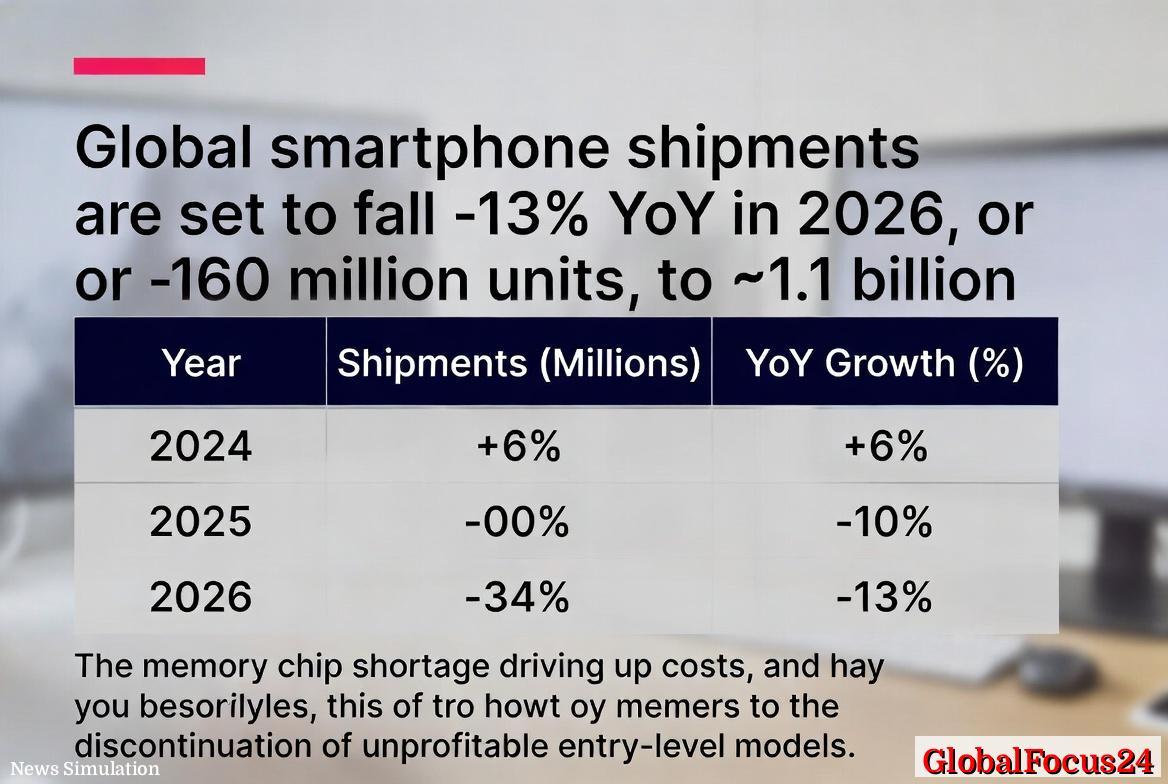
The global smartphone market is bracing for a significant contraction in 2026, with shipments projected to fall by 13% year-over-year. This decline represents a drop of approximately 160 million units, bringing total annual shipments down to around 1.1 billion devices. The downturn marks a sharp reversal after two consecutive years of growth, including a 6% increase in 2024 and a more modest 2% rise in 2025.
At the center of this shift is a severe and ongoing shortage of memory chips, a critical component in modern smartphones. The supply disruption has sent shockwaves across the electronics industry, driving up production costs and forcing manufacturers to rethink product strategies, pricing models, and long-term market positioning.
Memory Chip Shortage Disrupts Global Supply Chains
Memory chips, including DRAM and NAND flash, are essential for smartphone performance, enabling multitasking, storage, and high-speed processing. The current shortage has been described by industry observers as unprecedented in scale, driven by a combination of factors:
- Increased demand for memory-intensive technologies such as artificial intelligence, electric vehicles, and cloud computing.
- Production bottlenecks at major semiconductor fabrication plants.
- Limited expansion capacity due to high capital costs and long lead times for new facilities.
The imbalance between supply and demand has pushed memory prices sharply higher, directly impacting smartphone production costs. Manufacturers, already operating within tight margins, have been forced to pass these costs on to consumers or absorb losses.
The End of the Ultra-Budget Smartphone Era
One of the most immediate consequences of rising component costs is the disappearance of ultra-low-cost smartphones. Devices priced under $100, once a cornerstone of emerging market growth, are rapidly being phased out.
In 2025, approximately 170 million smartphones in this price range were shipped globally. These devices played a crucial role in expanding digital access, particularly in regions such as South Asia, Sub-Saharan Africa, and parts of Latin America. However, with current cost pressures, producing such devices is no longer economically viable for most manufacturers.
Companies are now discontinuing entry-level models that fail to generate sustainable profits. Instead, they are focusing on mid-range and premium devices, where higher margins can offset rising production expenses.
Strategic Shift Toward Higher-Priced Devices
The shift away from budget smartphones reflects a broader transformation within the industry. Manufacturers are increasingly prioritizing profitability over volume, emphasizing features such as:
- Enhanced camera systems and computational photography.
- Advanced processors optimized for artificial intelligence.
- Premium materials and design.
- Expanded storage and memory configurations.
This strategy aims to encourage consumers to upgrade to more expensive devices, even as overall shipment volumes decline. In mature markets such as North America and Western Europe, where smartphone penetration is already high, this approach aligns with consumer preferences for longer-lasting, feature-rich devices.
However, the implications are more complex in developing regions, where affordability remains a key driver of adoption.
Regional Impact and Market Disparities
The projected decline in smartphone shipments is expected to affect regions unevenly, highlighting existing disparities in digital access and economic resilience.
In North America and Europe, consumers are likely to respond to higher prices by extending device replacement cycles rather than exiting the market altogether. Premium devices continue to dominate sales in these regions, and financing options help mitigate upfront costs.
In contrast, emerging markets face more significant challenges:
- In India and Southeast Asia, the disappearance of sub-$100 smartphones could slow the pace of first-time smartphone adoption.
- In Africa, where entry-level devices have been essential for expanding internet access, the impact could be particularly pronounced.
- In Latin America, economic volatility may amplify the effects of rising prices, further constraining demand.
China, the world’s largest smartphone market, presents a mixed picture. While domestic brands have strong supply chain integration and may adapt more quickly, overall demand is expected to soften due to economic headwinds and shifting consumer behavior.
Historical Context: Cycles of Growth and Contraction
The smartphone industry has experienced cycles of rapid growth and periodic slowdowns since its emergence in the late 2000s. The early 2010s were characterized by explosive expansion, driven by technological innovation and widespread adoption.
By the late 2010s, growth began to plateau as markets matured and replacement cycles lengthened. The COVID-19 pandemic introduced additional volatility, initially disrupting supply chains before triggering a surge in demand for connected devices.
The current downturn differs from previous slowdowns in one key respect: it is driven primarily by supply-side constraints rather than demand saturation. The memory chip shortage has created a bottleneck that limits production capacity across the industry, regardless of consumer demand.
Economic Implications Across the Technology Sector
The impact of the smartphone shipment decline extends beyond device manufacturers, affecting a wide range of industries and stakeholders:
- Semiconductor companies are experiencing increased demand but also facing pressure to expand production capacity.
- Component suppliers, including display and battery manufacturers, may see reduced orders as smartphone output declines.
- Telecommunications providers could face slower subscriber growth in regions where smartphone adoption stalls.
- App developers and digital service providers may encounter reduced user growth in emerging markets.
At the same time, higher device prices could boost revenue per unit for manufacturers, partially offsetting the decline in shipment volumes. This shift may lead to a more consolidated industry, with larger players better equipped to navigate supply chain disruptions.
Supply Outlook and Timeline for Recovery
Industry forecasts suggest that the memory chip shortage will persist into the middle of 2027. While new fabrication facilities are under construction, the semiconductor industry’s long development cycles mean that supply increases will take time to materialize.
Even after supply stabilizes, memory prices are not expected to return to 2025 levels. Structural changes in demand, particularly from data centers and AI-driven applications, are likely to keep prices elevated over the long term.
This new pricing environment could permanently alter the economics of smartphone production, reinforcing the trend toward higher-priced devices and reduced emphasis on entry-level segments.
Consumer Behavior in a Changing Market
As smartphone prices rise, consumer behavior is evolving in response:
- Longer device lifespans are becoming the norm, with users holding onto smartphones for three to five years or more.
- Refurbished and second-hand markets are gaining traction, offering more affordable alternatives.
- Consumers are placing greater emphasis on durability, software support, and long-term value.
These trends reflect a broader shift in how smartphones are perceived—not as disposable gadgets, but as essential, long-term investments.
Industry Adaptation and Future Outlook
Facing a challenging environment, smartphone manufacturers are exploring new strategies to maintain competitiveness:
- Investing in supply chain diversification to reduce reliance on single sources of components.
- Developing in-house semiconductor capabilities to gain greater control over production.
- Expanding into adjacent markets such as wearables, augmented reality devices, and connected ecosystems.
Innovation remains a key differentiator, with companies continuing to push advancements in foldable displays, AI integration, and energy efficiency. However, these innovations are increasingly concentrated in higher-priced devices, reinforcing the industry’s shift away from affordability.
A Defining Moment for the Smartphone Industry
The projected 13% decline in global smartphone shipments in 2026 represents more than a temporary setback. It signals a structural transformation driven by supply constraints, rising costs, and changing market dynamics.
The era of ultra-affordable smartphones, once a driving force behind global connectivity, is coming to an end. In its place, a new landscape is emerging—one defined by higher prices, longer device lifecycles, and a renewed focus on profitability.
As the industry navigates this transition, the balance between innovation, accessibility, and economic sustainability will shape the next chapter of the global smartphone market.