Elon Musk Unveils Terafab: Tesla and SpaceX Join Forces to Build Massive Chip Plant in Austin
A Bold Vision for Domestic Chip Production
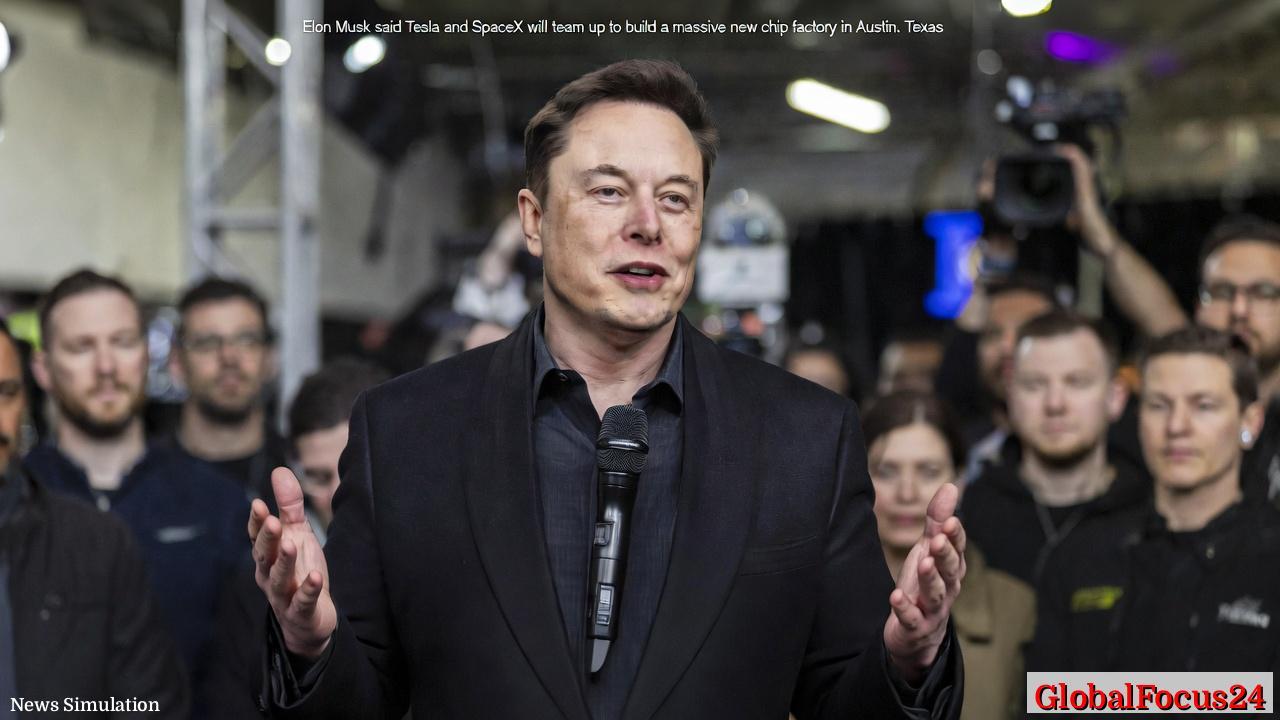
Elon Musk has announced plans for Tesla and SpaceX to co-develop a large-scale semiconductor manufacturing facility in Austin, Texas, marking a major expansion of both companies’ technological and industrial ambitions. The project, named Terafab, will focus on producing advanced chips tailored for electric vehicles, humanoid robots, and artificial intelligence-driven satellites.
Speaking during an event in Austin, Musk described the initiative as essential to the continued evolution of his companies’ operations. “We either build the Terafab or we don’t have the chips,” he said. “We need the chips, so we’re going to build the Terafab.” The statement underscored both the urgency and strategic significance of domestic chip capacity amid growing global demand for high-performance semiconductors.
The Strategic Merger of Tesla and SpaceX Expertise
This unprecedented collaboration merges Tesla’s expertise in automotive and robotics engineering with SpaceX’s mastery of aerospace and satellite systems. The partnership signals a deeper integration of hardware and AI capabilities across Musk’s corporate ecosystem.
The Terafab plant is expected to serve as a shared hub for multiple product lines:
- Tesla: supplying custom-designed chips for self-driving vehicles and Optimus humanoid robots.
- SpaceX: fabricating high-performance processors for its expanding Starlink satellite constellation, newly outfitted for onboard AI processing.
Although the timeline for construction and production has not yet been revealed, insiders suggest the initiative could become one of the largest semiconductor projects undertaken by a private U.S. company.
Context: The Global Semiconductor Shortage
The announcement comes at a time when semiconductor supply chains remain strained following the disruptions of the early 2020s. Throughout that decade, automakers and technology firms faced production halts due to chip shortages stemming from the COVID-19 pandemic, geopolitical tensions, and surging demand for cloud computing and consumer electronics.
While global chip production has since recovered, demand for AI-optimized and high-performance semiconductors continues to far outpace supply. Tesla and SpaceX, which rely on custom computing power for autonomous systems, have felt this constraint acutely. Musk’s decision to embark on in-house fabrication reflects a broader industry shift toward vertical integration, mirroring strategies employed by giants such as Apple and Amazon in chip design.
Challenges and Scale of Investment
Launching a full-fledged semiconductor manufacturing operation represents one of the most complex industrial undertakings possible. Each level of the process—from wafer lithography to etching, doping, and assembly—requires millions of precision steps and highly specialized infrastructure.
Industry analysts estimate Terafab’s total investment could exceed $20 billion over several years. The facility is expected to employ thousands of engineers and technicians across AI hardware development, process engineering, and advanced robotics. Two separate semiconductor units will operate within the facility, dedicated to distinct chip architectures. This dual-architecture approach allows for parallel innovation, faster testing cycles, and rapid design iterations.
The chips will reportedly be built using next-generation lithography technologies, potentially including extreme ultraviolet (EUV) processes, which enable nanometer-scale precision. Such capabilities would allow Tesla and SpaceX to push the performance boundaries beyond what is currently achievable through third-party foundries.
Strengthening U.S. Technological Independence
The Terafab initiative aligns with broader efforts to revitalize domestic semiconductor manufacturing and reduce dependence on overseas suppliers. Over the last several years, the United States has made significant policy and financial commitments to reshore chip fabrication, acknowledging the strategic importance of semiconductors for both economic and national security.
Companies such as Intel, TSMC, and Samsung are already expanding their U.S. operations, building multibillion-dollar plants in Arizona, Ohio, and Texas. Musk’s entry into the field adds an influential private-sector dimension to this movement and positions Austin as one of the country’s emerging semiconductor capitals.
The region’s combination of engineering talent, robust infrastructure, and proximity to Tesla’s Gigafactory Texas makes it a logical choice. Texas has long served as a base for hardware innovation, with Dell’s roots in nearby Round Rock and a growing network of chip suppliers throughout the state’s central corridor.
Comparing Austin to Other Global Tech Hubs
Austin’s growing influence in the semiconductor sector mirrors similar transformations seen in Taiwan’s Hsinchu Science Park, South Korea’s Gyeonggi Province, and the greater Phoenix area in the United States. Each of these regions became global centers for high-value manufacturing by fostering collaboration between engineers, universities, and capital investment.
Should Musk’s Terafab achieve its goals, it could elevate Austin into that same elite tier of global semiconductor hubs. The integration of automotive, aerospace, and AI design under one roof offers a distinctive model unseen elsewhere in the industry—a synthesis that could set a precedent for multi-industry chip ecosystems.
Economic and Employment Impact
Local economic analysts expect significant ripple effects from the construction of the Terafab facility. The direct employment of engineers, technicians, and support staff could be supplemented by thousands of indirect jobs in construction, logistics, and supply chain services.
Austin’s booming real estate and technology markets are already feeling the anticipation. New residential developments, transportation upgrades, and utility expansions are being discussed to accommodate the influx of high-skilled workers. The region’s universities—including the University of Texas at Austin—are likely to benefit from research partnerships and workforce training programs connected to the project.
The initiative also signals confidence in Texas’ business climate, long recognized for its low corporate taxes and pro-manufacturing policies. In contrast to traditional tech centers such as Silicon Valley, Austin offers comparatively lower operating costs and fewer regulatory hurdles, factors that may accelerate construction and production timelines once finalized.
Overcoming Industry Obstacles
Despite Tesla and SpaceX’s track records for innovation, semiconductor fabrication is a vastly different discipline from aerospace manufacturing or electric vehicle production. The technical barriers to entry are high: cleanroom design, yield optimization, and supply chain logistics for raw silicon and photolithography tools require deep expertise.
Both companies will likely lean on experienced suppliers and technical partners—potentially including ASML, Applied Materials, and Lam Research—for equipment and materials. Musk acknowledged earlier collaborations with Samsung Electronics and Taiwan Semiconductor Manufacturing Company, expressing gratitude for their contributions while emphasizing their limited ability to meet his projects’ accelerated demands.
Expanding into full-scale chip fabrication will test Tesla and SpaceX’s operational bandwidth. However, their vertically integrated cultures and track records of achieving firsts—from reusable rockets to mass-market electric vehicles—suggest that major challenges could be met with inventive engineering solutions.
The Broader Vision: AI, Robotics, and Beyond Earth
Beyond industrial production, the Terafab project reflects Musk’s overarching vision: a seamless continuum linking artificial intelligence, robotics, and space exploration. High-performance chips are the connective tissue enabling this future. Whether powering neural networks for Tesla’s self-driving systems, controlling the limbs of Optimus robots, or analyzing data onboard Starlink satellites, semiconductors are the foundation of Musk’s multi-planetary enterprise.
The creation of a shared chip ecosystem between Tesla and SpaceX also hints at longer-term possibilities—interoperable AI systems spanning terrestrial and orbital platforms, adaptive robotic factories, and even autonomous spacecraft leveraging shared computing architectures.
Looking Ahead
While timelines and detailed specifications remain undisclosed, early planning activity around Austin suggests momentum is already building. Site evaluations, environmental assessments, and infrastructure studies are expected to proceed over the coming months.
If realized, Terafab could reshape the competitive landscape of both the American semiconductor industry and the global technology economy. For Musk’s companies, it represents more than a manufacturing upgrade—it is the backbone of an integrated future where artificial intelligence, automation, and spacefaring technology converge.
As the world races to secure the chips that will power the next generation of innovation, Austin, Texas, may soon stand at the center of a new era in global manufacturing—one defined by speed, intelligence, and the relentless pursuit of self-reliance.