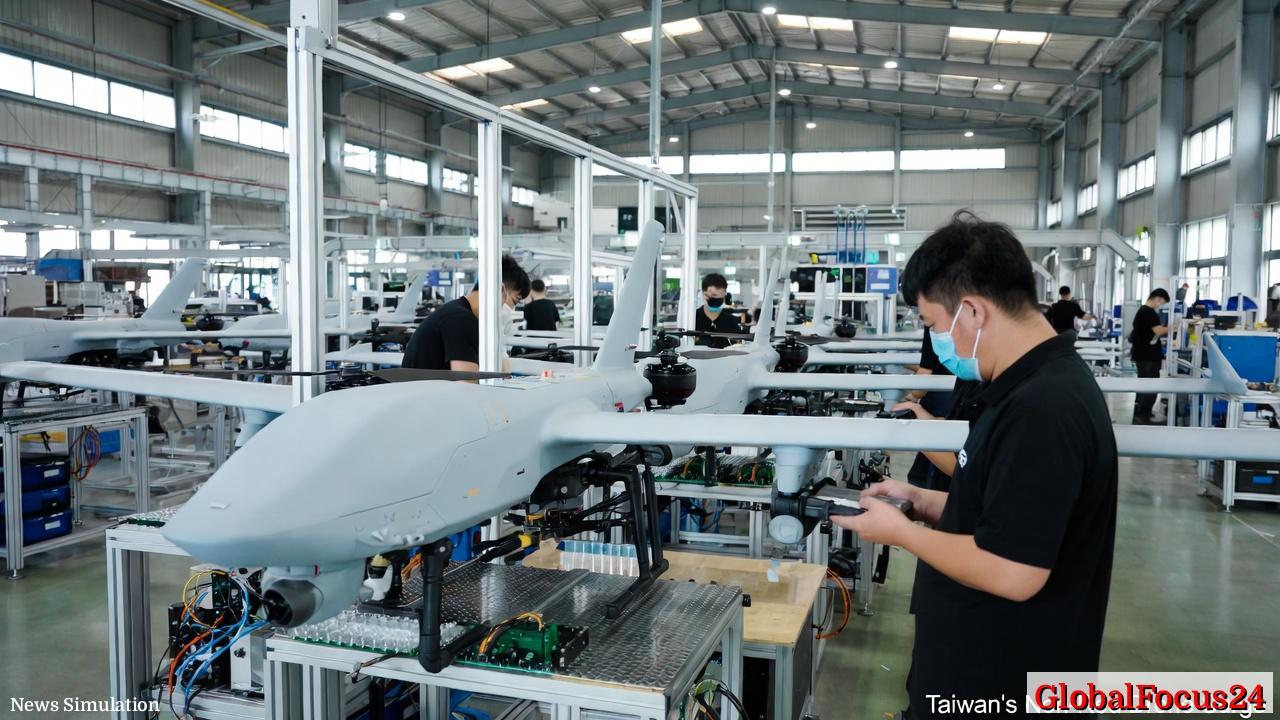
Taiwan Accelerates Production of “Non-Red” Drones Amid Rising Global Security Concerns
Taipei’s Strategic Push to Build a China-Free Drone Industry
Taiwan is significantly expanding its domestic production of drones entirely free of Chinese components, positioning itself as a leading global supplier of so-called “non-red” unmanned aerial vehicles (UAVs). The ambitious effort reflects growing international demand for secure and trustworthy drone technology at a time of rising geopolitical tension and increasing scrutiny of Chinese-made equipment.
The initiative, which began in 2022, was inspired by Ukraine’s strikingly effective use of drones in its defense against Russian aggression. Since then, Taiwan’s production capacity has surged from around 10,000 units in 2024 to well over 120,000 in 2025. The sharp increase has transformed the island into one of the fastest-growing drone manufacturing hubs in Asia outside mainland China.
As of early 2026, exports have already surpassed 85,500 units, underscoring how Taiwan’s rapidly expanding industry has tapped into a global market increasingly concerned about security, transparency, and supply chain vulnerabilities.
The Appeal of “Non-Red” Drones
Despite costing nearly twice as much as Chinese counterparts, Taiwan’s drones have won market share thanks to their complete absence of Chinese parts—a feature that has become a decisive selling point for buyers wary of cybersecurity risks or potential geopolitical exposure. China currently dominates an estimated 70 to 80 percent of the global drone market, led by companies whose products have been restricted or banned in several Western nations.
This global unease has accelerated opportunities for Taiwanese manufacturers. Governments and defense departments in the United States, Europe, and parts of Asia are diversifying away from Chinese suppliers, turning instead to what they view as secure, democratic alternatives. For Taiwan, this shift marks both a commercial opportunity and a strategic imperative.
Inside Taiwan’s Industrial Expansion
Taiwan’s Ministry of Economic Affairs has identified UAVs as a “strategic emerging industry,” aligning with the island’s broader goals of strengthening its domestic tech ecosystem and reducing dependence on any single foreign market. The government has rolled out subsidies, research incentives, and procurement programs to foster a fully independent supply chain for motors, sensors, flight controllers, and lithium batteries—all essential components typically sourced from Chinese manufacturers.
Local producers such as Thunder Tiger, GEOSAT Aerospace, and other startups have ramped up investment in manufacturing facilities across Taichung, Kaohsiung, and Hsinchu. These companies are not only producing drones for agricultural surveillance and mapping but also rapidly advancing into tactical and reconnaissance-grade UAVs capable of carrying payloads of up to 8 kilograms and flying at speeds of 140 kilometers per hour.
By building up capacity in design, software integration, and sensor manufacturing, Taiwan is laying the groundwork for a vertically integrated industry resilient to supply chain shocks. Officials target full elimination of Chinese parts by the end of 2026, with an ambitious production goal of 180,000 units annually by 2028.
A Global Market in Transition
The surge in Taiwanese drone exports coincides with sweeping policy shifts worldwide. In the United States, federal agencies have imposed strict procurement bans on UAVs containing Chinese components due to data security concerns. The European Union is also reassessing its dependence on Chinese technology, prompting several member states to seek reliable, transparent alternatives.
Countries such as the Czech Republic, Poland, and Lithuania have expressed interest in partnerships with Taiwanese firms, reflecting a broader move among NATO-aligned nations to diversify their defense technology sources. Some of Taiwan’s newer drone models have already reached Ukraine’s front lines, supporting reconnaissance and logistics operations.
These developments underscore a fundamental transition in the global UAV market—from a low-cost, China-centric structure to one driven by trust, security, and interoperability with Western defense standards.
Lessons from Ukraine and the Rise of Combat-Ready Drones
Ukraine’s experience has profoundly influenced Taiwan’s strategic direction. The conflict demonstrated how drones, both consumer-grade and purpose-built, can redefine modern warfare through real-time surveillance, precision targeting, and rapid technological adaptation. Watching these lessons unfold, Taiwanese defense planners recognized the importance of a robust unmanned systems industry, not only for export but also for the island’s own national defense.
The government quickly mobilized state-backed programs to stimulate collaboration between defense institutes, private manufacturers, and universities. The goal is to create dual-use technologies—civilian drones that can be modified for battlefield or disaster-response applications if required. This flexible development approach allows Taiwan to expand both commercial and military capabilities without breaching international export restrictions.
Economic and Employment Impact
Beyond defense and security considerations, the economic implications of Taiwan’s drone expansion are substantial. The island’s growing UAV industry supports thousands of high-skill jobs in engineering, materials science, and data analytics. Small and medium enterprises have benefited from government grants aimed at encouraging production of components such as brushless motors, optical sensors, and flight control systems.
Taiwan’s strong base in semiconductors and electronics gives it a natural edge. Integrating drone production into the broader high-tech manufacturing ecosystem enables companies to innovate rapidly, improve performance levels, and enhance competitiveness against regional rivals like South Korea and Japan. According to analysts, if current trends continue, UAVs could become one of Taiwan’s top five technology exports by the end of the decade.
Regional Comparisons: Taiwan Versus Its Neighbors
While Japan and South Korea have also increased their investment in drone technology, Taiwan’s concentrated push to eliminate Chinese components gives it a unique position. Japan focuses heavily on robotics integration, while South Korea emphasizes dual-use defense applications tied to its aerospace sector. Yet neither has matched Taiwan’s pace in scaling civilian and tactical drone production simultaneously.
Southeast Asian nations such as Malaysia, Vietnam, and Indonesia have shown growing interest in establishing local UAV industries, but most remain reliant on imported components from China. Taiwan’s early move to localize production and secure international partnerships puts it ahead of the curve in an increasingly fragmented technology market.
Challenges in Supply Chain Localization
Despite rapid progress, Taiwan’s producers still face hurdles. Developing domestic suppliers for high-efficiency motors, advanced sensors, and navigation systems requires sustained investment and technical expertise. Local firms must compete not only with China’s cost advantages but also with established Western manufacturers offering premium components.
To overcome this, industry associations are promoting joint ventures between Taiwanese research institutes and foreign technology partners. The government’s goal is to ensure that critical subsystems—from propulsion to encryption—are fully developed and manufactured within trusted networks by the end of the decade.
Cybersecurity remains another top priority. As UAVs increasingly rely on cloud-based data sharing and AI-driven navigation, Taiwan is investing in secure data links and encryption protocols to prevent interference or unauthorized control. These security features further differentiate Taiwan’s drones from their lower-cost rivals.
Expanding Civilian Applications
While global attention often focuses on military drones, Taiwan’s domestic market for civilian UAVs is also growing rapidly. Drones now support agricultural spraying, powerline inspection, mapping, and environmental monitoring across the island. Government agencies are incorporating aerial data into disaster management and coastal patrol efforts, signaling broad institutional adoption.
Startups are exploring new frontiers such as medical supply delivery in mountainous regions and maritime surveillance for fishing fleets. This expanding ecosystem contributes to Taiwan’s reputation as a center for innovation in unmanned systems and autonomous technologies.
A Future Defined by Strategic Autonomy
With the global UAV market poised for sustained growth, Taiwan’s deliberate move toward self-sufficiency marks a decisive turn in its broader industrial strategy. Officials emphasize that “non-red” drone production is not merely a reaction to security concerns but part of a long-term vision for technological independence and economic resilience.
By combining domestic innovation, rigorous quality control, and trusted international partnerships, Taiwan is on course to become a cornerstone of the world’s non-Chinese drone supply network. The island’s trajectory from niche producer to global contender illustrates how geopolitical realities, industrial policy, and technological agility can converge to reshape entire sectors.
As nations continue to rethink the security of their supply chains, Taiwan’s success in building a “non-red” drone industry may offer a powerful template for balancing economic opportunity with strategic autonomy in the new era of global technology competition.