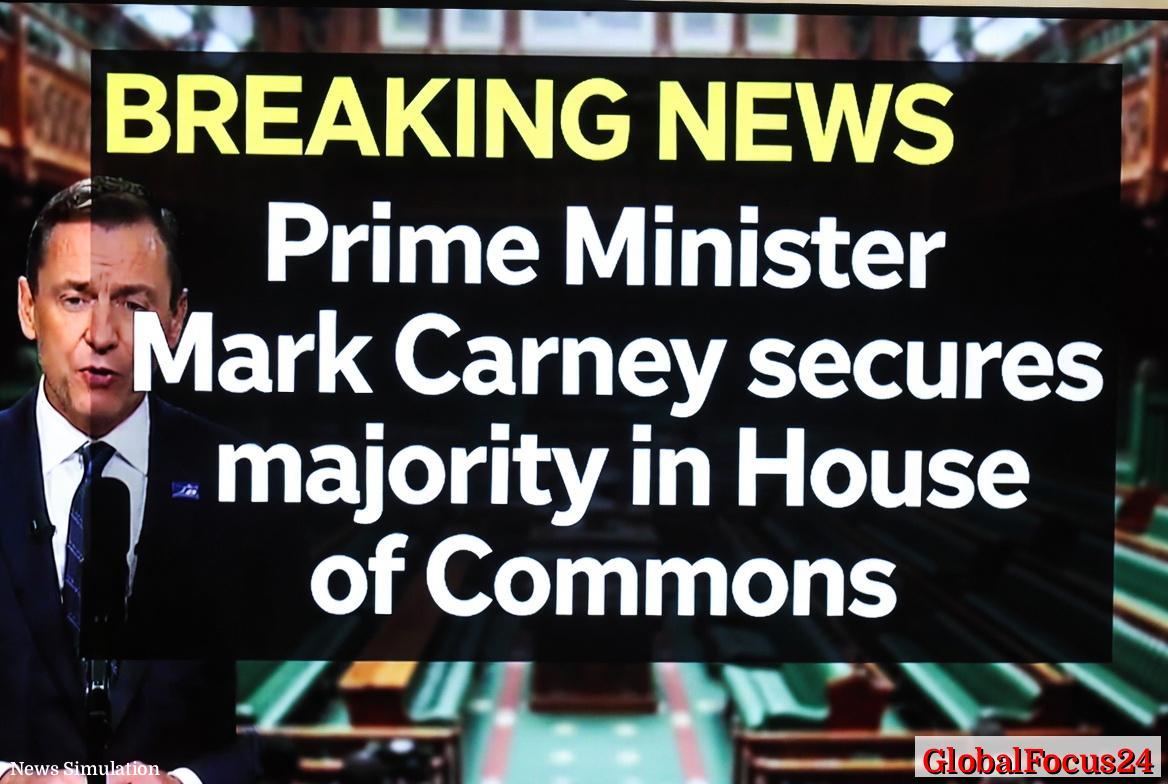
Mark Carney’s Liberals Secure Majority, Ending Canada’s Year of Uncertainty
A Turning Point in Ottawa
Prime Minister Mark Carney’s Liberal Party has achieved a decisive parliamentary majority after Monday’s special elections, marking a major shift in Canada’s political landscape and ending more than a year of fragile minority rule. With two victories out of three contested ridings, the Liberals now surpass the threshold of 172 seats required for control in the 343-member House of Commons.
The result comes after months of speculation about whether Carney could consolidate power amid growing defections from opposition ranks. Five lawmakers—most recently a Conservative MP from Alberta—crossed the floor since late 2025, signaling widening cracks within rival parties. The victories on Monday formally complete that political realignment and grant Carney the firm legislative footing he lacked since coming to office last April.
From Minority Maneuvering to Majority Power
For much of the past year, Carney led a minority government that relied on issue-by-issue negotiation with opposition parties. That arrangement often slowed debates on key policies, particularly those tied to trade diversification and energy strategy.
Political analysts describe the new majority as “transformative” for Carney’s economic agenda. Freed from constant parliamentary bargaining, the Liberals can now advance legislation with greater confidence—an outcome that could reshape Canada’s economic orientation after a decade of intense North American integration.
Carney, viewed broadly as a technocratic leader with deep economic expertise, has repeatedly emphasized the need for Canada to “stand economically independent” while maintaining strong global partnerships. His past leadership roles at the Bank of Canada and the Bank of England shaped his reputation as a steady hand in turbulent economic times.
A Speech Framing National Unity
At the Liberal convention in Montreal over the weekend, Carney avoided direct reference to the political defections that helped make the majority possible. Instead, he struck a tone of inclusivity and purpose, urging Canadians to move “beyond politics as usual.” His speech, met with extended applause, underscored a theme of unity and national resilience.
Analysts say that message resonates in an atmosphere where many Canadians are looking for stability. Following years of fragmented governance and successive minority legislatures—from Justin Trudeau’s narrow post-2019 re-election to Carney’s own minority win in 2025—the return of a majority government signals renewed predictability in Ottawa.
Historical Context: Canada’s Cycles of Minority Rule
Canada’s political history shows that periods of minority government often precede notable policy resets. The Pearson government of the 1960s, for instance, passed landmark social legislation despite its limited mandate. More recently, the Conservative minority under Stephen Harper from 2006 to 2011 showcased how agile governance can still yield durable policy outcomes, from tax reform to foreign trade measures.
However, sustained minority conditions can strain parliamentary collaboration, especially on fiscal planning. In Carney’s case, the dynamic proved difficult amid global economic uncertainty and the throttling effects of U.S. trade tensions. Monday’s majority redefines that equation, clearing obstacles on matters such as investment incentives and resource development.
Economic Implications: A Clearer Path Forward
The consolidation of Liberal power is poised to have meaningful economic ripples. Carney’s focus—reducing Canada’s trade dependency on the United States—aligns with ongoing debates over national competitiveness and industrial diversification. His administration’s “Balanced Growth Framework,” introduced in late 2025, calls for increased engagement with European and Asia-Pacific partners, renewable energy expansion, and domestic manufacturing revival.
With majority backing, the Liberals are expected to push forward several delayed bills:
- The Canada Global Trade Enhancement Act, aimed at broadening export markets beyond North America.
- The Domestic Innovation Fund, which would channel subsidies into high-tech and green technology startups.
- The Energy Transition Initiative, targeting net-zero emissions in the electricity sector by 2035.
Economists note that uninterrupted implementation could bolster investor confidence, as multinationals weigh where to locate production within North America’s rapidly evolving trade landscape.
Comparing Regional Economies Across North America
Canada’s shift toward diversification comes as North American partners revisit their own trade priorities. The United States continues to favor reshoring and protectionist frameworks under the Trump administration, while Mexico deepens strategic ties with South American economies.
Regional analysts in Toronto suggest that Carney’s majority could lead to greater autonomy for Canadian companies—especially in energy, automotive, and technology sectors—by encouraging industries to reduce dependence on U.S. supply chains.
In western provinces such as Alberta and Saskatchewan, where resource exports dominate local economies, reactions are mixed. Some see diversification as essential in the face of fluctuating oil demand; others fear economic decoupling could complicate exports. In British Columbia and Ontario, business leaders express cautious optimism, viewing a majority Parliament as historically supportive of infrastructure and innovation spending that benefits urban centers.
Public Response and Political Landscape Ahead
By late Monday evening, celebrations were underway at Liberal headquarters in Ottawa, where supporters described the result as a “mandate reaffirmed.” Streets near Parliament Hill filled with party workers and volunteers waving red flags and banners, marking what one participant called the end of “parliamentary gridlock.”
Opposition parties issued brief statements acknowledging the results. Conservative leaders pledged to hold the government accountable on fiscal discipline, while New Democrats highlighted ongoing social equity concerns. Political commentators anticipate renewed debates over federal spending and housing affordability—issues that have featured prominently in Carney’s platform but faced slow legislative progress until now.
What the Majority Means for Global Engagement
Diplomatically, a majority gives Carney greater stability in negotiating trade frameworks with major partners. Canadian officials have been preparing for renewed talks with the U.S. administration, seeking to address cross-border energy policies and critical mineral supply coordination.
At the same time, Canada is expected to strengthen relationships with the European Union and Indo-Pacific nations under agreements that emphasize sustainability and technology transfer. A more cohesive parliamentary mandate could lend credibility to those negotiations, especially as foreign investors watch for signs of steady governance.
Global observers often note that Canada wields influence disproportionate to its size due to its reputation for regulatory reliability and multilateral cooperation. Carney’s leadership has reinforced that image, anchoring his foreign policy on fiscal transparency and long-term competitiveness.
The Road to Monday’s Election: Political Realignment in Motion
Monday’s special elections stemmed from vacancies caused by resignations and one judicial appointment, but their political impact far exceeded expectations. The contests in Ontario, Nova Scotia, and Manitoba became national bellwethers for public sentiment toward Carney’s government one year after his minority victory.
The Liberals’ success in Ontario’s Durham West and Nova Scotia’s Bayfield–Annapolis districts pushed them over the majority line. The remaining Manitoba race in Red River North remained too close to call late Monday night, though preliminary counts showed the Liberals trailing narrowly.
The campaigns were characterized by record voter engagement and unusually short races, with the Liberal messaging focused on economic renewal, cost-of-living relief, and cross-party cooperation—an approach that dovetails with Carney’s own technocratic appeal.
Broader Impact on Canada’s Political Stability
While political realignments are not new in Canada, the recent series of floor crossings indicates a rare convergence of pragmatism across ideological lines. Historically, cross-floor movements have occurred during moments of national challenge, such as during wartime coalitions or constitutional crises. Today’s defections appear rooted less in ideology than in confidence in Carney’s economic stewardship.
Political scientists point out that such consolidation can moderate partisan polarization—an increasingly prominent concern in Canada’s fragmented political scene. Whether this new majority ushers in long-term cohesion or simply offers temporary breathing room remains to be seen, but for now, few question the symbolic significance of Carney’s victory.
Looking Ahead: Opportunities and Challenges
With control of Parliament secured, Carney faces a phase of governance defined by expectation rather than uncertainty. The public will look for tangible progress on issues that dominated last year’s debates—chiefly housing affordability, infrastructure renewal, healthcare sustainability, and the cost of living.
The majority’s strength may also raise new challenges. Political analysts warn that dominance can sometimes dilute accountability in the legislative process. Balancing efficiency with transparency will be central to preserving trust among constituents who voted for stability over spectacle.
In practical terms, Canada enters spring 2026 with a clear political horizon: a governing party unified under a leader known for economic discipline and an opposition regrouping for the next test.
A New Chapter for Canada’s Governance
As dawn breaks on a government now free from parliamentary arithmetic, many see this moment as the beginning of a new chapter for Canadian policy direction. From trade diversification to green energy expansion, the Carney era’s second act promises ambition backed by the necessary votes to realize it.
For a nation long accustomed to compromise politics, the return of majority government delivers not only authority but renewed momentum—an opportunity for Canada to proceed with clarity in an increasingly uncertain global economy.