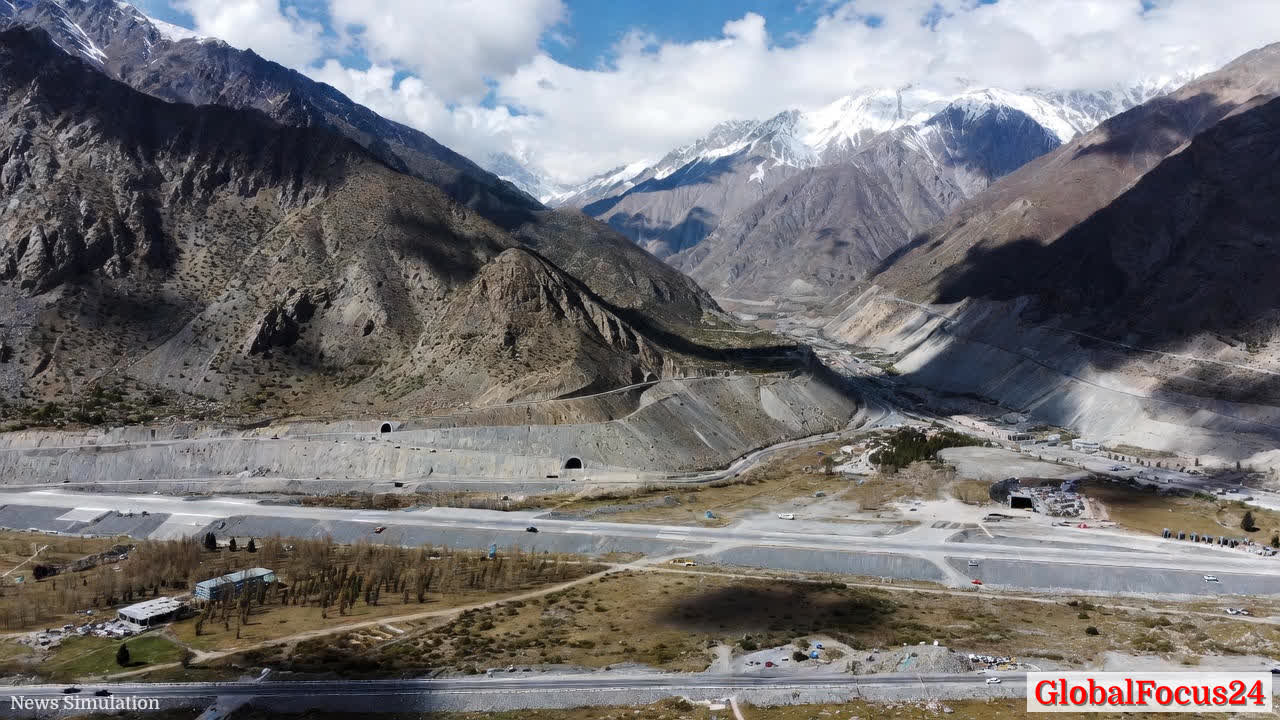
India’s Himalayan Infrastructure Drive: Roads, Tunnels, and Landing Strips Redefining Mountain Defense and Connectivity
In the rugged terrain where the plains meet the high peaks of the Himalayas, an ambitious transformation is taking shape. India is channeling hundreds of millions of dollars into a broad-based network of roads, tunnels, and airstrips that traverse some of the most challenging landscapes on the planet. The project, spanning multiple states and strategic sectors, aims to improve civilian mobility, spur regional development, and, increasingly, reinforce national defense capabilities in a region long watched with wary eyes by neighboring powers. As this infrastructure unfolds, it is reshaping economic patterns, stimulating local industries, and recalibrating regional dynamics in a area that has not only geographic but also historical significance in terms of trade and security.
Historical Context: Paths that Shaped a Nation and a Region
The Himalayas have long served as both barrier and corridor. For centuries, caravan routes and ancient passes connected India’s heartland with Central and Southeast Asia. The modern era, however, has imposed a different scale of urgency. After decades of limited high-elevation infrastructure, the early 21st century witnessed growing recognition that the region’s mountainous geography—while formidable—could be leveraged to support national resilience. The current push builds on a sequence of national programs aimed at “soft and hard” connectivity: improving road quality, expanding air-connectivity, and creating resilient corridors that can sustain economic activity even under extreme weather or security contingencies. The result is a synchronized effort to turn isolated hill towns into accessible nodes of commerce while ensuring that critical supply chains remain robust in times of crisis.
Economic Impact: From Local Roads to Regional Prosperity
The immediate economic logic behind the investment is clear: better transport links reduce transit times, lower logistics costs, and attract investment to remote districts. In the Himalayan belt, where terrain can render certain valleys effectively cut off for portions of the year, the new or rehabilitated routes can dramatically expand market access for farmers, artisans, and small manufacturers. Local economies stand to gain from increased tourism potential, with more reliable access for visitors seeking natural beauty, monastic centers, or adventure tourism experiences. The ripple effects extend to associated sectors, including maintenance services, fuel distribution, and warehousing, creating steady employment in areas that have historically depended on seasonal activity.
Beyond regional growth, the national economy benefits from improved resilience in supply chains. The Himalayan corridor increasingly functions as a backbone for the movement of essential goods, medical supplies, and emergency relief during natural disasters or regional disruptions. In a country as geographically diverse as India, the role of state and union authorities in coordinating cross-border logistics and border-area security is central to sustaining steady economic momentum. Enhanced airstrips and helicopter landing facilities add a new dimension to this resilience, allowing rapid deployment of personnel and materials in response to weather events, landslides, or other incidents typical of high-altitude environments.
Regional Comparisons: How the Himalayan Initiative Stacks Up
Several neighboring regions have pursued comparable infrastructure-led development, though at different paces and scales. In the mountainous belts of neighboring nations, investments in tunnel construction, avalanche protection, and all-weather routes have produced measurable shifts in regional accessibility. When comparing these approaches to India’s program, a few distinct features stand out. First, the scope spans not only road networks but also airstrips and airlift-enabled facilities, enabling multi-modal mobility that can adapt to seasonal constraints. Second, the emphasis on local procurement and community engagement has aimed to generate inclusive growth, ensuring that small towns experience the benefits of the projects rather than merely serving through-traffic. Third, the projects are designed with climate resilience in mind, incorporating enhanced drainage, slope stabilization, and avalanche risk mitigation—critical factors for maintaining long-term usability amid shifting weather patterns.
From the perspective of regional security and geopolitics, these improvements have a consequential impact on how neighboring states perceive the ability to respond to emergencies. The capacity to move strategic materials quickly, to establish temporary airfields in contested or disrupted zones, and to sustain civilian life in remote districts all contribute to a broader sense of national steadiness. While infrastructure alone cannot resolve political tensions, it does alter the practical calculus of regional power projection, signaling a commitment to maintaining open lines of communication and rapid response across the borderlands.
Technical Innovations and Engineering Challenges
The Himalayan terrain presents engineers with a suite of challenges that push the limits of current construction practice. Extreme weather windows, permafrost-like ground conditions, and seismic risk require advanced design approaches and meticulous maintenance planning. Modern tunnel boring machines, rockfall protection systems, and advanced monitoring networks are deployed to ensure long-term stability and safety. Glacier-fed streams and unpredictable monsoon patterns demand that drainage systems be capable of handling peak flows, preventing erosion and infrastructure damage. To keep projects on schedule, authorities have integrated remote sensing data, drone-based surveys, and real-time weather analytics into planning and execution.
Material sourcing and skilled labor represent additional layers of complexity. Procuring high-quality aggregates, steel, and specialized lining materials in remote valleys often requires careful logistics planning, local partnerships, and sometimes cross-border sourcing arrangements within regulatory bounds. Training programs for local engineers, masons, and technicians help create a workforce capable of sustaining this ambitious portfolio over decades, not just the duration of a single project cycle. The result is a growing ecosystem of suppliers, service providers, and skilled labor that contributes to longer-term regional development beyond the initial capital outlay.
Social and Environmental Considerations
A project of this scale intersects with communities and ecosystems at multiple points. Local residents are stakeholders in both the economic uplift and the environmental stewardship that accompanies large-scale infrastructure. Impact assessments, stakeholder consultations, and ongoing environmental monitoring aim to balance growth with preservation. Measures commonly emphasized include wildlife corridors to minimize habitat fragmentation, soil stabilization to reduce landslide risk, and reforestation programs to offset ecological disruption. In the long run, the infrastructure is intended to unlock safer, more resilient livelihoods for people who have historically navigated the region with caution and endurance.
Public sentiment towards the initiative has been mixed in some districts, reflecting a balance between anticipation for improved mobility and concerns about disruption during construction. Communities emphasize the importance of transparent timelines, fair labor practices, and tangible local benefits. Authorities have responded with inclusive planning processes, targeted employment opportunities, and local procurement mandates designed to ensure that the capital investment translates into broad-based prosperity.
Operational Milestones: What Has Been Achieved and What Comes Next
Current milestones include the completion of key road corridors that connect hill towns to major urban centers, the opening of new tunnel segments that slice through particularly difficult mountain passes, and the expansion of airstrips capable of accommodating small to medium-sized aircraft. These developments collectively reduce travel time, improve reliability during adverse weather, and enable more frequent emergency responses. As the program progresses, new phases are planned that extend the reach of the highway networks into more distant valleys, while additional airstrip sites will be prepared to support both civil and strategic air operations under civilian control.
The planning framework emphasizes phased expansion, with continuous evaluation of environmental impact, safety metrics, and community benefits. In practice, this means that progress is regularly reviewed by regional authorities, with performance indicators tied to maintenance budgets, traffic volumes, and the rate at which safety upgrades are implemented. The sequencing also takes into account seasonal constraints, ensuring that critical work avoids the harshest weather while maintaining momentum during favorable windows.
Public Reaction and Observations
Public reaction to the Himalayan infrastructure expansion encompasses a spectrum from optimism to measured concern. Advocates point to the potential for improved accessibility, economic diversification, and disaster readiness. Local businesses highlight reduced logistics costs and expanded markets, while farmers note more reliable routes for transporting seasonal produce. On the other side, some residents voice concerns about temporary displacement during construction, noise pollution in settled areas, and the long-term environmental footprint of new corridors through sensitive ecosystems.
Across the region, engineers and planners emphasize that the true measure of success will be sustained performance and resilience. A transportation system that functions smoothly in the most challenging conditions—during heavy snow, landslides, or flash floods—will be viewed as a robust foundation for broader social and economic stability. As with any large-scale modernization effort, transparent governance, consistent communication with communities, and demonstrable local benefits are critical to maintaining public trust over time.
Conclusion: A Long View of Mountain Connectivity
The Himalayan infrastructure push represents more than an investment in roads, tunnels, and airstrips. It is a long-term strategic effort to integrate some of the most challenging terrains into a broader vision of economic development, regional connectivity, and national resilience. By linking remote settlements with major markets, the program opens avenues for trade, education, and healthcare access that can alter the trajectory of entire communities. At the same time, the enhanced mobility and rapid deployment capabilities contribute to a steady and credible signal of preparedness in a region with complex geopolitical dynamics.
Looking ahead, the success of this initiative will depend on sustaining momentum, balancing growth with environmental stewardship, and ensuring that gains are equitably distributed across districts and populations. If implemented with a focus on local participation, transparent governance, and adaptive engineering practices, the Himalayan infrastructure program could serve as a model for mountainous regions worldwide—where ambition meets adversity in the persistent pursuit of connectivity and resilience.