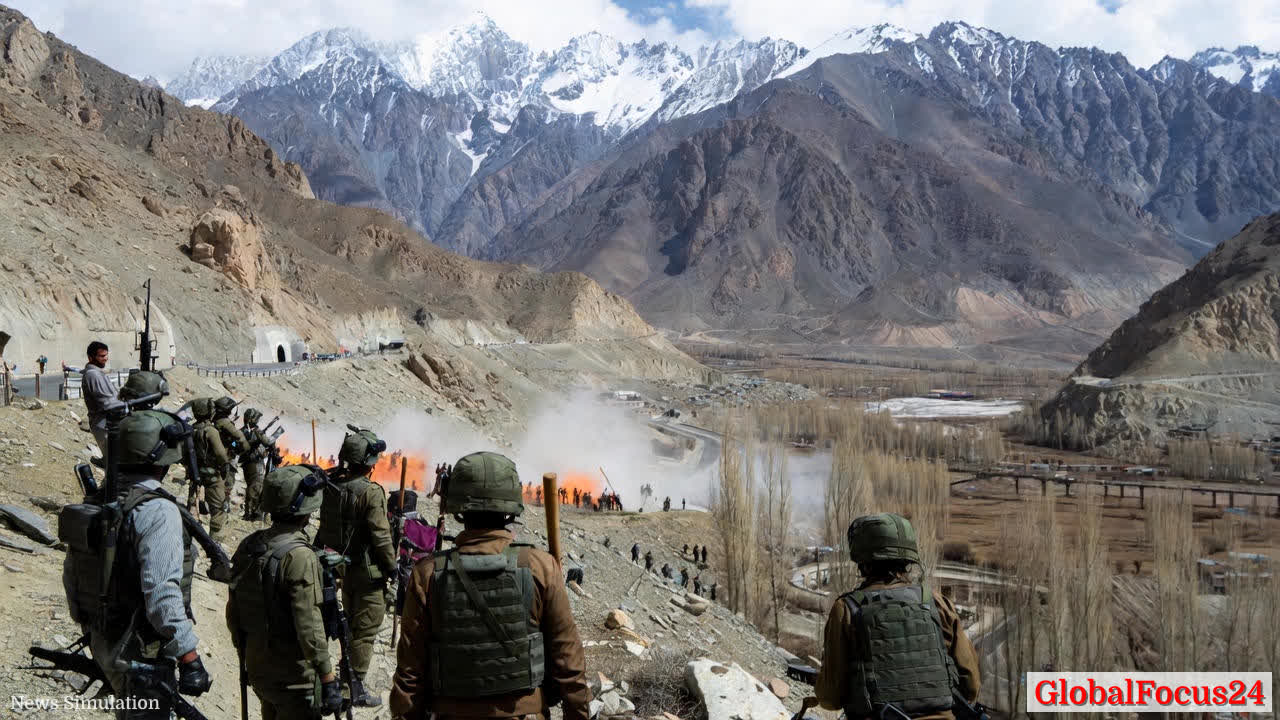
A Fragile Thaw at the Top of the World
Five Years After Galwan, a Measured Calm Returns to the Himalayas
Five years after a deadly confrontation between India and China shook the frigid heights of the Himalayas, signs of cautious de-escalation are emerging along one of the world’s most perilous borders. The Line of Actual Control (LAC), the nearly 3,500-kilometer frontier dividing the two Asian giants, remains heavily fortified—but both sides have begun to edge toward dialogue over confrontation.
In June 2020, violent hand-to-hand combat in the Galwan Valley left 20 Indian soldiers dead and an undisclosed number of Chinese casualties. The clash was the worst border violence between the two nuclear-armed nations in more than four decades, jolting bilateral relations and triggering a surge in military deployments across the high-altitude terrain of Ladakh. Today, the region shows signs of transformation—both in its landscape and in the fragile diplomacy shaping its future.
From Confrontation to Communication
Since the 2020 clash, a series of diplomatic and military talks have gradually reduced tensions in certain sectors of the border. In October 2025, both nations announced an agreement to coordinate patrols in selected disputed areas, a move described by analysts as a “controlled confidence-building measure.” This arrangement, while limited, represents one of the most tangible steps toward risk reduction in years.
Leaders Narendra Modi and Xi Jinping have met intermittently on the sidelines of multilateral gatherings, expressing mutual interest in maintaining stability and preventing escalation. Official statements from both sides emphasize dialogue, although the tone remains cautious. Indian military officials continue to report the presence of People's Liberation Army (PLA) units in sensitive positions, while Chinese sources claim Indian infrastructure expansion has altered the balance along the frontier.
Despite lingering mistrust, both nations appear to recognize the steep costs of renewed conflict in a region where logistics, climate, and geography impose severe constraints. At altitudes above 17,000 feet, even the most basic operations demand extraordinary resources—an enduring reminder that in the Himalayas, the terrain itself is often the greatest adversary.
A New Geography of Power
The rugged landscape of Ladakh has undergone dramatic change since 2020. What once required a week’s journey from Leh, the regional capital, to the forward posts can now be reached within a single day. India’s ambitious program of high-altitude infrastructure expansion has produced an extensive network of all-weather highways, tunnels, and bridges. Projects like the Zojila Tunnel and the realignment of the Leh–Demchok highway have shortened routes critical for rapid military and humanitarian access.
New airstrips, helipads, and advanced logistics bases now dot the desolate mountain valleys. The Indian Air Force has upgraded airfields such as Nyoma into full-fledged forward bases capable of supporting fighter operations and heavy-lift sorties. Similarly, China has fortified its side of the border with permanent barracks, surveillance outposts, and fiber-optic communications, making the entire frontier a high-tech corridor of vigilance.
These parallel infrastructural drives—one visible from the winding Ladakhi roads, the other discernible through satellite imagery—underscore how preparation and precaution coexist with diplomacy. The Himalayas, once more isolated by nature than by policy, have become a showcase of 21st-century frontier modernization.
Local Impacts: Progress at a Price
For the people of Ladakh, the transformation has been both empowering and disruptive. Improved connectivity has brought essential goods, healthcare, and educational opportunities closer to remote settlements that were once accessible only seasonally. Yet, the militarization of the terrain has restricted traditional livelihoods. Nomadic communities, particularly those in areas near Pangong Tso and the Changthang plateau, report losing access to grazing lands that sustained their yak and pashmina herds for generations.
Tourism—a mainstay of Ladakh’s economy—collapsed during the height of the border crisis but is now rebounding. Improved roadways and safer travel routes have drawn adventurous visitors back to iconic sites like Nubra Valley and Pangong Lake. However, the boom raises environmental concerns. Locals warn that an influx of traffic, construction, and waste threatens the fragile alpine ecosystem already stressed by climate change and reduced glacial meltwater.
Ladakh’s residents express mixed emotions: relief at the relative stability, pride in the region’s strategic importance, but anxiety over the permanent military presence reshaping everyday life. “The border feels calmer,” said one shopkeeper in Leh, “but it also feels closer than ever before.”
Historical Roots of Rivalry
To understand the current calm, it helps to revisit the long history of Himalayan contention. The modern boundary dispute dates back to the mid-20th century, when differing interpretations of historical maps and treaties produced overlapping claims between the newly independent Republic of India and the newly established People’s Republic of China.
The dispute escalated into the 1962 Sino-Indian War, in which Chinese troops advanced deeply into Indian-held territory before declaring a unilateral ceasefire. That brief but intense conflict left psychological scars and an ambiguous boundary known today as the Line of Actual Control.
Since then, the two countries have faced periodic standoffs—in 2013 at Depsang, in 2017 at Doklam, and again in 2020 at Galwan. Each incident has deepened public and political mistrust, even as both economies grew increasingly interdependent through trade and multilateral forums.
Economic and Strategic Stakes
The geopolitical stakes of the Himalayan border extend far beyond the icy ridges themselves. Both India and China view control of high-altitude corridors as essential to national security, infrastructure planning, and regional connectivity projects.
For India, improved border roads are crucial not only for defense but also for integrating Ladakh with its national economy. The construction boom has created jobs and improved supply chains across the northern frontier, stimulating local markets in Leh and Kargil. However, the high cost of transporting materials and maintaining installations at extreme altitude strains public finances.
China’s interests lie in securing the Tibet Autonomous Region and maintaining the stability of its western frontiers, which connect to the Belt and Road Initiative’s key routes through Central Asia. Analysts note that China’s development of dual-use infrastructure—capable of supporting both civilian and military operations—reflects a long-term doctrine of “border defense through development.”
Despite these strategic investments, economic links between the two countries remain significant. Bilateral trade peaked in recent years, topping over $135 billion in 2024. But India’s growing emphasis on reducing dependency on Chinese imports and promoting domestic manufacturing has introduced friction into an already delicate relationship.
Regional Comparisons and Geopolitical Ripples
The India-China thaw comes as other nations across Asia navigate similar high-altitude tensions and strategic realignments. On its northern borders, China continues to manage boundary issues with Bhutan and Nepal, while India’s military modernization in the Himalayas mirrors efforts by countries like Japan and Australia to strengthen deterrence within the broader Indo-Pacific framework.
Compared to the Korean Peninsula or the South China Sea, the LAC receives less constant attention. Yet the silent, icy frontier now plays an outsized role in shaping the regional security architecture. Both nations’ coordination efforts, though tentative, have reassured observers that Asia’s two largest powers may choose strategic restraint over brinkmanship—at least for now.
Climate and the Future of the High Frontier
Beyond the politics and infrastructure, the Himalayas themselves are changing. Glacial melt, erratic snowfall, and shifting river patterns have begun altering the physical geography of the borderlands. Scientists warn that accelerated thawing could transform both ecosystems and hydrological systems, affecting water availability for millions downstream in India and China alike.
Military engineers on both sides are adapting to these realities. New solar-powered outposts and climate-resilient shelters have made year-round deployments viable, while satellite monitoring helps detect landslides and glacial movement that could disrupt routes. Yet even as technology adapts, the larger question persists: can political will outpace environmental change?
A Cautious Peace
The fragile calm now blanketing the Himalayas is built on a complex balance—between vigilance and diplomacy, deterrence and dialogue. Both India and China appear unwilling to return to the hostility of 2020, but neither trusts the other enough to fully disarm or disengage.
For troops stationed at 17,000 feet, the daily rhythm still revolves around drills, patrols, and watchful nights under subzero stars. For the villagers below, life continues amid booming construction and quiet uncertainty. And for the world’s two most populous nations, the high-altitude silence remains a subtle test of coexistence in an era defined by competition.
At the top of the world, peace exists—but it is a peace measured in fragile degrees, dependent on restraint, patience, and the hope that dialogue can withstand the thin air of the Himalayas.