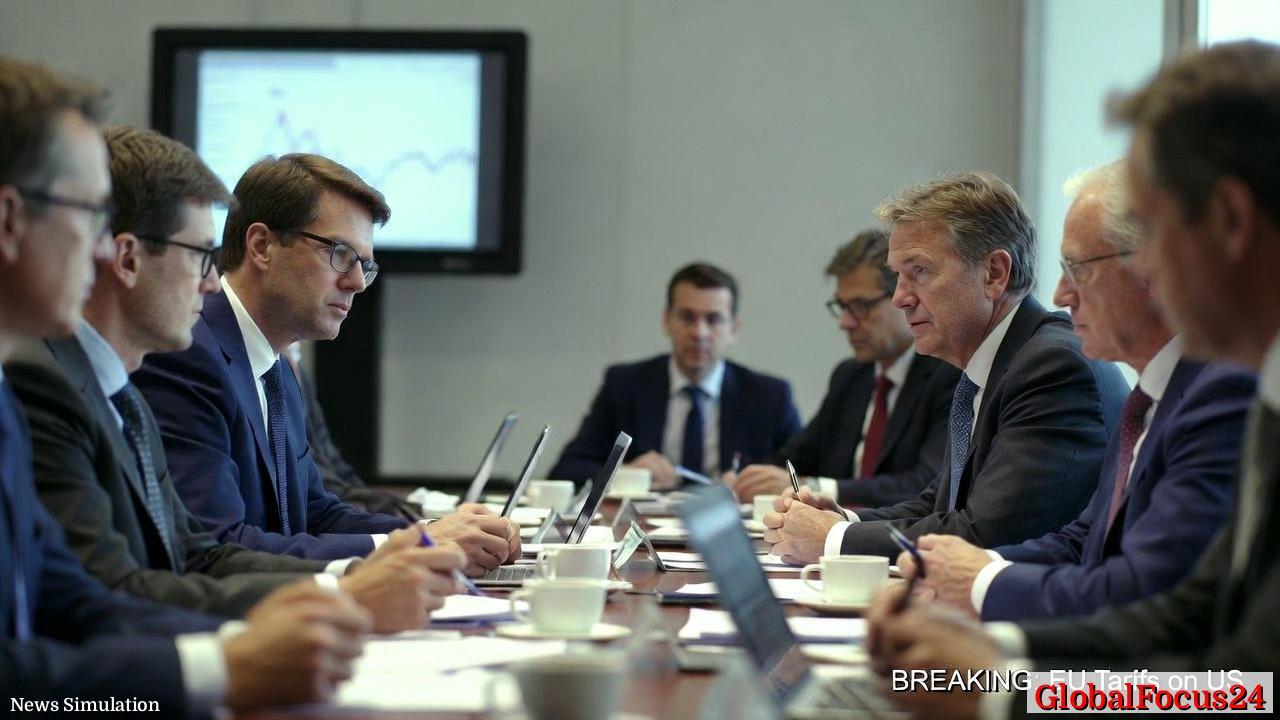
EU Prepares Major Tariff Response to New U.S. Trade Measures
Brussels, January 18, 2026 — The European Union is poised to impose up to €93 billion in tariffs and restrictions on American goods and services, escalating a renewed transatlantic trade conflict triggered by the U.S. administration’s decision to apply a 10% blanket tariff on EU exports. The move, reportedly combined with new U.S. demands related to territorial negotiations over Greenland, marks the sharpest deterioration in U.S.–EU trade relations in more than a decade.
Officials in Brussels confirmed late Saturday that the European Commission has finalized contingency plans targeting multiple sectors — from technology and manufacturing to agriculture and aviation — mirroring the comprehensive scope of the U.S. tariffs. Developments are expected to accelerate overnight as markets prepare for a volatile open, with U.S. stock futures due to begin trading in less than four hours.
A Strategic but Risky Retaliation
According to senior EU trade diplomats, the planned €93 billion counter-tariff package is designed both as a deterrent and as a statement of parity. “Europe cannot remain idle while unilateral tariffs undermine the global system,” one senior official said under condition of anonymity.
The European response could include new levies on U.S.-made vehicles, energy imports, and technology components such as semiconductors and cloud infrastructure services. European consumers might also feel the effects, as rising costs ripple through sectors dependent on American exports.
Brussels is walking a delicate line: ensuring a firm response while minimizing economic self-harm. Analysts warn that Europe’s measured but forceful approach reflects growing frustration with Washington’s protectionist posture — a reversal of decades of steady economic cooperation across the Atlantic.
A History of Trade Flashpoints
Transatlantic tariffs are not new. The United States and the European Union have sparred repeatedly over trade rules since the mid-20th century. Disputes over aircraft subsidies between Boeing and Airbus led to tit-for-tat duties in 2019 and 2020, temporarily resolved in 2021 with a five-year suspension.
Earlier, tensions flared in the 2000s over steel and aluminum tariffs, with both sides ultimately reaching negotiated settlements through the World Trade Organization. However, today’s developments carry broader implications due to the globalized nature of supply chains and the heightened economic fragility following the COVID-19 pandemic and ongoing geopolitical fragmentation.
If the EU proceeds with the full €93 billion package, it would represent one of its largest coordinated trade responses in history — comparable in scope to the tariffs imposed during the U.S.–China disputes of the late 2010s.
The U.S. Tariffs and Greenland Factor
The trigger for Europe’s latest retaliation lies in Washington’s sweeping 10% tariff on foreign imports, announced this week as part of a renewed “America First” manufacturing policy. White House officials framed the measure as necessary to “rebalance trade” and “protect U.S. jobs.”
Complicating the dispute further are reports that the U.S. administration attached diplomatic conditions involving Greenland, a territory of the Kingdom of Denmark, an EU member state. The demands, which reportedly sought expanded investment and resource extraction rights, have drawn ire from both Copenhagen and Brussels, which view them as overreach into sovereign European affairs.
European leaders described the linkage between tariffs and territorial negotiations as “highly unusual” and “unacceptable.” Denmark’s foreign minister convened an emergency session with EU counterparts late Saturday, aligning European positions ahead of formal announcements expected Sunday morning.
Economic Implications for Both Sides
Economists warn that the impact of the emerging tariff war could reverberate through financial markets and global supply chains.
- For the European Union, retaliatory tariffs could provide short-term leverage but risk weakening export-driven economies such as Germany, Ireland, and the Netherlands. Automotive giants and precision manufacturers dependent on U.S. buyers may face sharp declines in demand.
- For the United States, higher import costs could exacerbate inflation pressures that have already strained consumers. Technology firms, particularly those with substantial European operations, may encounter bottlenecks as new EU restrictions take effect.
A senior analyst at a London-based financial consultancy described the standoff as “an economic version of mutually assured discomfort.” He added that “global investors had only just begun to stabilize expectations after several quarters of volatility; this takes us back to a period of uncertainty.”
Stock market futures reflected those concerns. Euro Stoxx 50 futures slipped 1.8% overnight, while early projections for the Dow Jones Industrial Average suggested a potential downturn when trading opens in New York. Currency markets also wobbled, with the euro briefly dipping against the dollar before recovering amid speculation of coordinated EU policy support.
Global Ripple Effects
Beyond Europe and the United States, other major economies are bracing for collateral fallout. Asian export hubs such as South Korea, Japan, and Taiwan are watching closely, as any disruption between the two large markets could redirect trade flows and alter investment priorities.
Energy markets are also on alert. Analysts point to potential turbulence in liquefied natural gas (LNG) and renewable energy sectors if energy-related tariffs become part of the EU’s measures. The United States has become a key supplier of LNG to Europe in the wake of the 2022 energy crisis, and any constraints could complicate Europe’s fragile energy balance.
Emerging markets, already struggling with inflation and debt costs, could see added volatility if global commodity prices or investor sentiment shift sharply in response to a trade escalation between two of the world’s largest economies.
Historical Parallels and EU Unity
The European Union has historically moved cautiously in trade retaliation, preferring multilateral solutions through the WTO. However, the scale and suddenness of Washington’s actions appear to have galvanized a rare level of EU unity.
This moment recalls the turbulent early 1980s, when the United States clashed with European allies over steel, grain, and automotive exports. Then, too, the EU responded with selective tariffs, ultimately spurring negotiations that redefined transatlantic economic cooperation.
Today’s response evokes similar dynamics but in a world far more interconnected. European industry leaders stress that maintaining a “rules-based global order” is essential — not only for Europe’s prosperity but for preventing a global economic downturn.
Political Reactions Across Europe
European capitals moved swiftly after the U.S. announcement. In Berlin, the German economy minister called the tariffs “a regrettable reversal of decades of partnership.” France’s finance minister characterized the move as “a test of European resolve,” while officials in Rome and Madrid voiced concern over the potential hit to small exporters.
In Brussels, Commission President Ursula von der Leyen convened an overnight strategy meeting, emphasizing the need for measured but firm action. “Europe will defend its interests and its industries,” she declared. “We will not escalate but we will not yield.”
Northern and Eastern member states, including Denmark, Poland, and Finland, supported the call for coordinated action but urged the bloc to preserve space for dialogue. Diplomats noted that both Brussels and Washington still maintain open communication channels, even as rhetoric intensifies.
The Road Ahead
Trade experts expect a fast-moving sequence of announcements in the next 24 hours. The European Council could formally approve the tariff package as early as Monday morning, triggering a new phase in the standoff.
Markets will closely monitor whether Washington signals a willingness to negotiate. Historically, both sides have used tariff threats to extract concessions before reaching compromise. Yet with the inclusion of the Greenland-related demands, the dispute has taken on dimensions that extend beyond trade.
Some analysts predict that multinational corporations operating across both jurisdictions will soon begin internal contingency planning — rerouting supply chains, adjusting pricing strategies, and lobbying for exemptions.
Conclusion: A Critical Night for Global Trade
As Sunday unfolds, investors, policymakers, and businesses await critical developments. The EU’s potential €93 billion tariff response could reshape the global trade landscape and signal a broader turn toward protectionism among advanced economies.
Whether this moment becomes a short-lived bargaining phase or the beginning of a protracted economic confrontation depends on choices made in the next several hours. The transatlantic alliance, built over generations of commerce and diplomacy, now faces one of its most consequential tests in modern history.
The coming night will likely define the trajectory of U.S.–EU trade relations for years to come — and perhaps the stability of the global economy itself.